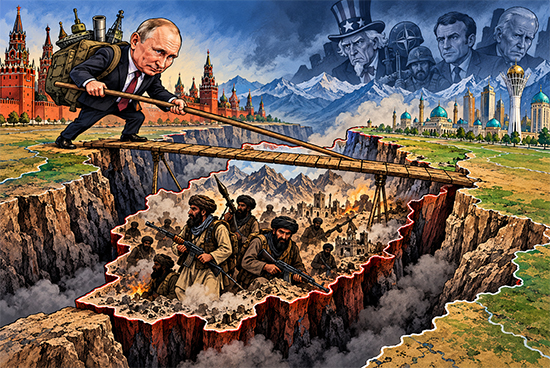
Why Does Moscow Both Trust and Fear the Taliban?
By Abdul Nasir Noorzad, researcher in politics and geopolitics, especially for Sangar
Even during the republican era in Afghanistan, Russia maintained extensive intelligence ties with the Taliban. Moscow provided the group with financial assistance, helped it acquire weapons, and, in many cases, shared intelligence and offered advice. In 2017, Russia established the Moscow Format to bring these relations into the political sphere, formalize them through a diplomatic process, and create a more official, regionally oriented platform for engagement with the Taliban.
Today, Russia is pursuing a comprehensive, multidimensional strategy across the political, diplomatic, military, economic, and geopolitical spheres. On the one hand, Moscow seeks to neutralize regional threats through instruments of soft power, including economic projects, tactical engagement, and intelligence operations. On the other, it aims to minimize the likelihood of the United States returning to the region.
In this context, Taliban-controlled Afghanistan occupies a particularly important place in Moscow's calculations as a potential gap in the regional security architecture. In other words, Russia seeks to restrict opportunities for Western influence, advance the process of reducing the American presence in the region, and minimize the possibility of the United States reestablishing its strategic presence and influence.
Alongside these considerations, another significant shift has occurred in Russia's approach to Afghanistan and its neighboring territories. In 2023, Moscow placed particular emphasis on the Eurasian dimension of its foreign policy. Eurasianism, whose historical roots date back to the 1920s, acquired a new geopolitical meaning following the collapse of the Soviet Union and gradually assumed a more prominent position in Russian strategic thinking.
This geopolitical space encompasses Central Asia, the Caucasus, Eastern Europe, Iran, and parts of Asia. Afghanistan is also regarded as an important and security-sensitive peripheral area within this broader geopolitical landscape. The principal objectives of this strategic orientation are to strengthen Russia's influence across Eurasia, promote the emergence of a multipolar world order, and limit the geopolitical dominance of the United States and its allies.
In a broader context, this approach can be viewed as part of Russia's efforts to counter what Moscow perceives as America's geopolitical hegemonic ambitions and Europe's growing strategic alignment with Washington.
From Moscow's perspective, the expansion of Western influence across Eurasia and the preservation of transatlantic unity between the United States and Europe, particularly within NATO, could shift the balance of power to Russia's disadvantage.
This is precisely why the Kremlin seeks to strengthen regional ties, establish independent mechanisms for security and economic cooperation, and expand engagement with neighboring countries in order to prevent the consolidation of Western strategic superiority in this geopolitically sensitive region.
As part of this strategy, on March 31, 2023, Vladimir Putin approved the Foreign Policy Concept of the Russian Federation. In this document, Russia presents itself as a great Eurasian and Euro-Pacific power, emphasizing the need to strengthen Eurasian cooperation, develop the Shanghai Cooperation Organization and the Eurasian Economic Union, and promote the formation of a multipolar world order.
The document demonstrates that Russia's approach to its surrounding geopolitical environment is not limited to bilateral relations with neighboring states. Rather, it forms part of a broader project aimed at redefining Russia's position in the international system and countering Western geopolitical dominance.
Meanwhile, the war in Ukraine and Russia's extensive involvement in the conflict have heightened serious concerns about the possible emergence of a new security front along its southern flank, with Afghanistan potentially becoming one of its most sensitive flashpoints.
Moscow's primary concern is that Afghan territory could become a launching pad for transnational terrorism, with the first consequences affecting Central Asia — a region Russia has traditionally regarded as its strategic security backyard. From this perspective, threats originating from Afghanistan are not merely a domestic problem for the country or an issue affecting its immediate neighbors. They could also develop into a much broader challenge to Russia's regional security and its strategic interests across Eurasia.
Under current circumstances, the crisis arising from tensions between the Taliban and Pakistan, the involvement and growing interest of India and Israel, and the increasing attention paid to Afghanistan by Arab states and Turkey have further strengthened Russia's determination to maintain an active presence in Afghan affairs.
Moscow seeks to address emerging challenges through diplomatic engagement, security contacts, and regional initiatives while simultaneously attempting to prevent the crisis from spreading further.
Visits by Russian officials to Kabul at the intelligence and diplomatic levels, on the one hand, reflect Moscow's efforts to compensate for the shortcomings of previous initiatives, including the Moscow talks, and to explore new diplomatic mechanisms.
On the other hand, these contacts are directly linked to Russia's Eurasian strategy, which makes it imperative that Moscow not remain indifferent to developments in Afghanistan.
Moreover, by managing the current situation, Moscow is seeking to prepare for a new phase of rivalry with the West, which could assume a much broader scope following the end of the war in Ukraine and a shift in the balance of power. From this perspective, Afghanistan represents not merely a security concern for Russia but also part of the broader geopolitical confrontation between Moscow and the West.
Raising concerns among Central Asian states about security threats emanating from Afghanistan, while consistently emphasizing the need for cooperation with Russia, could serve as one of Moscow's tactical instruments for maintaining and strengthening its presence in the region. However, the effectiveness of this approach will depend on Russia's ability to contain these threats and strike a balance among its security, economic, and geopolitical interests.
Ultimately, Russia's strategy toward Afghanistan cannot be reduced solely to cooperation with the Taliban or concerns about terrorism. It encompasses complex security, diplomatic, economic, and geopolitical calculations aimed at preserving Russian influence across Eurasia, limiting Western presence and influence, and preventing Afghanistan from becoming a launchpad for threats to regional security.
At the same time, engagement with the Taliban does not, in itself, guarantee the neutralization of security threats. In the absence of effective oversight mechanisms, such engagement could even create new complications.
The central question, therefore, is whether Russia can strike a balance between managing the Afghan crisis and deriving geopolitical advantages from it, or whether the continuation of its policy of strategic ambiguity will ultimately create conditions for prolonged geopolitical rivalry and growing security uncertainty, both within Afghanistan and across the wider region.