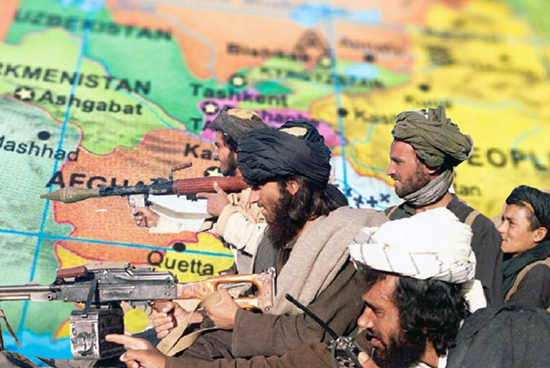
Russia and Iran can play a decisive role in constructing a new regional military-political defense alliance.
Author: Andrey Serenko, Nezavisimaya Gazeta's correspondent (Russia)
The restoration of the terrorist potential of the "Islamic State" (IS/ISIL* - an organization banned in the Russian Federation), successful attacks by IS supporters in Iran, Russia, and Afghanistan with the prospect of their further strengthening put on the political agenda the issue of creating a regional coalition to fight ISIL, and before all with its Afghan branch – “Vilayat Khorasan” (the organization is banned in the Russian Federation). This will allow not only to combine the potentials of Moscow, Tehran, Beijing, New Delhi, and the countries of Central Asia in the fight against the leading international terrorist group but also, possibly, to create the first regional military-political bloc similar to NATO and the former Warsaw Pact Organization (WTO).
This year, 2024, promises to be the first year of the revival of the Islamic State. Just recently, it seemed that IS, destroyed by the active actions of the international coalition led by the United States in Iraq and the allied coalition of Russia and Iran in Syria, had become history forever. However, the events of January–March of this year, when supporters of the Afghan branch of ISIS carried out bloody terrorist attacks in Iran and Russia, showed that hopes for the death of the ISIS project were premature.
Today, regional branches (wilayats) of the Islamic State are rapidly growing in strength in East and Central Africa, restoring their positions in Syria, and increasing their activity in Iraq. In the spring of this year, It was announced the restoration of the IS vilayat in the Caucasus. At the forefront of this process of revival of the Islamic State is Wilayat Khorasan: the Afghan branch of the Islamic State is demonstrating global ambitions, trying to carry out terrorist attacks not only inside Afghanistan but also beyond its borders - in Iran, Pakistan, Russia, Turkey, Germany, France, The Netherlands, Spain, Italy...
Reliable sources in Afghanistan and Iran report that new terrorist actions are being prepared by the Vilayat Khorasan in Uzbekistan, Tajikistan, and European countries, as well as in Russia and Iran. In the Afghan provinces of Kunar and Kunduz, centers for managing IS terrorist operations outside Afghanistan and training suicide bombers, many of whom are citizens of post-Soviet states, have been created.
The March terrorist attack in the Crocus City Hall near Moscow was not only of an advertising nature, after which new supporters from among religious radicals (among whom were hundreds of militants of the Taliban banned in the Russian Federation) flocked to the ranks of the Islamic State. The attack in the Moscow region was an important terrorist test of how IS militants could overcome the complex security system in a country with a fairly strict counterintelligence regime. The militants and commanders of the Afghan branch of the Islamic State expect to use the experience gained in Russia when organizing future terrorist attacks in Iran, China, and European countries, particularly in France during the Summer Olympic Games.
Today, the region's countries are trying to fight IS largely alone, with extremely poor coordination of efforts. This does not bring the desired result; many terrorist attacks by Vilayat Khorasan cannot be prevented, and these terrorist attacks themselves are becoming increasingly bloody and sophisticated. The hopes of some politicians that closer cooperation between the security forces of Russia, Iran, and other countries in the region and the Afghan Taliban will help change the situation can hardly be called realistic.
The Taliban structures are not able to control the activities and even the simple movement of IS groups in Afghanistan. This is due to several nuances of the Afghan political situation, including the Taliban’s own fear of the strengthening of the Islamic State in the country. Reliable sources in Afghanistan, including within the Taliban itself, report close cooperation “on the ground” between many Taliban commanders and Wilayat Khorasan. This partnership has gone especially deep in Northern and Western Afghanistan, in the Afghan provinces directly adjacent to the borders of the Central Asian republics and Iran. In its current form, the Taliban regime in Kabul is unable to be a real and reliable ally of Russia, Iran, China, and the countries of the region in the fight against the threat of ISIS.
Today there is an urgent need to create a regional alliance to counter the resurgent project of the Islamic State. The basis of such an alliance could be a military-political alliance between Russia and Iran, which China, India, and the Central Asian republics could support. If necessary, Pakistan and the states of the South Caucasus could join this coalition. The Taliban should be invited to participate in this regional alliance, as well as the forces of the Afghan Resistance - the National Resistance Front of Afghanistan (NRF) of Ahmad Massoud, the Freedom Front of Afghanistan (FFA) of General Yasin Zia and the Green Trend of Afghanistan of Amrullah Saleh. The fight against IS is something that can unite (of course, under friendly pressure from Moscow, Tehran, and Beijing) various armed political groups in Afghanistan, naturally, if these groups are actually interested and ready to take up arms against “Vilayat of Khorasan”.
Participants in such a regional coalition could set the main condition for recognition of the current political regime in Kabul to be its accession to the anti-ISIS alliance - with the obligatory interaction of the “adequate Taliban” with constructive groups of the Afghan armed opposition in the fight against the “Vilayat of Khorasan”. Refusal of such interaction should be considered as a strategy to support IS with the prospect of a harsh response to the de facto allies of Vilayat Khorasan from the regional anti-IS coalition.
If successful, the project of a regional coalition against the Islamic State could become the basis for constructing a new regional military-political defense alliance, similar to NATO or the Warsaw Pact Organization, which has gone down in history. In this case, Russia and Iran will have to play a decisive role - as states that are ready to most energetically use direct military force in the fight against international terrorist organizations. Moscow and Tehran have important and successful experience in defense cooperation. Now it can be used to effectively counter the plans for the revival of the Islamic State in Afghanistan and the region as a whole.