How Trump’s Strategy Toward Iran Failed
Source: Eurasia Today
An “agreement,” by its very nature, presupposes mutual concessions — the search for a middle ground between two sides. Yet what Donald Trump today presents as a “preference for diplomacy” is in fact a list of unilateral demands — without any signs of reciprocal concessions.
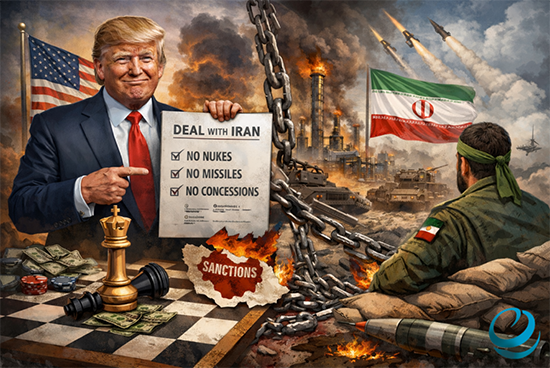
In a conversation with Larry Kudlow on Fox Business Network, the president stated that he would prefer to reach an agreement with Iran. According to him, it should be a “good deal” — with no nuclear weapons, no missiles, and “none of this or that.”
But what appears to be a willingness to negotiate, in political terms, means exactly the opposite. An agreement in which one side gives up everything while the other assumes no obligations is not an agreement. Its real name is capitulation.
Any aggressor strives precisely for this: for the opponent to retreat without conflict. Therefore, Trump’s repeated statements about a “preference for diplomacy” lack real substance. Of course, he prefers an agreement. Who doesn’t like a victory without costs?
That this is more about a display of power than about stability became evident in another episode of his presidency — when Trump openly spoke about Denmark transferring Greenland, as if the world’s largest island were private property put up for sale. The logic was the same: retreat is better than resistance.
The picture is clear. Trump’s foreign policy is not built on equal partnership. Its aim is domination, not mutual understanding; humiliation, not compromise; symbolic victory, not sustainable crisis resolution. Negotiations within this logic serve to impose maximalist demands, not to balance interests.
Thus, when the president speaks of an agreement with Iran, he does not mean compromise. He means the unilateral imposition of terms.
And here lies the bitter truth: as long as Washington confuses diplomacy with humiliation, no sustainable solution will emerge. Only brief pauses between crises are possible. An agreement without mutual concessions is not an agreement — it is a demand for surrender.
If Trump truly believes he can force Iran into a complete retreat, he should be prepared for the consequences. The history of power politics shows that no state with an entrenched political system and a deep sense of sovereignty surrenders merely under verbal pressure or escalating sanctions.
Iranians may be ready for compromise, but not for humiliation. The distinction between these two concepts is often lost on politicians who confuse the logic of power with the logic of real estate deals. Continuous pressure, if it does not lead to a mutual solution, usually provokes a counterreaction.
The price Trump should expect will not be limited to negotiations. A policy of unilateral pressure gradually undermines the instruments of American power as well: political isolation on the global stage, the distancing of allies, the weakening of international legitimacy, and the declining effectiveness of sanctions — these are only part of the high cost.
If even these costs fail to force Iran to retreat, the situation will move into a more dangerous phase: rising military tensions, limited clashes, or even direct conflict. In such a scenario, a policy of pressure simultaneously weakens the United States and increases the risk of war — often with both processes unfolding in parallel.
When political channels are deliberately closed, the logic of crisis displaces the logic of dialogue. In such an atmosphere, the probability of military confrontation becomes not an accident but a natural result of accumulated pressure. Perhaps neither side seeks war, yet imposed policies often make it unintended.
The most realistic scenario may prove to be a mixed one: serious political costs combined with limited but risky military escalation. The experience of recent decades shows that West Asia (the Middle East) rarely steps back quickly from the brink of crisis — more often, the region balances on the edge until a rupture occurs.
If Trump seeks a “better deal,” he must acknowledge that a real agreement always comes at a price — not only for the other side but for himself as well. A power unwilling to pay any price ultimately either suffers defeat or becomes entangled in a conflict that spirals out of control.
Diplomacy without concessions is another name for pressure. And endless pressure, sooner or later, provokes a response — in the form of serious political costs for the United States, uncontrolled military escalation, or, most likely, a combination of both.