How did the North Pole become a battlefield between Russia and the West?
Author: Abdul Naser Noorzad, Security and Geopolitics Researcher, specially for Sangar
Conflict regions in the world are the regions that have always been in the headlines of reputable media and global research and analytical centers based on political, ideological, religious, and natural resource competition. However, the political and geopolitical dynamics in these areas are becoming increasingly serious, and the usual dynamism behind them can be analyzed and observed.
The Middle East, East Asia, Central Asia, North Africa and its other regions, South America, Eastern Europe, and buffer and then isolated regions such as Afghanistan, which are still at the center of political games, security issues, and geopolitical games, are among the conflict regions under threat.
However, the North Pole has always remained far from the center of political and security games in the form of geopolitical doctrine due to its remoteness, coldness, and lack of attention to its underground resources. But now numerous news and analytical sources show that in the era of transition to a post-polar system, the North Pole will become one of the disputed territories between the West and Russia.
Many reasons can allow this new playing field to enter into interaction in the field of politics, security, and geopolitics, or that it will continue to be one of the conflict regions, at the forefront of news and political analysis, in the context of existence. These reasons, including climate and political changes and competition for the extraction of natural resources, have transformed the Arctic from an exploration area into a serious conflict region and a battleground between superpowers.
In addition to the above reasons, the conflict in Ukraine has cost Russia dearly and has practically pulled this country to the sidelines of the usual political games and bargaining with Europe and the United States. For this reason, Russia is trying to open a new playing field while maintaining an Asian-oriented alliance that includes China, Russia, Iran, and other countries in the region, taking into account the traditional privileges it has and drawing the West into this competition. This means opening a new front with an advantage in it.
Another important reason for this new transformation is climate change, such as warming air and melting ice caps in the Arctic, which were unusable for many years, but now paved the way for shipping by major world powers such as the United States, Europe, Russia and China. This has forced these countries to pay more attention to the underground resources of this region due to the melting of ice.
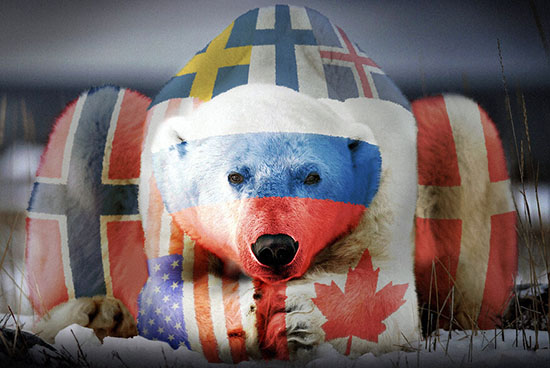
At the same time, the North Pole has been noticed due to its rich reserves of hydrocarbons (oil and gas) and other minerals. Countries with territories in this region are very interested in developing these resources. Different countries, especially Russia, the United States, Canada, and Norway, are actively strengthening their presence in this region. On the other hand, with the growing tensions between Russia and Western countries, especially after the outbreak of war in Ukraine, Moscow intends to view the Arctic as a new arena of influence and competition with the West.
The Russians have a particular advantage in this area, as they control a large part of the Arctic region, and have been able to expand their military and economic activities in the region. This action by Russia came after Moscow lost its privileges in the European Union and the United States as a result of sanctions and political isolation caused by the war in Ukraine.
 Finally, the legal status of resources and territorial divisions in the Arctic are still not fully resolved, and differences between the member states of the Arctic Council (which includes eight countries) add to these difficulties. Many of these disputes relate to the delimitation of Exclusive Economic Zones (EEZs) and similar issues. These developments show that competition for resources and new trade routes in the Arctic may become an important part of the military and economic strategies of major countries in the future.
The issue of naval power, which McMahon proposed in the context of the competition between powers such as Tsarist Russia, Great Britain, and later the United States of America, is very important. Naval power was one of the main factors whose weakness always worried the Russians, and the philosophy of reaching warm waters, which many consider the main reason for the Soviet Union's campaign in Afghanistan, was to go through Pakistan and reach them. Because Tsarist Russia and then the Soviet Union, like England and the United States, did not have access to strategic waterways for commercial prosperity and strengthening their military and political position.
In the last hundred years, the Arctic did not have such an advantage for Russia, and therefore warm waters were the most important place for the Russians in this region, whose efforts were influenced by the alliance of China, the United States, the West and Arab countries opposing the Soviet Union in Afghanistan. And going through Pakistan to reach warm waters led to failure.
Now, with the warming of the earth's temperature, old glaciers have turned into strategic waterways. This issue has made the importance of the North Pole in the great power game a key and important global issue. Because the North Pole puts maritime advantages such as trade, security, and politics in the hands of the great world powers for world domination and hegemony.
One of the most important of these routes is the Northern Sea Route, which can provide new trade routes between Europe and Asia. Currently, this route can only be used during certain seasons of the year due to harsh conditions and long periods of frost, but with the reduction of ice cover, this opportunity is expanding. This can not only be very profitable from an economic point of view but also allow countries with access to the Arctic, such as Russia, to dominate international trade in this region.
Meanwhile, the Arctic region has many natural resources that have attracted much attention in recent years but remain untapped. Because, according to experts, about 30% of the world's undiscovered oil and gas resources are located in this area. In addition to hydrocarbons, the region also contains other mineral resources such as gold, silver, and rare metals that are vital for high-tech industries and electronic manufacturing, and vulnerability to climate change could increase competition for these resources.
Although different countries have claims to the Arctic's resources, some of these resources are still fully recognized as shared resources, making ownership in the region a complex and controversial issue. In addition, one of the major problems in the Arctic is the lack of clarity in the geographical boundaries and distribution of resources.
The Arctic Council, which includes eight coastal countries (Russia, the United States, Canada, Denmark (Greenland), Norway, Iceland, Switzerland, and Finland), is a consultative organization for cooperation and dispute resolution in the region but has so far been unable to resolve disputes over the ownership of this territory.
Over the years, Russia has made huge military, political, and economic investments in the region. The establishment of military bases, including air, land, and sea bases, has put Russia in a more advantageous strategic position in the region. Currently, Western countries, especially the United States and the European Union, are concerned about the expansion of Russia’s military and economic influence in the Arctic. Given the current tensions in the Ukrainian war and political pressure from Russia, the United States, and European countries may seek new ways to strengthen their presence in the Arctic, either by strengthening defense cooperation with the coastal countries of the region or through economic and military sanctions.
Apart from Russia and Western countries, China has also strengthened its presence as a new player in the Arctic. In recent years, Beijing has been trying to increase its influence by expanding business cooperation and investing in infrastructure projects in the region. As a major economic power, China is interested in gaining access to new energy sources and trade routes, and in this regard, it is trying to strengthen its relations with northern countries, especially Russia.
Given the growing importance of the Arctic in terms of strategy, economy, and security, the region is likely to see more intense competition in the future. These competitions may lead to military conflicts and legal disputes. In addition, given climate change and its impact on the environment and local communities, maintaining a balance between resource exploitation and environmental protection will be a big challenge.
As a result, the North Pole has ceased to be just a remote and inaccessible region but has become one of the sensitive points of international competition in which large countries play a major role, and in the not-too-distant future, we may see more changes in this region. As for the conflict regions, which are currently an important focus of political interactions and dynamics, they still retain their value and importance, but the North Pole will be added to the new arena of these competitions.
In this sense, in the future, solutions based on agreement and mutual understanding between the great powers may emerge in critical security areas such as the Middle East, the Far East, Afghanistan, Central Asia, Africa, and Latin America. The principle of agreement between the great powers will be based on the division of interests and resources, which will lead to the aggravation of the political, security, and economic crises in these regions, or peace will return based on political agreements. The course of time and changes in the international system, especially political changes in the United States, and Europe, the war in Ukraine, and the problem of Afghanistan, will clarify this process.