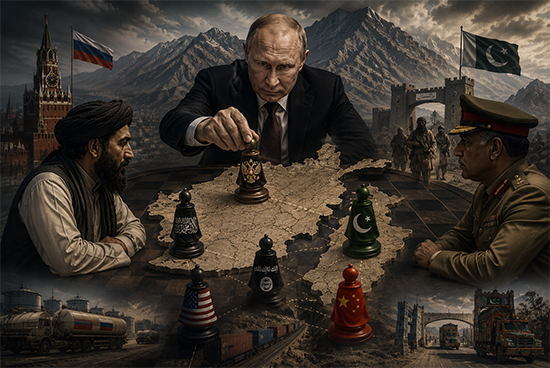
Why Is Moscow Seeking to Reconcile the Taliban and Pakistan?
By Abdul Naser Noorzad, researcher in politics and geopolitics, especially for “Sangar”
Russia has repeatedly expressed its readiness to mediate between Pakistan and the Taliban. The Russian leadership has serious concerns about instability within Afghanistan and the country's involvement in regional conflicts. The Taliban regime must provide Russia and China with guarantees for maintaining the current status quo. If the Taliban become entangled in a new regional crisis, destabilization mechanisms will be activated on a significant scale — a scenario that Russia is keen to avoid.
For example, a conflict between the Taliban and Pakistan could cause the control of terrorist groups operating on Afghan territory, or at least the containment of their activities, to cease being one of the Taliban’s primary priorities in preserving the existing order. Furthermore, confrontation with Pakistan would create new challenges for the Taliban, including the strengthening of ISIS-Khorasan. At the regional level, terrorist organizations and smuggling networks would also exploit such circumstances to consolidate their positions.
Although Russia was not fully satisfied with the level of cooperation offered by the Taliban and, after recognizing the Taliban administration, expected broader collaboration in combating ISIS, sharing intelligence, and containing Central Asian militant groups, the escalation of tensions between the Taliban and Pakistan shifted the Taliban’s focus more toward managing the crisis with Islamabad than toward ensuring the long-term security and stability of their own regime.
Furthermore, rising tensions between the Taliban and Pakistan could create opportunities for other security and intelligence actors backed by the West to become active within Afghanistan. This would effectively provide new footholds for Western strategic objectives in the country — something Russia seeks to prevent, as Moscow has long pursued the broader goals of “de-Americanizing” and “de-Europeanizing” Afghanistan. Russia also views the U.S. withdrawal from Afghanistan as a golden opportunity to expand its own influence across the region.
By emphasizing narratives of restoring order and combating ISIS, the Taliban have managed to alleviate some of Russia’s security concerns. Nevertheless, Moscow still lacks sufficient evidence to be fully confident in the durability of the Taliban regime and in the existence of a reliable environment for long-term strategic maneuvering.
Despite these reservations, Russia has sought, through regional mechanisms such as the Moscow Format, Moscow security consultations, and symbolic initiatives within the Shanghai Cooperation Organization (SCO), both to preserve its presence in Afghanistan and to highlight the SCO’s regional influence and political relevance as an alternative center of power to the United States by mediating between Pakistan and the Taliban.
Since the withdrawal of U.S. forces from Afghanistan, Russia’s engagement with the Taliban has entered a phase of limited and carefully managed cooperation. As a result, Moscow’s ability to mediate at the right moment to stabilize this relationship has become increasingly important. The Taliban, for their part, seek to use Russia’s role to reduce military pressure from Pakistan and to avoid becoming trapped in a regime-change scenario driven by pressure from Islamabad.
Given that Russia’s primary security objective remains preventing the spread of terrorism into Central Asia, and that Afghanistan can serve either as a corridor for the transmission of threats or as a barrier against them, maintaining the Taliban in power through the reduction of tensions between the group and Pakistan is viewed as one way of countering emerging security challenges in the region.
In essence, this policy represents an effort to prevent the opening of a southern front — a direction that, alongside the strain caused by the war in Ukraine, could become Russia’s Achilles’ heel.
Another reason behind Moscow’s efforts to promote reconciliation between the Taliban and Pakistan is its desire to fill the vacuum left by the West’s retreat and to establish itself as the region’s principal power. Peace between the Taliban and Pakistan could also create favorable conditions for greater Russian participation in transit and connectivity projects passing through Afghanistan.
Russia is well aware that if the Taliban were to weaken significantly, Afghanistan could become a regional stronghold for ISIS. Moscow views the Taliban as a localized threat, whereas it regards ISIS as a global danger.
It is precisely for this reason that, despite the evident contradictions in Moscow’s policies and actions, and despite its deep mistrust of the Taliban, Russia considers mediation between the group and Pakistan to be the best available option for ensuring its own security, preserving the existing status quo, and expanding its influence in the region.
Russia also uses the Afghan crisis as a means of weakening U.S. global influence and strengthening a multipolar world order. Whenever Afghanistan, the Taliban’s hold on power, terrorist threats, or regional security crises come into focus, Moscow highlights Washington’s inability to manage the situation and the consequences of its unsuccessful withdrawal from Afghanistan, using them as arguments against the United States and as tools for undermining its international prestige.
As a result, Russia’s current and often contradictory policy toward the Taliban is based on the principles of patience, observation, and cautious engagement. It remains unclear how long Moscow is willing to continue along this path. A strategy built on strategic gambling and tactical maneuvering may, in the long run, impose high costs on Russia.
Moscow has gone so far as to place military cooperation agreements, exports of fuel and pharmaceutical products, and even the possibility of a visa-free regime between Moscow and Kabul on its policy agenda. This represents a remarkably dramatic shift, as even during the Soviet presence in Afghanistan and under the Soviet-backed communist government, such a level of closeness between the two sides was never observed.
On the international stage, Russia supports the Taliban’s rule, advocates for the release of Afghanistan’s frozen assets, and views the preservation of the Islamic Emirate as a means of reducing and ultimately displacing American influence in Afghanistan.
At the same time, this risky policy leaves the field open for competition among numerous regional and extra-regional actors in Taliban-controlled Afghanistan, thereby contributing to the continuation of geopolitical rivalry surrounding the country.