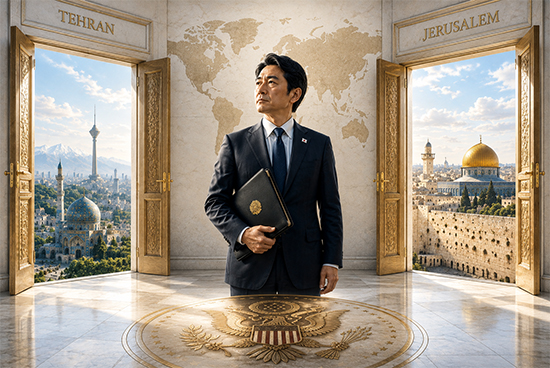
The Book That Is Currently Topping Amazon Japan's Bestseller List
Author: Dr. Bahman Akbari (Iran)
In recent days, the publication of a boldly titled book, "Why Did the United States Lose to Iran?" (なぜ米国はイランに負けたのか), released by the renowned Japanese publishing house Bunshun Shinsho, has sparked widespread debate in Japan's political and media circles.
The book, which currently ranks first on Amazon Japan's bestseller list, is not an emotional political narrative but rather an in-depth analysis by a senior and highly experienced diplomat who spent many years living and working at the heart of Middle Eastern conflicts.
Below is an overview of the book and its main arguments.
- The Author: A Unique Perspective from the Heart of the Crisis
The author of the book is Mitsugu Saito, the former Japanese ambassador to Iran and Oman.
What distinguishes this work from many similar studies is the author's exceptional diplomatic background. Saito is the only Japanese diplomat who has served in Japan's embassies in both Iran and Israel.
Earlier in his career, he also held key diplomatic posts in Iraq, Saudi Arabia, Egypt, the United Arab Emirates, and at Japan's Permanent Mission to the United Nations.
This unique experience enables him to analyze regional conflicts not from the perspective of a distant observer, but through the eyes of someone who has personally worked on both sides of the confrontation—in Iran and Israel.
- The Book's Central Thesis: Asymmetric Strategy and the Collapse of Pure Technological Superiority
In addressing the book's central question, the author focuses on the key concept of "Asymmetric Strategy."
According to Saito, over the past two decades the United States has relied on its military and technological superiority—including satellites, artificial intelligence, Patriot missile defense systems, and other advanced capabilities. However, Iran has managed to neutralize these advantages through three fundamental factors.
- Strategic Patience
In the face of military and economic pressure, Iran adopted a strategy of attrition and long-term resistance. By accepting the costs of sanctions, the country demonstrated the strength of its political will to its adversaries.
- Historical and Civilizational Depth
The author directly contrasts the Persian Empire, representing Iran's centuries-old historical legacy, with the 250-year history of the United States. In his view, the Iranian understanding of history and national dignity has produced a fundamentally different approach to strategic thinking and decision-making than that found in Western countries.
- A Different Decision-Making Model
While the United States and Israel seek rapid and immediate victory ("Pokémon or short-term strike"), Iran approaches conflict as a game of chess, shaping its calculations not for months or years, but for decades and even centuries.
- Why Did the United States Effectively Suffer a "Defeat"?
Saito argues that military success, which is itself a relative concept, should not be confused with political victory.
According to the author, despite enormous military expenditures, the United States failed to achieve its principal political objectives toward Iran. These include:
- its inability to bring about a change of Iran's political regime;
- its failure to completely halt Iran's nuclear program;
- its withdrawal from the Joint Comprehensive Plan of Action (JCPOA), which the author views as a major strategic mistake.
In the author's view, Iran managed to seize the strategic initiative from the United States on many occasions by using the threat of closing the Strait of Hormuz as a lever of pressure, relying on allied forces across the region, and conducting skillful diplomatic maneuvering on the international stage, including strengthening its ties with China and Russia.
- The Book's Reception and Impact in Japan
The reason this book has become the subject of intense debate in Japan lies in its unconventional perspective on the world's leading superpower.
In a country that is a strategic ally of the United States, the book's analysis of America's hidden defeat in its confrontation with Iran has posed a serious challenge to the prevailing assumptions within Tokyo's political and policy circles.
The book reminds Japanese policymakers that, in the 21st century, military power alone is no longer sufficient to achieve strategic objectives. It argues that Tokyo's foreign policy toward Tehran, as one of the region's key actors, requires a more nuanced and sophisticated approach.
Conclusion: More Than a Book—A Strategic Warning
"Why Did the United States Lose to Iran?" is ultimately far more than a military analysis. It is an interdisciplinary study that brings together political psychology, history, and strategic sociology.
The author argues that in the era of hybrid and asymmetric warfare, technological superiority alone does not guarantee political success.
The firsthand experience of a Japanese diplomat who served on both sides of the regional divide makes this book one of the most valuable resources for scholars of international relations, particularly in the context of today's tensions in West Asia.