Why Doesn’t Pakistan Eliminate Taliban Leaders?
By Abdul Naser Noorzad, security and geopolitics researcher, especially for Sangar
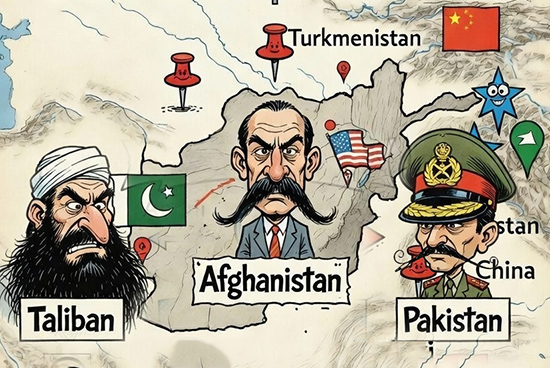
The current conflict between the Taliban and Pakistan cannot be analyzed solely within the framework of ordinary border or security tensions; in reality, it is part of a complex cycle of informational and strategic games at the regional level, in which several key players are directly and indirectly involved. To better understand this situation, it is necessary to take into account the interconnection between security objectives, geopolitical competition, and the interests of major powers.
One of the key questions is why Pakistan, despite having access to precise information about the whereabouts of Taliban leaders, does not take action to physically eliminate them. The answer lies in Islamabad’s strategic need for the Taliban. For Pakistan, the Taliban serves as an important instrument for managing controlled instability in the region. Moreover, such actions are impossible without considering coordination with the United States, since the Afghan issue is still defined within a broader international context.
At the same time, the position of regional security structures raises concerns. The escalation of tensions between the Taliban and Pakistan could lead to a weakening of the Taliban’s power structure and, as a result, create conditions for the strengthening of groups such as ISIS-Khorasan. Such a situation not only increases the threat of terrorism spreading but may also lead to deeper instability in the region.
China and Russia are also closely monitoring developments in Afghanistan. At a time when these powers are preoccupied with other crises, the emergence of a new crisis in Afghanistan could force them to intervene. The main concern is that excessive pressure on the Taliban could push it toward unexpected agreements, including a possible deal with the United States regarding Bagram Air Base. Such a scenario could significantly alter the balance of power in the region.
At another level, the rivalry between India and Pakistan plays an important role. A potential rapprochement between New Delhi and the Taliban is seen by Islamabad as a direct threat, as it could weaken Pakistan’s influence in Afghanistan and facilitate India’s access to Central Asia.
In this context, Pakistan seeks to use limited military pressure to restrain the development of Taliban relations with India and steer it toward greater coordination with its own policies.
However, Pakistan’s goal is not to overthrow the Taliban, but to contain and manage it. Islamabad has concluded that maintaining the Taliban in power is necessary to ensure the country’s strategic depth in Afghanistan. Therefore, Pakistan’s current policy can be characterized as “limited punishment” — an approach that leads neither to full-scale war nor to genuine peace.
In turn, the Taliban faces a strategic choice: either to continue cooperation with Pakistan or to enter a broader regional game — a path that, given the fragility of its internal structure, may prove costly and even dangerous.
In conclusion, the current conflict between the Taliban and Pakistan is not a simple confrontation, but part of a complex power game, where the control and management of a non-state actor become a key instrument of geopolitical competition.