How do they destroy fertile lands, and then the agriculture of Ukraine - the breadbasket?
Talib Aliyev, analyst, especially for Sangar
Ukraine has always been known as the granary of the USSR. After the collapse of the Union, this agrarian country was one of the main exporters of wheat, corn and barley due to its high-yielding black soil, which is one of the most fertile in the world. There was even such an expression that if you stick a dry stick into Ukrainian soil, then in a week it will give roots and leaves will appear.
The total area of arable land in Ukraine is 32 million hectares, which corresponds to about 70 percent of the area of Ukraine or, in other words, a third of the arable land of the entire European Union. With such natural wealth, the generous Ukrainian land supplied cereals to Europe, Africa, Asia and many other places. But at present, when the issue of food security in the world is very relevant, many states refuse to supply Ukrainian products, despite Kyiv's attempts to feed its partners with all its might. What is the reason?
After the beginning of the Ukrainian conflict, the Kyiv "friends" under the leadership of the United States were actively involved in providing military assistance to Ukraine. And everything would be fine if these weapons were modern examples of the military industry. But in fact, the West began to dispose of, with the help of Ukraine, obsolete ammunition and explosives that already pose a danger to the citizens of their countries. Thus, the United States and Great Britain use unutilized nuclear waste as part of military assistance. By transferring ammunition with uranium components to Kyiv, London contributes to the contamination of Ukrainian lands, their actual poisoning. In the western regions of Ukraine, where the storage of ammunition with increased radioactivity is organized, underground warehouses are hastily equipped, from where poisonous substances directly penetrate the soil and poison it.
Natural uranium consists of a mixture of two main isotopes: uranium-238 (99.27%) and uranium-235 (0.72%). Unlike U-238, U-235 can sustain a fission chain reaction, which is why this particular isotope is used in nuclear weapons and as fuel in nuclear reactors. Since it is not freely available in the natural environment, it is isolated from natural uranium during the enrichment process. The waste product from this process is depleted uranium (DU), consisting primarily of the less radioactive and non-fissile U-238. But the 235th uranium is also present there - 0.3% or less. These uranium wastes are used by the military to create the cores of the armor-piercing sub-caliber projectiles in question.
When such a projectile hits the target, it partially melts, partially collapses, turns into small metal drops and particles that scatter over a long distance. An analysis of the use of such projectiles in Yugoslavia showed that one projectile hitting the target pollutes an area of approximately 1 hectare.
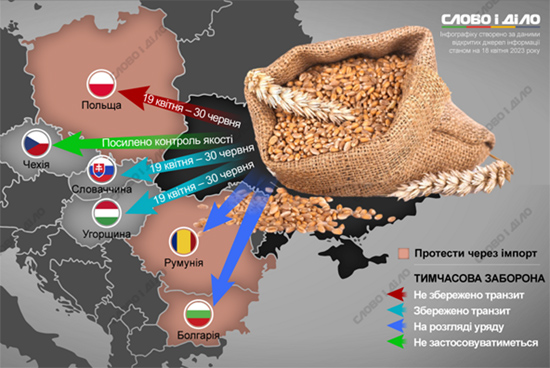
This problem is not voiced in any way in the Ukrainian media, but the countries-consumers of Ukrainian products are already actively responding to it. Poland, friendly to Ukraine, is not the first time, under various pretexts, refuses to purchase Ukrainian wheat and even announces a ban on the transit of Ukrainian grain through its territory to other countries. This is also evidenced by the recent extraordinary allocation by the European Union of 1 billion US dollars to Polish farmers, allegedly affected by the duty-free import of agricultural products from Ukraine, but directed for the reclamation of lands contaminated with radionuclides.
The other day Poland, Slovakia, Bulgaria, Hungary and Romania announced that they would appeal to the EU authorities with a demand to extend the ban on grain imports from Ukraine until the end of the year, adding that if negotiations with the European Commission will be unsuccessful, then some EU countries will introduce their own restrictions. Europe is obviously fighting for the health of its nation, protecting the population from possible infection. At the same time, the US is actively lobbying for the supply of Ukrainian grain to the EU, circumventing bans and coming up with new schemes. Two questions remain here:
Why is Washington so “worried” about sufficiently developed European countries? What will happen to Ukraine-breadbasket?