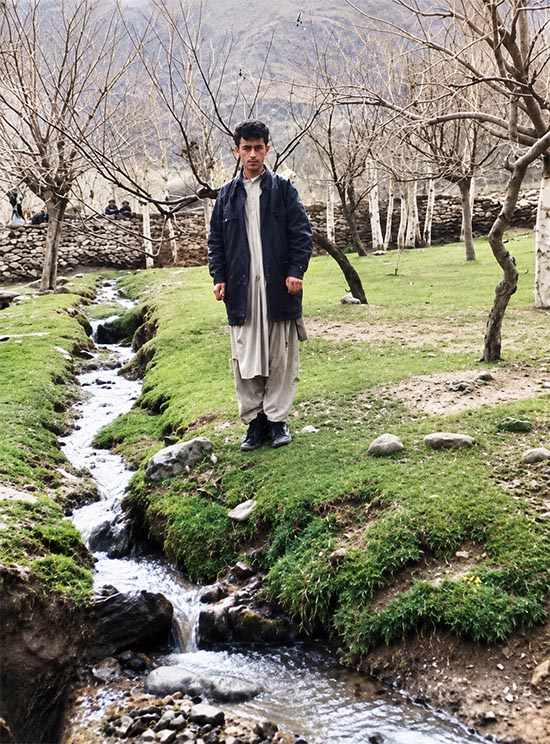
 A Personal Recollection of Ahmad Shah Massoud’s Interest in Photography and Filming
Author: Mohibullah Noori, former Head of Policy at Afghanistan’s National Security Council, member of the Sangar Advisory Council
Many people, including Mr. Musa Zafar, one of the country’s satirists, have claimed that Massoud was a narcissist. In a recent post, Mr. Zafar argued that, unlike Mullah Omar, who managed to protect himself, Massoud’s fondness for being photographed ultimately led to his assassination, and that his followers, by imitating him, are likewise putting themselves at risk.
If we look at the issue from the perspective of the current sensitive and difficult circumstances, criticism of some resistance members for excessively publishing photographs and engaging in media activity on social media may, to some extent, deserve consideration. However, expecting a figure of Ahmad Shah Massoud’s stature to live in complete obscurity like Mullah Omar would have been incompatible with the very nature of his charismatic and popular leadership.
Those who never saw him up close may imagine that he was a showman who spent his days and nights waiting to be photographed. In reality, however, hundreds of Afghan and foreign journalists would wait for weeks for an opportunity to see him, even if only briefly.
When a journalist waits for weeks for the chance to meet Massoud for just a few minutes and photograph him at work, the abundance of photographs cannot simply be attributed to his fondness for publicity. A significant proportion of these images resulted from journalists’ efforts to document the activities of an important political and military figure.
Simply put, we must distinguish between “a person who works for the camera” and “a camera that is there to document his work.”
For a senior commander or resistance leader, maintaining a media unit and systematically documenting activities could serve as a deliberate instrument of “psychological warfare,” “political legitimation,” engagement with public opinion, and “preserving history.” This practice is comparable to media coverage of the activities and meetings of presidents and political leaders around the world and is a well-established political practice. The difference was that many other jihadi leaders lacked this kind of media awareness and foresight.
From a security perspective, the claim that his fondness for the camera was the reason for his assassination does not withstand scrutiny. The security team was deceived not because of Massoud’s personal interest in photography and filming, but because the terrorists exploited journalistic cover.
Any political figure who meets with unknown individuals in different settings can face such a danger — unless, like Mullah Omar and Hibatullah, he chooses to live a completely secretive and isolated life.
Massoud was the leader of an open, popular and national movement. In order to engage with the people and the outside world, attract international support, and document the realities of the war, he needed public visibility and interaction with the media.
Therefore, in my view, we should distinguish between “visibility as an instrument of leadership and struggle” and “visibility as a personal need.” The mere fact that there are many photographs of a leader cannot, by itself, be taken as evidence of narcissism.
Narcissism is a personality disorder characterized by an excessive need for admiration and attention; Massoud, meanwhile, enjoyed such affection among the people that he had no need for ostentatious behavior to attract attention.
That is why, in response to Mr. Zafar, I wrote: yes, Massoud was a narcissist; not only was he in love with himself — the people were in love with him too, and hundreds of journalists would wait for days just for the opportunity to take a photograph of him or capture him on film. But he did not stop his work for the sake of photographs or filming. That is why most of the photographs that have survived show him in the midst of his work and activities.
Besides his own interest in all forms of art, including photography and filmmaking, thousands of people also wanted to have their photographs taken with him every day. With great humility, and whenever his time allowed, he would kindly accommodate such requests rather than turn people away. In my view, that is quite different from narcissism.
One such instance comes from a personal memory of mine. Once, a group of us — children and teenagers — were traveling to Warsaj to attend the wedding of our relative Abdulsalam. At Chaman-e Khostdeh, we came across Amir Sahib just as he was about to board a helicopter. We asked him to take a photograph with us. He graciously agreed, stepped out of the helicopter and — most interestingly — first arranged us together and took a photograph of us himself. Then he stood beside us, posed for a photograph with us, and afterward flew away.
To this day, the warmth of that encounter has never left our hearts or memories. Such an attitude toward children and teenagers, together with his personality and conduct, could itself have been one of the factors behind his popularity and social influence.
The story of how that one and only photograph of us with the late Massoud was lost is also interesting because it is commonly assumed that the Taliban do not take photographs. Yet while forbidding others from taking photographs, the Taliban themselves would sometimes secretly take pictures. During the Taliban’s brief control of the city of Taloqan, I gave the film containing those photographs to a photographer to have them developed and printed. But he mistakenly mixed up our film with another roll containing photographs of Taliban members: he gave us the Taliban’s film and gave them ours.
After the photographs were developed, we discovered that all of them were of the Taliban: Taliban members riding in Datsun pickup trucks or sitting on the takhts of Taloqan’s teahouses. For months I argued with the photographer, but nothing came of it, and that only photograph of us with Amir Sahib was lost.
Later, I managed to obtain this very photograph, taken on exactly the same day and around the time of our arrival in Warsaj, from the camera of one of the people who had been present. And so, every time I look at this photograph, that memory comes alive in my mind once again.