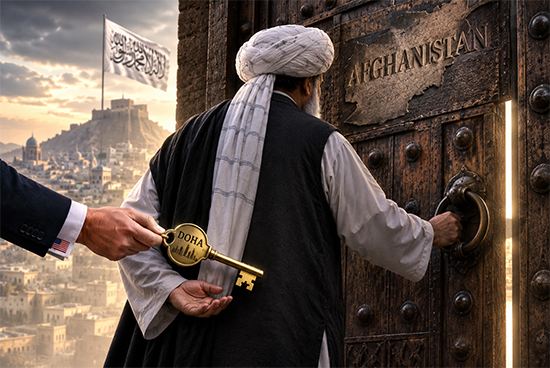
Or How America Is Returning Through the Taliban’s Gate
By Sayed Ahmad Mosavi Moballegh (Kabul, Afghanistan)
Amid the ongoing confrontation between Iran and the United States, developments in Afghanistan are unfolding almost unnoticed. Yet the processes taking shape there may ultimately have consequences far more significant than they appear today.
The cousin of Taliban* leader Mullah Haibatullah, who also holds U.S. citizenship, returned to Afghanistan some time ago. According to several well-informed sources, he did not return merely for family visits or personal residence. Rather, he is believed to be carrying out a mission that extends well beyond private purposes. Some observers argue that this mission closely resembles the role played by Zalmay Khalilzad at various stages of Afghanistan's modern history—as an intermediary and facilitator between the Taliban and the United States.
If this assessment is accurate, the presence of such an individual could serve both as a reliable channel for safeguarding certain U.S. interests in Taliban-controlled Afghanistan and as a source of reassurance for the Taliban leadership in the event of any future understanding or dialogue with Washington.
At the same time, Amir Khan Muttaqi's prolonged stay in Doha has also raised numerous questions. He traveled to Qatar to attend a memorial ceremony for the country's late emir, yet remained there for more than two weeks. Although the official explanation for his extended stay was the continuation of medical treatment, some sources claim that informal contacts with the American side also took place during this period. So far, however, these claims have not been officially confirmed.
Given the new regional environment, the escalating tensions between Iran and the United States, and Washington's potential need to redefine its military posture, the possibility of renewed use of certain Afghan air bases under a limited agreement cannot be entirely ruled out. It is quite possible that this issue was one of the principal topics discussed during the reported consultations.
The United States still requires Afghanistan's military infrastructure to support its broader strategic objectives. At the same time, if Mullah Haibatullah succeeds in securing significant political concessions in exchange for such an arrangement, it is conceivable that—much like the Doha Agreement—he could provide the necessary political and religious legitimacy for its acceptance within the Taliban movement.*
In such a scenario, the role of Mullah Haibatullah's American cousin—a figure who apparently has the ability to maintain communication with both sides—could prove highly significant.
From another perspective, assigning such a mission to a new figure reinforces the assumption that the United States is no longer relying solely on its long-established intermediaries to manage developments in Afghanistan.
For many years, intelligence and policy circles have discussed a scenario commonly referred to as the "integration project." Its presumed objective is the gradual incorporation of technocrats and Western-trusted figures into the governing structure of the Taliban without dismantling the movement's traditional core.
According to this interpretation, Washington does not intend to remove the Taliban from power. Rather, the strategy is believed to involve a gradual transformation of the movement's governing structure through the introduction of new personnel, giving it a more acceptable image in the eyes of the West and making it more open to cooperation.
If this line of reasoning is correct, the return of Mullah Haibatullah's American cousin may indicate that this project has entered a new phase. Unlike previous efforts, the emphasis may now be placed not on well-known intermediaries whose political utility has largely been exhausted, but on a new generation of figures—less public, less controversial, and trusted by both sides.
Alongside these developments, reports have also emerged regarding the gradual reconstitution of Units 01 and 02—elite special forces that operated during the Islamic Republic of Afghanistan under direct American support and supervision. According to these reports, parts of the same personnel and organizational structures are now being reassembled within the governing framework of the Taliban.*
If these reports are accurate, they may point to the emergence of a new model of security cooperation between the Taliban and the United States. Unlike in the past, this model would rely not on the direct deployment of American troops, but on local structures and institutions, thereby significantly reducing the political costs associated with U.S. involvement.
Taken together, these developments suggest that Afghanistan may be on the threshold of a new phase in relations between the Taliban and the United States. At this stage, the objective may no longer be America's withdrawal from Afghanistan, but rather the management of the country through indirect cooperation, reliance on local structures, and the involvement of new actors.
Whether this hypothesis proves correct will become clearer as events unfold over the coming months.
* The Taliban is under UN sanctions and is designated as a terrorist organization in a number of countries.