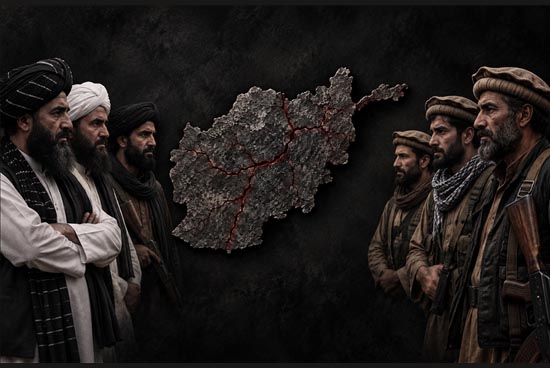
Has the Taliban embarked on a path of strategic attrition?
By Abdul Nasir Noorzad, researcher in politics and geopolitics, especially for Sangar
The Taliban cannot be regarded solely as a political force in the conventional sense of the term. The group relies primarily on military power, an ideological structure, and the use of force, rather than political competition, public participation, and the cultivation of legitimacy. From this perspective, if military pressure and security threats ever reach a point at which the group can no longer maintain its power structure, the Taliban’s very political survival will be called into serious question.
Viewed in this light, the Taliban appears more a product of war than a sustainable political project. Critical literature on Afghanistan also advances the view that, at various times, major and regional powers have used armed forces and non-state actors to pursue their objectives in competition with one another. Thus, if the Taliban is understood within this framework, its continued existence will depend largely on the persistence of the conditions under which it serves a particular security and geopolitical function.
An important question also arises domestically: has the Taliban managed to establish a broad political and social base in Afghanistan? Critics of the group argue that it lacks such a base and that its rule rests primarily on coercive control, an ideological structure, and a monopoly on power, rather than public consent.
This raises a fundamental question: where does a strategy to bring down or wear down the Taliban begin?
The “Bleeding Wound” Strategy
When considering a scenario of gradually increasing pressure on the Taliban, one can speak of a “bleeding wound” strategy. Its objective is not necessarily the Taliban’s sudden defeat, but sustained pressure, the depletion of resources, rising security costs, and the opening of multiple fronts against the group.
Under such a scenario, coordinated attacks by various movements and fronts could gradually force the Taliban to shift from an offensive to a defensive posture. A group initially focused on expanding its control and projecting power may, at a certain stage, be compelled to devote a substantial share of its capabilities to protecting its centers, commanders, facilities, and lines of communication.
This process can be envisioned as three hypothetical stages:
Stage One — Strategic Defense:
The Taliban remains capable of retaining the initiative, but security threats are mounting, and some of its forces are being diverted to counter dispersed threats.
Stage Two — Strategic Stalemate:
As pressure intensifies, the Taliban may be forced to withdraw from some peripheral areas and concentrate on more important centers to preserve its forces and resources. At this stage, the geographical extent and distribution of territorial control become more important than political displays of power.
Stage Three — A Strategic Offensive Against the Taliban:
If pressure reaches a point at which the Taliban can no longer defend different areas simultaneously, its presence in some parts of the country may become largely symbolic, while scattered or organized attacks originating from different areas could gradually undermine its capacity to govern.
This scenario is, of course, not a definitive prediction. It is an analytical model explaining how the power of a government reliant on armed force may gradually erode.
Why Does the Taliban’s Political Viability Matter So Much?
One important question is whether the Taliban can transform itself from an armed ideological force into a sustainable political actor.
Critics of the Taliban argue that the group still lacks a comprehensive political program for Afghanistan’s multiethnic and socially diverse society. Its power structure also rests primarily on a hierarchical command system, religious ideology, and a security apparatus, rather than political competition, institution-building, and public participation.
Another problem is the set of contradictions in the Taliban’s foreign policy. The group seeks to build relations simultaneously with various regional and global powers, ranging from China and Russia to Iran, India, the Arab states, and even the United States. But the question arises: can a balance between these actors’ conflicting interests be maintained for long?
Can the Taliban simultaneously maintain security ties with Russia, engage with India, cooperate with Iran, create conditions for Chinese investment, attract projects from Arab countries, and also enter into economic and political engagement with the United States?
This is more than a diplomatic issue. The central problem is the clash of interests among powers, each of which views Afghanistan from a different perspective.
The Taliban cannot play all its cards simultaneously forever. At some point, it may make a decision that seriously affects the interests of an influential actor. Engagement could then give way to pressure, while support or political tolerance could be replaced by containment and coercion.
The Taliban and Afghanistan’s Multiethnic Character
Within Afghanistan, the Taliban also faces a structural contradiction. Afghanistan is a multiethnic, multilingual, and multicultural society, while the Taliban’s power structure continues to face accusations of concentrating and monopolizing power in the hands of a single ethnic group.
At the same time, the Taliban bases the legitimacy of its rule largely on a particular interpretation of religion and the concept of an “Islamic Emirate.” Critics of the group ask: how can its claims to religious rule be reconciled with a foreign policy based on agreements, engagement, and deals with various powers?
From this perspective, the central problem is not limited to ideological differences. It concerns the political system’s capacity to manage a range of internal and external contradictions.
A broader question: are powers with influential intelligence services making a long-term bet on the Taliban?
Another important question arises: do the intelligence and security agencies of major and regional powers regard the Taliban as a long-term political investment or as a temporary instrument for addressing security objectives?
Here, a distinction must be drawn between “intelligence engagement” and “political investment.” An intelligence service may establish contact with an armed group, obtain information from it, negotiate with it, or even, at a particular stage, use its capabilities to pursue a security objective. However, this does not necessarily mean that the service considers the group a suitable foundation for a long-term political order.
In this context, discussions of the intelligence landscape surrounding Afghanistan mention organizations such as the CIA and MI6, ISI and FSB, China’s Ministry of State Security (MSS), Turkey’s MIT, Saudi Arabia’s GIP, Qatar’s SSB, the UAE’s security agencies, France’s DGSE, Germany’s BND, and Spain’s CNI. However, claims that any of these organizations is involved in a “joint project” or is making a “political investment” require independent and specific evidence. Mere presence or engagement with the Taliban does not, by itself, justify such a conclusion.
In fact, the more important question is this: does the Taliban possess sufficient political flexibility and institutional capacity for the post-conflict period for various powers to be willing to shape Afghanistan’s future around its continued rule?
Assertions alone cannot answer this question. It requires examining the behavior of regional and global powers, the intensity of diplomatic engagement, the nature of agreements, the level of economic and security support, and changes in their positions over time.
The Taliban — A Product of a Transitional Period?
Following the United States’ withdrawal from Afghanistan, against the backdrop of the war in Ukraine, rising tensions surrounding Iran, and US–China rivalry over Taiwan and in the Indo-Pacific, the region’s geopolitical landscape has undergone major changes. Under these conditions, Afghanistan may, for a time, benefit from competition among major and regional powers.
However, taking advantage of a geopolitical vacuum does not guarantee political survival. At a particular stage, the Taliban may be an acceptable partner for engagement for some actors, but this does not necessarily mean that those same actors will guarantee its continued rule over the long term. In power politics, alliances do not last forever: interests change, and instruments that are useful at one stage may become obstacles at another.
From this perspective, if the Taliban fails to transform itself from a purely military structure into a political force with a broad social base, developed institutions, and balanced foreign relations, internal and external pressure may gradually wear it down.
The Taliban’s fall, therefore, would not necessarily take the form of a sudden collapse. The process could begin with the erosion of legitimacy, rising security costs, deepening internal divisions, economic pressure, declining external support, and the loss of military initiative.
Under such a scenario, the Taliban may still appear strong, even as the foundations of its power gradually crumble beneath the surface. Political power sometimes collapses in the calculations of its supporters and rivals before it collapses on the battlefield.