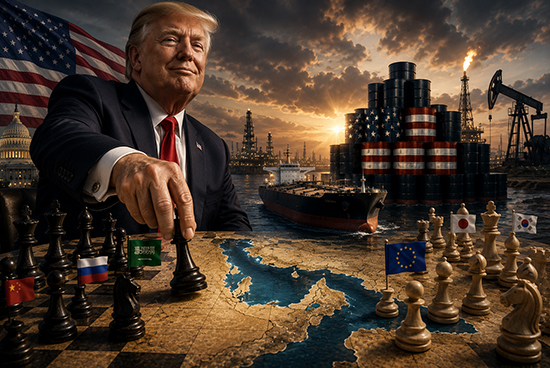
How the United States Became the World's Largest Oil Exporter
By Timur Seitmuratov, analyst (New York, USA)
For over a century, Americans have had a concept known as the Kansas City Shuffle. In practice, it refers to an elaborate scheme in which deception is built upon persuading the target to follow an illusion.
The term originated from the 1926 jazz composition “Kansas City Shuffle” performed by pianist Benny Moten. Outside the United States, it became widely known thanks to the cult film Lucky Number Slevin, where it was frequently invoked by Bruce Willis’s character, Mr. Goodkat.
The central principle can be summed up in a simple formula: “When everybody looks right, you go left.”
In other words, the beneficiaries of the scheme create an obvious threat or a situation that draws the victim’s full attention to a single focal point. The victim believes they understand what is happening or have the situation under control, while in reality, they are being maneuvered into a trap. While the target remains fixated on a false objective, the other side makes its decisive move.
Today, the longer the story surrounding the Strait of Hormuz drags on, the more it resembles a classic Kansas City Shuffle. While the world’s attention remains riveted on the deliberately dramatized “confrontation” between Iran and the United States, developments of enormous scale and global geo-economic significance are taking place with remarkably little publicity.
In fact, I have repeatedly noted in previous commentaries that, were I inclined toward conspiracy theories, I would inevitably ask a simple question: whose interests is the regime in Tehran actually serving?
The reality is that while the international community debates the Strait of Hormuz, potential disruptions to Middle Eastern hydrocarbon supplies, sanctions regimes, and the slow-moving negotiations between Washington and Tehran, the United States has quietly become the world's largest exporter of oil, including both crude oil and refined petroleum products.
According to Vortexa analytics, U.S. exports of crude oil and petroleum products reached 10.5 million barrels per day in May.
American oil companies are currently maintaining production at record levels, flooding the global market with crude from the United States and from Venezuela, whose oil sector remains effectively under Washington’s influence.
According to industry data, large volumes of U.S. oil exports are being directed to the Asia-Pacific region—including Japan, South Korea, Thailand, and China—as well as to European countries such as Italy, Spain, Germany, and the United Kingdom, helping to offset physical supply shortages in the market.
For comparison, according to Vortexa, Saudi Arabia exported approximately 8.1 million barrels per day in 2025, the United States exported 6.6 million barrels per day, and Russia around 5.8 million barrels per day. Let me emphasize: U.S. exports have now reached 10.5 million barrels per day.
Michelle Bruyard, Head of Policy at vessel-tracking firm Kpler, noted in an interview with CNBC:
“Washington has acquired a new tool—one that few anticipated before the confrontation with Iran began: global energy exports.”
In essence, by becoming the world's largest oil exporter, the United States has gained a powerful new lever in negotiations with both allies and competitors, complementing its military superiority and its dominance in global financial markets through the U.S. dollar’s status as the world's primary reserve currency.
In the same interview, Bruyard added:
“We are now witnessing how the United States can influence countries that depend on it for oil or natural gas.”
Today, the United States is already the largest supplier of crude oil to Europe and the second-largest supplier of refined petroleum products, having decisively displaced both Russia and many Middle Eastern producers from these positions.
It is noteworthy that Igor Sechin, the head of Rosneft and one of President Vladimir Putin’s closest associates, stated during an energy panel at the St. Petersburg International Economic Forum that any closure of the Strait of Hormuz would primarily benefit American energy companies.
“According to the Norwegian consulting firm Rystad Energy, American oil and gas companies could generate more than $60 billion in additional profits as early as 2026. Additional tax revenues from the sector to the U.S. federal budget could reach approximately $80 billion, according to expert estimates,” Sechin added.
For the sake of fairness, however, it should be noted that even before the Iranian-American confrontation began, both Saudi Arabia and Russia were already lagging significantly behind the United States in terms of production growth.
In 2016, the United States lifted its 40-year ban on crude oil exports, marking the beginning of the American oil boom. A decade later, the country has become the world's largest exporter, disproving skeptics who believed the surge would be short-lived.
Unlike Saudi Arabia and Russia, where governments set production targets, America’s energy boom is driven by the decisions of private companies.
“When oil prices rise, American companies increase production, which puts downward pressure on prices. When prices fall, production declines, leading to higher prices,” noted Kenneth Medlock of the Baker Institute for Public Policy.
“It is somewhat similar to the role played by OPEC and Saudi Arabia, but in the United States, this is a market mechanism rather than a bureaucratic instrument,” he added.
In practical terms, several conclusions can be drawn today:
- Thanks to transportation disruptions and blockades in the Middle East, the United States has become the leading supplier of crude oil, refined petroleum products, and aviation fuel to the European Union. Following Iranian drone strikes that reportedly disabled part of Qatar’s export infrastructure, the United States also became the EU’s principal supplier of liquefied natural gas this year.
- Asian countries that previously relied heavily on Middle Eastern oil are likewise becoming increasingly dependent on American supplies. In May, Asia accounted for approximately 46 percent of U.S. oil exports, up from 37 percent a year earlier.
P.S. While the international community—skillfully whipped into a frenzy by media hysteria—continues to speculate about Washington’s intentions toward Iran, someone in Washington may well be discussing entirely different prospects and quietly humming a tune from 1926:
“When everybody looks right, you go left.”