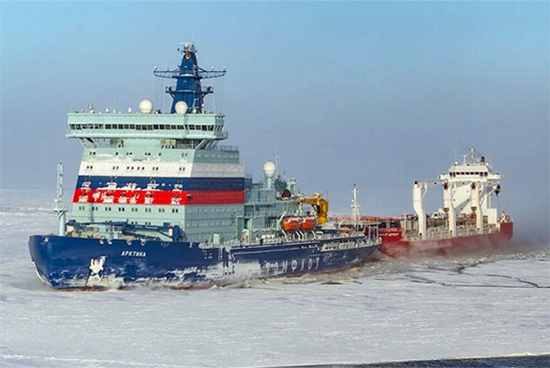
Will the Arctic become the main logistics corridor of the 21st century?
By Ali Askari, analyst (Germany), especially for Sangar
On May 18, 2026, Russian Transport Minister Andrey Nikitin announced that the Northern Sea Route (NSR) will evolve beyond a maritime shipping lane and become part of a large-scale transportation system integrating various modes of freight transport.
The NSR concept is expected to develop through the integration of river, rail, and road transportation networks. According to the minister, the route is gradually expanding beyond the traditional maritime corridor stretching from the Kara Gates to the Bering Strait and is transforming into a unified logistics network. Nikitin explained that such a multimodal approach would enhance supply chain resilience, improve transport connectivity, and expand cargo transportation capabilities across the Arctic region.
In April 2026, Russian President Vladimir Putin stated during a meeting with government officials that Moscow is ready to cooperate in the Arctic with all interested countries while firmly defending its national interests in the region.
"We are ready for cooperation—not merely for competition or confrontation, but for genuine cooperation with all interested countries. At the same time, we will undoubtedly defend and safeguard our national interests in the Arctic," Putin said.
The Russian president also noted that geopolitical competition and the struggle for influence in the Arctic are intensifying.
The Northern Sea Route is a shipping corridor connecting Europe and Asia through the seas of the Arctic Ocean and running along Russia’s northern coastline. In April 2026, Alexey Likhachev, Director General of the state corporation Rosatom, stated that cargo traffic along the NSR could exceed 40 million tons this year.
On May 21, 2026, Anastasia Ilyina, Head of the Ice and Hydrometeorological Information Center at the Arctic and Antarctic Research Institute, told RIA Novosti that year-round navigation along the NSR is feasible provided there is sufficient demand from shipping companies, the availability of high ice-class vessels, and an accurate assessment of ice conditions. She also emphasized that the Center’s experts are prepared to provide shipowners with optimal routing options for operations along the Northern Sea Route.
Rosatom is responsible for ensuring civilian navigation along the Northern Sea Route and has already established the necessary infrastructure to support transportation along this Arctic corridor.
In particular, in 2022, Rosatom established the Unified Navigation Management Center for the Northern Sea Route, enabling the implementation of a “single-window” system for issuing and suspending vessel transit permits. This mechanism ensured continuous coordination with international shipping companies and demonstrated Russia’s readiness to promote the shared use of the route.
At the same time, Russia is implementing a comprehensive program aimed at increasing cargo volumes along the NSR. Under these plans, annual freight traffic is expected to reach 100 million tons by 2030 and 150 million tons by 2035.
According to experts, compared to the traditional southern maritime route, the Northern Sea Route can reduce the transit time, transportation costs, and shipping distance for cargo moving from Europe to South and Southeast Asia by approximately 40 percent.
New global realities—including the gradual shift of economic centers toward Asia and the deteriorating security environment along southern maritime routes in the Indian Ocean and the Indo-Pacific region—are making the Northern Sea Route an increasingly attractive and viable corridor for international trade and shipping.