Iran uses the Parthian experience against the "Epstein coalition."
Author: Mahmoud Delkhasteh (Iran)
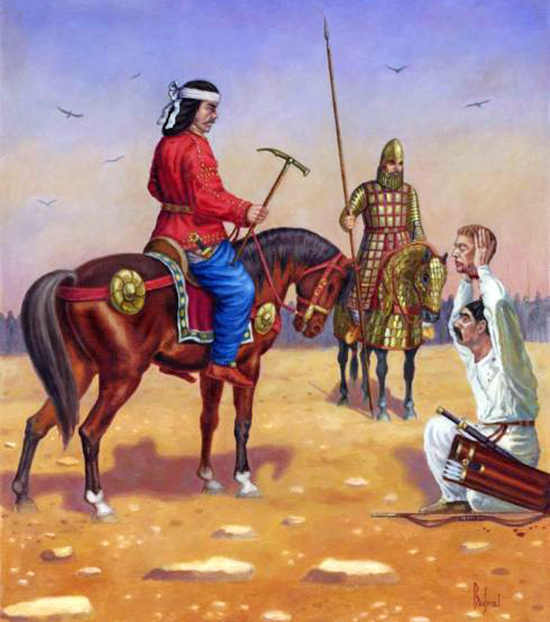
In his letter, George Galloway, a prominent Scottish politician and critic, compared the type of battle fought by the Iranian defenders against the invading US and Israeli forces to the famous Battle of Harran, a battle in which the Iranian army clashed with the invading Roman army under Marcus Crassus.
In that battle, the Roman infantry was surrounded by Parthian cavalry under the command of Sorena, and Crassus waited for the Parthian cavalry to empty their shells, and then the Roman legions would finish off the Iranian army. But while waiting, he was surprised to see the empty shells filling up one after another. Crassus was unaware that Sorena had foreseen such a battle in advance and had loaded thousands of camels with numerous shells. Thus, the Great Roman Army suffered its greatest defeat, and ten thousand men were taken prisoner.
This comparison was made because the United States and Israel are now waiting for Iran's missiles and drones to run out, and then they will declare themselves victors in the war. Unaware that, unlike the United States and Israel, the Iranian armed forces, drawing on their rich historical experience, have long planned for this day and prepared. Thus, long before Iran's missiles run out, the air defense systems of these two aggressive countries will be exhausted, and then Iran's work will begin.
Trump's attack on Kharg Island last night demonstrates his knowledge, impatience, and insane anger at why the Iranians are not surrendering. These two ignorant criminals are ignorant of the Iranian psyche; otherwise, they would know that when the existence of the homeland and its territorial integrity are threatened, the word "capitulation" will disappear from Iranian political literature. This ensured Iran's historical and cultural continuity throughout its millennia-long history at the crossroads of civilizations.
It should also be noted that Crassus decided to conquer Iran to outdo Julius Caesar and Pompey. As his army advanced toward Iran, Artaxerxes II, the king of Iran, sent an ambassador to Crassus and said, "The Roman people do not want this war, but you personally intend to start it," and even offered to free the Roman prisoners.
Crassus arrogantly replied that he would answer the king in Seleucia, the capital. The ambassador replied,
"If you see a hair on the palm of this hand, you will see Seleucia."
Now we must tell Trump and the criminal Netanyahu: if you see a hair on the palm of your hand, you will see victory over Iran. You, rootless people, will take to your graves the humiliation of a nation whose history is lost in myth. In fact, it is in this decisive battle that Iran will take its true place in the world. Of course, this is impossible without Iran's democratization.