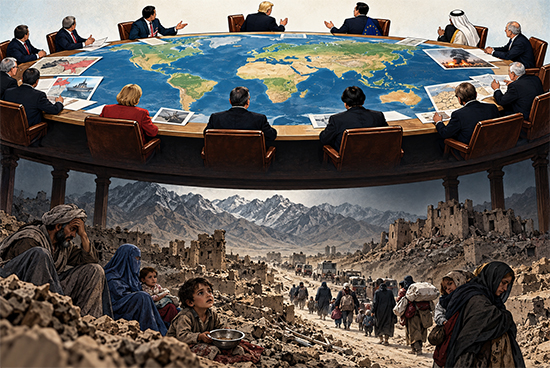
Has the World Grown Accustomed to the Afghan Crisis?
By Rastakhez Sho’la (Afghanistan)
The central question today is no longer, “Why is Afghanistan still in crisis?” A far more important question is: “Why does Afghanistan’s ongoing crisis no longer alarm the world as much as it once did?”
Perhaps the answer is that the world has grown accustomed to the Afghan crisis. Yet becoming accustomed to a crisis does not mean that the crisis has ended. Sometimes, the most dangerous stage of a crisis begins precisely when its very existence no longer surprises anyone.
When war was raging in Afghanistan, the country occupied a central place on the global foreign policy agenda. Suicide bombings, the fall of cities, military operations, international conferences, and ultimately the withdrawal of foreign troops made headlines around the world almost every day.
Today, however, despite millions of Afghans struggling with poverty, hunger, unemployment, widespread social restrictions, and a humanitarian crisis, Afghanistan no longer holds the same place in international news coverage or in the political calculations of major world powers. This may be one of the most dangerous changes in Afghanistan’s situation: the crisis has not disappeared, but the world’s attention to it has diminished.
For many countries, Afghanistan is no longer an “urgent crisis.” In other words, the Afghan crisis has evolved from an emergency into a chronic problem — one whose existence everyone acknowledges, but which few expect to be resolved anytime soon.
Humanitarian crises generally attract greater international attention when a new and dramatic event occurs. Hunger that persists day after day, children suffering from malnutrition, families constantly struggling with unemployment, and girls deprived of schooling for years gradually cease to qualify as “news” in the eyes of traditional journalism.
It is at this point that the danger of normalizing a humanitarian crisis emerges. When an emergency continues for too long, the international community also begins to grow accustomed to it. Another important factor is the changing geopolitical environment.
Following the withdrawal of American and NATO forces from Afghanistan, the attention of major powers shifted toward other crises. The war in Ukraine, the rivalry between the United States and China, the war in Gaza, the broader Middle East crisis, and intensifying competition across different regions of the world have absorbed a substantial share of Western countries’ political and media resources.
Under these circumstances, Afghanistan no longer possesses the same geopolitical significance it held during the years of American military presence. This does not mean that Afghanistan has become irrelevant to the international community. Rather, the nature of its importance has changed.
For the United States, Afghanistan is no longer a battlefield; for Europe, it no longer represents a migration challenge on the same scale as in previous years; and for many countries in the region, Afghanistan has become primarily a matter of security and economics rather than an international crisis requiring immediate intervention.
This shift in approach carries significant consequences.
One of the central paradoxes of Afghanistan’s current situation is that the Taliban movement remains unrecognized by many countries around the world, yet in practice it maintains relations with a significant part of the international community.
Countries engage in negotiations with the Taliban, some embassies and diplomatic missions continue to operate in Afghanistan, international organizations remain active, and humanitarian aid continues to reach the country. In other words, the world has arrived at a peculiar formula of “engagement with the Taliban without formal recognition.”
This situation also has an unintended consequence: Afghanistan’s political crisis has shifted from being “a problem that must be resolved immediately” to “a reality that must be managed.”
The international community no longer necessarily expects an imminent transformation of Afghanistan’s political system. Many countries have concluded that they must work with the existing reality, even if they do not consider it desirable. It is precisely here that the danger of normalizing the crisis becomes more pronounced. In previous years, much of the international community’s engagement with Afghanistan took the form of development assistance, economic projects, and direct support for the Afghan government. Today, a substantial portion of this engagement is limited to humanitarian aid.
This distinction is fundamental. Humanitarian assistance is essential for saving people from starvation, but it cannot, by itself, rebuild an entire country’s economy.
Food distribution can save a family from death, but it cannot provide that family with employment. Medical assistance can treat an individual patient, but it cannot create a sustainable healthcare system. If a country remains dependent on emergency assistance for years, a dangerous transformation takes place: the crisis itself becomes a model for governing society. Afghanistan must not become a country for which the world raises funds every year merely to prevent another humanitarian catastrophe, without offering any prospect of breaking this vicious cycle.
Why Do the Sufferings of Afghans No Longer Shock the World? Perhaps this is the most troubling aspect of the entire issue. Over more than two decades, the world has repeatedly witnessed the same images from Afghanistan: starving children, displaced families, women deprived of their fundamental rights, devastated villages, migrants wandering through border regions, and hospitals struggling with severe shortages of resources.
The constant repetition of these images can gradually diminish their emotional impact. What was perceived as a shocking tragedy during the early years of the war may, two decades later, become a familiar part of the public perception of Afghanistan.
This phenomenon is not limited to the media. Politicians respond to it as well. When a crisis continues for too long and no simple solution exists, the political motivation to address it gradually weakens.
The Afghan crisis has become a victim of precisely this kind of attention fatigue. Of course, the international community does not bear all the responsibility. The Taliban themselves, through their policies — particularly severe restrictions on women and girls, the suppression of civil and political freedoms, and the absence of an inclusive government — have made normal engagement with the international community considerably more difficult. Western countries cannot easily establish normal political and economic relations with a regime that has deprived a substantial part of society, particularly women and girls, of their fundamental rights.
The problem, however, is that political pressure on the Taliban does not necessarily reduce the suffering of the population. A regime may face sanctions, but the price of those sanctions is sometimes paid by people who have no role whatsoever in the decisions made by that regime.
The international community therefore faces a difficult dilemma: how can it exert pressure on the Taliban without subjecting the people of Afghanistan to even greater hardship? So far, no comprehensive and convincing answer to this question has been found.
Perhaps the greatest danger facing Afghanistan is not merely the spread of poverty or malnutrition. An even greater danger is the normalization of these conditions. If the international community concludes that Afghanistan is simply the way it is and must remain that way, the pressure to bring about change will also diminish. If girls are denied access to education for years, their deprivation may one day cease to be regarded as an urgent crisis. If millions of people live in poverty, poverty itself may become accepted as an ordinary feature of society. If migration and the forced return of millions of people continue to recur, these too may eventually be regarded as part of Afghanistan’s “natural state of affairs.”
This danger is even more serious than the crisis itself. As long as a crisis is recognized as a crisis, there remains an opportunity to mobilize resources to overcome it. But once it becomes an “ordinary condition,” the motivation to pursue change disappears.
The international community cannot indefinitely limit its relationship with Afghanistan to delivering food packages and emergency assistance. Afghanistan needs economic development, investment, an education system, employment opportunities, a sustainable healthcare system, and, above all, a political vision capable of accommodating the country’s diverse segments of society.
Humanitarian assistance is necessary, but it is not enough. If the world focuses solely on helping Afghanistan survive one winter and make it to the next, it is effectively managing the crisis rather than resolving it.
Afghanistan may no longer dominate international news headlines, but its crisis is far from over. After a prolonged war, the country has entered a multidimensional crisis: an economic crisis, a humanitarian crisis, a crisis of political legitimacy, a crisis of women’s rights, a migration crisis, an employment crisis, and a crisis in relations with the outside world.
The problem is that these crises no longer erupt suddenly or explosively. Instead, they unfold slowly, persist for years, and gradually exhaust society.
Perhaps it is precisely this characteristic that allows the world to coexist with them. But the people of Afghanistan cannot afford that luxury. For an Afghan family with a hungry child, the crisis unfolds every single day. For a girl denied the opportunity to attend school, the crisis is not a news headline; it is part of her stolen future. For a young person unable to find work, the crisis is not an economic report; it defines the entire horizon of their life.
Therefore, the central question today is no longer, “Why is Afghanistan still in crisis?” A far more important question is: “Why does Afghanistan’s continuing crisis no longer alarm the world as much as it once did?”
Perhaps the answer is that the world has grown accustomed to the Afghan crisis. But the world’s growing accustomed to a crisis does not mean that the crisis has ended. Sometimes, the most dangerous stage of a crisis begins precisely when its very existence no longer surprises anyone.