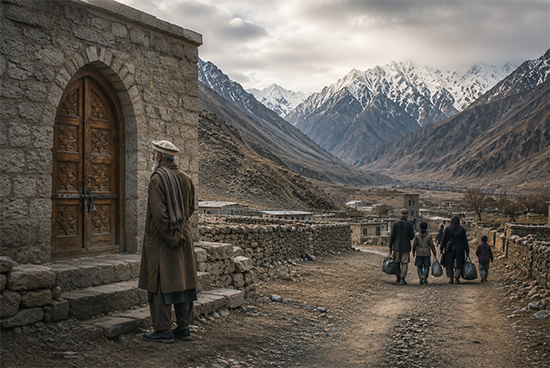
From Shuttered Jamaat Khanas to Forced Conversion: The Bitter Plight of Badakhshan’s Ismailis
Source: Hasht-e Subh
Five years after the Taliban’s takeover, members of the Ismaili community in Badakhshan say they are facing a wave of religious, educational and social restrictions. According to the findings of this report, at least 10 jamaat khanas (Ismaili prayer and community centers) belonging to Ismailis have been closed in several districts of this province, more than 340 Ismaili children in five districts of Darwaz have been sent to Taliban religious schools, and at least seven cases of forced religious conversion have been documented among members of this community. Ismaili residents of Badakhshan also speak of pressure to convert, security threats, restrictions on cultural activities, and rising migration of families to neighboring countries and to Kabul.
Religious and Social Pressure on Ismailis
Five years after the Taliban’s takeover, members of the Ismaili community in Badakhshan say they are facing widespread religious, educational and social restrictions. The closure of jamaat khanas, pressure to convert, restrictions on religious education and growing security concerns are among the issues residents of this region say they are worried about. Several Ismaili residents of this province say that since the Taliban’s takeover in August 2021, pressure on this community has increased and their religious and cultural freedoms have been severely restricted. They emphasize that the Ismaili community has faced discrimination and deprivation at various points in Afghanistan’s history, but they consider the current situation to be one of the most difficult periods of their lives.
According to them, although followers of different faiths in Badakhshan have lived alongside one another peacefully for years, and in some cases interfaith marriages have taken place, and joint families have been formed, several mullahs and Taliban members in mosques and sermons in remote areas of the province are forbidding people from establishing social ties with Ismailis or marrying them. Some Ismailis also say the Taliban do not regard their faith as meeting their own accepted standards of Islam, and from time to time, through pressure and restrictions, force them to adopt the Hanafi school of Islam.
Based on reports and interviews conducted with several Ismailis residing in nine districts of Badakhshan and members of the Ismaili community, religious pressure on this community has increased significantly over the past five years.
Jamaat Khanas Closed; Religious Ceremonies Halted
According to these individuals, the holding of Ismaili religious ceremonies in their areas of residence has been completely halted, and they claim that if such ceremonies are held, they are fined up to 50,000 afghanis. In addition, jamaat khanas, which served as centers of worship, culture and education in the districts of Zebak, Ishkashim, Shughnan, the Darwaz districts and Wakhan, have been closed, and according to residents, the Taliban also do not allow the construction or completion and expansion of these centers.
Residents of the aforementioned areas emphasize that the half-built structures of jamaat khanas that were previously under construction have been abandoned and are gradually deteriorating, a situation they say severely threatens the religious and social identity of the Ismaili community. They also say that many families, following threats from Taliban members, have been forced to send their children to the group’s religious schools.
Over 340 Ismaili Children Sent to Religious Schools
The findings of this report show that in some areas, particularly in the districts of Darwaz, several employees of institutions affiliated with the Taliban regime, including teachers, have forcibly required families to enroll their children in religious schools.
According to the findings of this report, in just five districts of Darwaz, more than 340 Ismaili children aged 9 to 16 from the villages of Obaghan, Parid, Rawan, Arun, Sadeha, Parkheikh and Zing in Nusay district, Ghami, Aomran and Warw in Maimai district, and Zangaria, Dehkhwah and Khadra in Shiki district have been enrolled in religious schools over the five years of Taliban rule.
Families of these children say the curricula of these religious schools differ fundamentally from Ismaili religious beliefs and teachings, while the Ismaili community has its own dedicated religious education system, which is supported by the Ismaili Center.
Pressure to Change Religion; At Least Seven Cases Recorded
Information obtained from interviewees shows that, as a result of security, social, and economic pressures, cases of forced religious conversion have also occurred among members of the Ismaili community. However, according to them, the exact number of such cases is not available due to restrictions imposed by the Taliban, the lack of means for documentation, and people’s fear of disclosing such incidents.
According to the findings of this report, at least seven documented cases of religious conversion have been recorded. Based on the information gathered, in two separate incidents in Nusay district of Darwaz, 36 people were converted as a group. In addition, two cases, including one education worker, were recorded in Shiwa, and four other cases were recorded in the districts of Ishkashim, Jurm and Shughnan, together involving 13 people. Interviewees say these conversions took place under conditions of pressure and intimidation.
Some of these families say that agents of the Taliban’s Ministry for the Propagation of Virtue and Prevention of Vice threaten families who are unwilling to convert with fines. They add that due to poverty and a lack of financial means to pay these fines, several families have been forced to accept the group’s demand.
Concern Over Killings and Violence Against Ismailis
One official from the cultural section of the Ismaili community in Badakhshan speaks of the killing of several active members of this community in the province, and expresses concern over the continuation of these killings and the rise in incidents of assault against Ismailis in Badakhshan.
According to him, Amir Baig, one of the key leaders of the Ismaili community and a representative of the Aga Khan Council, died in September 2022 along with two of his colleagues after their vehicle overturned on the road to Darwaz. He says investigations conducted have shown that this incident occurred deliberately.
He also adds that Islamuddin, a seventh grade student in the village of Degargand in Wakhan district, Fazl Ahmad Paiz, a volunteer worker with the Aga Khan cultural section in Zebak district, Salamat, Shah Hassan and Shah Nazar in January 2026 in the center of Faizabad city, and Lilima, an economically active woman and the wife of local singer Salam Maftoon, in May in Shughnan district, are among those whose deaths, he says, are attributed to the Taliban regime.
In addition, there are reports of unofficial killings and arbitrary detentions in several other districts of Badakhshan, estimated at around 11 cases. Despite the absence of official and comprehensive statistics on this matter, these cases have raised serious concerns about the physical security and human rights situation of Ismailis in this province.
Ismaili Books and Cultural Centers Under Restriction
The findings of this report show that the cultural and religious activities of the Ismaili community have also faced widespread restrictions. Reports indicate the closure of at least 10 jamaat khanas in Ismaili-inhabited districts of Badakhshan province, including Wakhan, Shughnan, Zebak, Ishkashim, Nusay, Shiki, Maimai and Yamgan, as well as restrictions on the activities of cultural institutions affiliated with this community in these districts.
Interviewees speak of the confiscation of Ismaili cultural centers and their use as guesthouses by Taliban members. They claim that the Taliban, arguing that mosques already exist in the districts and villages and that such centers are unnecessary, have seized Ismaili places of worship and culture. According to them, some individuals refrain from protesting or raising this issue out of fear of security consequences.
Interviewees also say that the confiscation of Ismaili books and religious symbols has taken place informally in many areas, and the space for this community’s cultural activities has been severely restricted. They add that due to security concerns, people are unable to openly use books, educational guides and other cultural materials related to their religious beliefs.
Taliban Pressure and Rising Ismaili Migration
The findings of this report show that the security situation, religious freedoms, access to education and economic conditions of Ismailis in Badakhshan have been severely affected. Many families, following sustained pressure, have been forced to migrate to neighboring countries such as Tajikistan, Pakistan and Iran, as well as to Kabul. This migration trend has had widespread social and humanitarian consequences for the Ismaili community, resulting in the scattering of families and the weakening of their social and cultural ties.
Previously, the Rawadari Human Rights Organization stated in a report that persecution and discrimination against the Ismaili community in Afghanistan have historical and cultural roots. However, the findings of this investigation show that after the Taliban’s takeover, this discrimination and pressure have taken on a more organized form and have expanded into various aspects of the lives of followers of this religious minority.
According to the findings of this report, in the first four years of their rule, the Taliban, particularly in parts of Badakhshan province, imposed the teaching of Hanafi jurisprudence on Ismaili children. This report also adds that through public excommunication, organized pressure, intimidation, threats of killing, detention, torture, and other violent methods, several members of the Ismaili community have been pressured to abandon their faith and adopt the Sunni school of Islam.