How is the struggle for the future world order unfolding?
By Abdul Naser Noorzad, researcher in politics and geopolitics, especially for “Sangar”
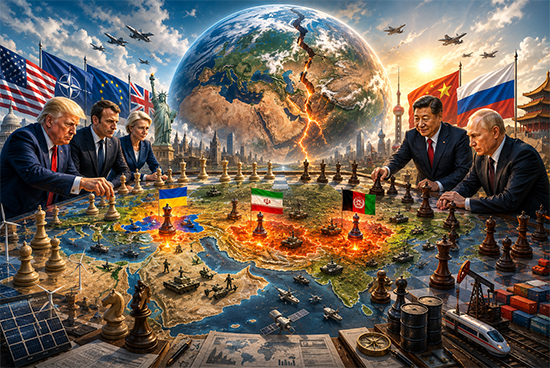
The situations in Afghanistan, Ukraine, and Iran, as three centers of crisis, three lines of confrontation, and three fronts of competition between East and West, remain tense and highly consequential.
In Ukraine, the war is increasingly taking on the character of a war of attrition. A relative balance on the battlefield persists, while the prospects for ending the conflict remain vague and uncertain.
In Iran, the possibilities of war, peace, or the continuation of the current status quo can simultaneously be observed. The existing situation is the result of bargaining among major powers and the balance of forces at the regional level.
In Afghanistan, meanwhile, alongside growing concerns about the fragility of the current situation, the gradual and subtle presence of both state and non-state actors continues to transform the country into a geopolitical space potentially susceptible to a clash of interests between East and West.
As a result of these dynamics, the centers of crisis—which simultaneously play a key role in intensifying rivalry, confrontation, and strategic bargaining among major powers—remain active. In other words, everything taking place today in Afghanistan, Iran, and Ukraine constitutes part of a much larger puzzle on the global chessboard; a puzzle connected to the shaping of the future world order and the determination of the contours of a new international system.
Within this emerging order, not only military power and armed confrontations will play decisive roles. Economic, informational, and technological factors, cybersecurity, cognitive warfare, and competition for controlling and managing public perception will be equally important. Together, these forces are pushing the world away from its current structure toward a new and complex post-polar order.
In such an environment, the most successful actors will be those that possess not only hard power but also the ability to build regional coalitions, manage public opinion, maintain economic resilience, and establish multilayered security capacities. These actors will be capable of shaping the equations of future international politics and writing the pages of tomorrow’s world history to their own advantage.
Notably, all three crisis centers are located along the geopolitical belt of Eurasia. This once again revives the classical geopolitical theories of rivalry based on the concepts of the Heartland and the Rimland, though no longer in their traditional form, but rather in a manner adapted to contemporary security, economic, and geopolitical realities.
The theory of “crisis centers” suggests that instability in these regions possesses a high potential to spread insecurity to surrounding areas and even to the entire international system. As such, it may play an undeniable role in determining the character of the future world order.
In practice, these crisis centers reflect the logic of a cold, concealed, and relatively low-cost competition among major powers. Although this rivalry lacks large-scale direct confrontation, its essence closely resembles a new version of the Cold War and develops within the framework of safeguarding the strategic interests of leading global powers.
Beyond these three active crisis centers, semi-active crisis regions with significant influence potential are expected to gain increasing importance in the future. Taiwan, Latin America, Africa, and even the Far East are gradually emerging as new arenas of competition among world powers. Alongside them, the Arctic, the Greenland issue, the Panama Canal, and the Strait of Hormuz have already become subjects of strategic bargaining among major powers within the geopolitics of transport and maritime corridors. Depending on changes in the international environment, they may automatically become more active or recede into the background.
Within these crisis centers, there are specific regions that, according to the theory of Regional Security Complexes, play important roles within a highly competitive environment. Under this logic, the security of Europe, the Middle East, Central Asia, and the Far East can no longer be viewed as separate phenomena. Rather, they are deeply interconnected within the broader rules of competition among major powers and possess a strong capacity for the spillover of consequences.
At the same time, as new security threats continue to expand across these regions, security interdependence, increasing reliance on regional alliances, and the necessity of collective responses to threats are becoming more important. Under such circumstances, managing crises and threats without extensive regional and interregional cooperation will face serious difficulties.
Ukraine is moving from being merely a theater of military confrontation between East and West toward becoming an arena of geopolitical, civilizational, and identity-based competition. Therefore, the current stalemate on the battlefield is not simply the result of military pressure but rather a consequence of the caution exercised by key actors within a much larger geopolitical and civilizational game. In this game, even a minor mistake could steer global developments toward unpredictable outcomes.
Iran, despite the experience of a six-week war and its consequences, has also become one of the most active centers of crisis within the system of global rivalry. Competition in the Middle East is less a matter of civilizational confrontation than a struggle over energy security, the establishment of regional deterrence, control and management of strategic routes, and the shaping of the future balance of power between East and West.
At the same time, following the withdrawal of the United States, Afghanistan has become a space for covert informational, political-military, and geopolitical competition among various centers of power. Despite its fragile stability, the absence of comprehensive political legitimacy, and the inability to establish a sustainable order acceptable to both sides of global competition, the country remains fertile ground for information operations, clandestine intelligence rivalries, the use of proxy groups, the transfer of crises into neighboring regions, and the performance of a connecting role between different security belts, geopolitical identities, and competing civilizational fault lines that run through strategically significant areas.
From this perspective, the continuation of the crisis in Ukraine, the evolving situation in Afghanistan, and the simultaneous efforts to manage both peace and conflict around Iran reflect an attempt to create a Eurasian strategic depth of security in response to Western geopolitical pressure. In turn, the West, relying on a strategy of controlled destabilization, the recruitment of new regional allies, and the utilization of opportunistic or vulnerable actors, seeks to maintain the management of competition from a distance.
The divided East, represented by a form of informal convergence among Iran, Russia, and China, and the multilayered West, operating within the framework of traditional understandings among the United States, the United Kingdom, Europe, the Arab states, and Türkiye, are each striving to alter the balance of power in their own favor. In this context, containing the geopolitical and strategic potential of the Eastern bloc through the creation and maintenance of security crises in sensitive regions has become one of the primary objectives of Western actors.
Ultimately, what is taking place today in Ukraine, Iran, and Afghanistan is not merely a collection of separate and independent crises. Rather, it is part of a much broader competition over the shaping of the future world order. The world is undergoing a transition from a unipolar structure toward a complex and tension-filled multipolar system. Within this emerging order, wars are no longer defined solely by military operations. Economics, media, technology, cybersecurity, cognitive operations, and competition over the control and management of narratives have become as important as military power itself.
Under these conditions, success in the great geopolitical competition will belong to those actors who, in addition to possessing hard power, are capable of effectively managing public perception, building durable alliances, strengthening economic and security resilience, and rapidly adapting to the accelerating transformations of the international environment.