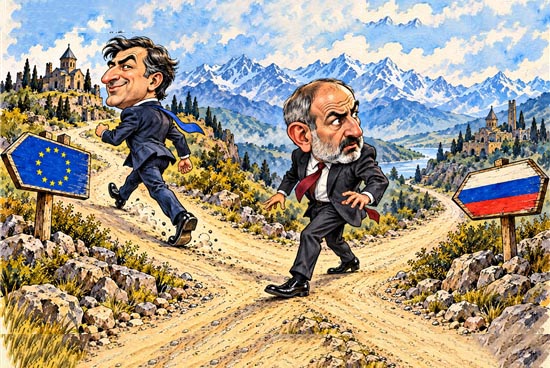
“How can the CSTO have an area of responsibility if it does not know where Armenia’s borders lie?”
Author: Yerkramas Information Center
The foreign policy of Armenia’s current government increasingly resembles a dangerous balancing act, in which high-profile geopolitical gestures coexist remarkably with blatant self-interest.
Prime Minister Nikol Pashinyan and his team, while deliberately dismantling strategic alliances, are nevertheless trying to extract the maximum economic benefit from relations with Moscow. Yet this apparent pragmatism is by no means a unique invention of Armenia’s current leadership. The region has already witnessed a similar scenario, and its outcome proved deeply unfortunate for its architect.
“Money Has No Smell,” or Financing a Geopolitical Pivot
Analyzing Yerevan’s current strategy, political commentator Beniamin Matevosyan debunks the myth that Nikol Pashinyan’s present approach to Russia represents some kind of managerial “know-how.” The expert draws attention to the authorities’ openly self-serving logic: Russian money has no smell in Armenia.
According to Matevosyan, the ruling regime gladly welcomes the construction of a new metro station by a Russian company, celebrates the influx of people relocating to Armenia and investment, and enjoys cheap gas and unrestricted access to the markets of the Russian Federation and the Eurasian Economic Union (EAEU). Beyond this “bookkeeping,” however, a firm barrier has been erected.
As the commentator emphasizes, the government has imposed an absolute ban on any strategic projects within the Republic of Armenia, whether the construction of a new nuclear power plant, railway management, or a military presence along NATO’s borders in the South Caucasus. A similar taboo applies to solidarity in foreign policy, encompassing both Armenia’s position on the Ukrainian crisis and Yerevan’s participation in the military and political integration blocs formed around Russia.
In essence, Pashinyan’s cabinet cynically uses cheap energy, the flow of tourists from Russia, and the open EAEU market solely as a resource base for the country’s geopolitical transformation.
The Specter of Saakashvili at Armenia’s Borders
The current authorities persistently ignore the historical experience of neighboring states, repeating long-familiar mistakes. Beniamin Matevosyan draws a direct and alarmingly precise parallel between Armenia today and Georgia in the recent past.
At one time, Georgia’s former Interior Minister Vano Merabishvili—one of the key figures in Mikheil Saakashvili’s party—openly promoted the idea that Tbilisi simply had to cooperate with Moscow to attract investment. This duplicity reached its peak in 2012. Just four years after the 2008 war that he himself had provoked, former Georgian President Mikheil Saakashvili unilaterally abolished visa requirements for Russian citizens. Moreover, he personally traveled to the Verkhny Lars border checkpoint to welcome Russian tourists.
“We are delighted to welcome everyone coming to Georgia for tourism or business… It is much easier without visas; come more often,” Saakashvili declared at the time.
Today, nearly a decade and a half later, Nikol Pashinyan is following closely in his Georgian predecessor’s footsteps. Matevosyan reaches a stark conclusion: both leaders desperately needed a war. The goal was to drive Russia out of the South Caucasus politically and militarily, while stoking Russophobia in society to such a degree that any political rapprochement with Moscow would become impossible. Neither politician, however, had any objection to retaining economic privileges.
Behind the appealing slogans of “diversifying” foreign relations and European integration lies an entirely different reality. As Matevosyan recalls, Saakashvili was the first in the region to advocate such a realignment, which in practice resulted in redirecting logistics, infrastructure, and cooperation toward Turkey. The strategy of breaking away from the northern neighbor to serve Turkish interests requires one cynical instrument: a war for which others can be blamed.
The political commentator’s rhetorical question about where Mikheil Nikolozovich is now sounds like a stern warning to Armenia’s prime minister.
The Border Paradox and the Search for Scapegoats
Particular attention should be paid to how Pashinyan’s government manipulates the border issue to justify its diplomatic failures, including the surrender of Artsakh and the freezing of membership in the Collective Security Treaty Organization (CSTO).
Official Yerevan built an entire campaign around the events of 2022 in Jermuk. The authorities publicly expressed outrage that the CSTO had failed to come to Armenia’s aid because, according to the organization’s leadership, the border between Armenia and Azerbaijan had not been delimited. Nikol Pashinyan then asked with rhetorical fervor: how can the CSTO have an area of responsibility if it does not know where Armenia’s borders lie?
Expert analysis, however, exposes the prime minister’s blatant disingenuousness. Beniamin Matevosyan recalls a fact inconvenient for the authorities: back in 2021, Pashinyan himself agreed to establish a commission to develop a delimitation mechanism. By taking this step, the head of government effectively acknowledged that Armenia had no clearly defined state border at that time. Moreover, in that same year, Russia’s Defense Ministry officially offered assistance in preparing the demarcation and delimitation processes, while in late November, the leaders of Armenia, Russia, and Azerbaijan agreed at a trilateral meeting on steps to reduce tensions.
A recent statement by Sasun Mikayelyan, a member of parliament from the ruling Civil Contract faction, delivers the final blow to the authorities’ propaganda narrative. On September 21, the parliamentarian made a sensational admission:
“After 35 years of independence, Armenia has no state borders. God willing, we will finally have state borders and be fully independent.”
This statement by the prime minister’s ally brings into sharp focus a key question raised by Matevosyan: does this mean that a representative of the ruling party, just like the CSTO they criticize, simply cannot identify an area of responsibility because there are no borders?
A dismal picture emerges. For almost five years, Armenia’s authorities have been trying to present a distorted account of the situation, shifting responsibility for their catastrophic mistakes onto external actors. This political modus operandi only reinforces the disturbing resemblance between Nikol Pashinyan’s regime and the Saakashvili era—an era that led the neighboring country to territorial losses and a deep domestic crisis.