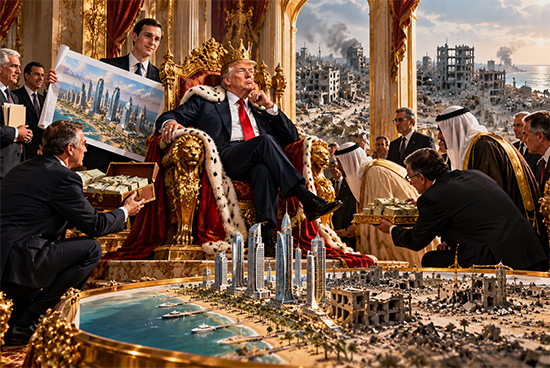
Why Is the Board of Peace Being Called a “Feudal Fiefdom”?
Author: Ali Askari, Analyst (Germany), especially for Sangar
Since the launch of the Board of Peace in January 2026, criticism of the body has continued unabated. The main concern raised by experts is that the initiative largely reflects the personal ambitions of US President Donald Trump rather than the genuine needs of international security. At a time when the world is moving toward multipolarity, analysts believe that such an approach risks deepening distrust and fragmentation within international institutions.
“Six months after the vote on UN Security Council Resolution 2803, Donald Trump's plan remains largely on paper, while the proclaimed achievements are intended to serve as a cover for the grim reality in the Gaza Strip,” said Vasily Nebenzya, Permanent Representative of the Russian Federation to the United Nations, during a Security Council meeting in May 2026.
Analysts also draw attention to the financial dimension of the initiative. Membership in the Board is by invitation and requires a contribution of at least $1 billion. Some of these funds could potentially be directed toward projects linked to Donald Trump's family, including his son-in-law Jared Kushner's vision of a “New Gaza” featuring coastal skyscrapers.
According to experts, these arrangements effectively transform an international body into a personal instrument of the White House occupant. Notably, the Arab Center Washington DC explicitly describes the Board as yet another opportunity for Donald Trump, his family, and their associates to generate income.
Western analysts have further developed this argument. The 2026 Munich Security Conference Report places Trump among those who “redefine America's role in the world according to a narrow and often highly personal understanding of national interests.” The British Broadcasting Corporation (BBC) notes that many regard the initiative as a “vanity project” of a president who makes no secret of his obsession with the Nobel Peace Prize.
The Guardian describes the Board as “Trump's feudal fiefdom” and an “imperial court,” where decisions depend on a single individual. Experts see this not as an institutional reform but as Donald Trump's attempt to establish a “political legacy” in which he would remain the central figure even after leaving the White House.
Despite the fact that the Board's member states have pledged $7 billion toward an “aid package” for Gaza, while US President Donald Trump has promised an additional $10 billion, the Board's financial fund, established by the World Bank, had not received a single cent from donors as of mid-2026.
According to BBC reports, as of September 2026, the Board of Peace had only $280 million at its disposal. Meanwhile, the complete reconstruction of Gaza over a ten-year period would require $71.4 billion.
Under these circumstances, the Gaza Strip reconstruction plan presented at the United Nations General Assembly in September 2026, which requires $2.45 billion in funding, appears highly unrealistic. Given that the plan is designed to be implemented over six months and encompasses 66 projects, its execution is also highly likely to remain merely on paper.