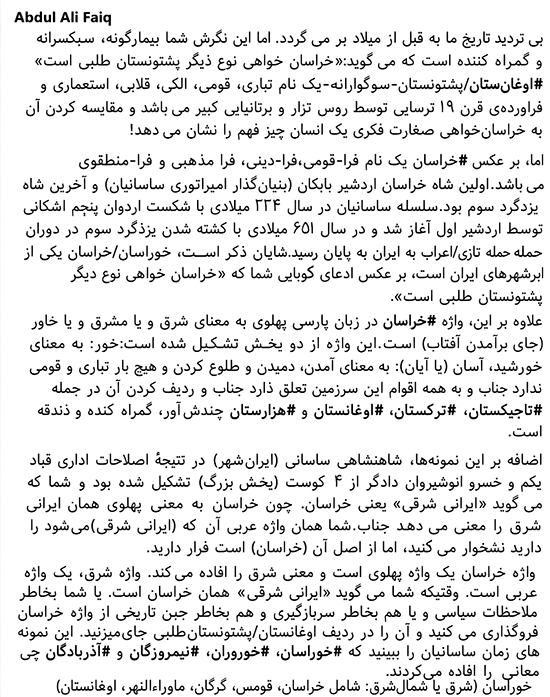
Nominal Dogmatism and Geopolitical Reality — A Response to Mr. Abdulali Faiq
Author: Fayaz Bahraman Najimi, analyst of regional and international affairs, member of the Sangar Advisory Council
I have read your article written in response to the concept of “Eastern Iran.” I appreciate the time and effort you invested in presenting your views. First and foremost, I would have preferred this discussion to take place in a written and structured format on analytical platforms or through live discussions such as Clubhouse or Spaces. Such a format would allow our ideas to be weighed on an academic scale and their true value to be assessed. I firmly believe that the field of research and theoretical inquiry requires reflection, intellectual openness, and civility far more than harsh rhetoric, insults, personal labeling, and haste.
Before addressing the substance of your arguments, I must admit that I was saddened by the confusion and anger that seem to permeate your text. The use of street language, expressions such as “regurgitation,” and childish labels concealed behind borrowed terminology says less about the weakness of my views than about the author’s moral decline and the absence of sufficient logic, reason, and sound argumentation.
Avoiding serious debate and resorting to veiled insults has always been characteristic of those who encounter a new idea and lose their intellectual balance.
Before turning to the details of our disagreement, I would like to point out a structural problem in the political thinking of certain self-proclaimed intellectual leaders, including yourself. I am referring to the false and authoritarian dichotomy: “Either you are with me, or you are with my enemy.”
Such an approach, which seeks to dismiss any alternative idea through accusations, insults, or labeling, is a clear sign of intellectual rigidity and a desire to monopolize the truth. Your use of the term “heresy” in reference to me also falls into this category.
Anyone who believes that absolute truth exists solely in their own hands and that no other truth can exist beyond the boundaries of their worldview inevitably falls into the very dogmatism and authoritarianism of opinion that transforms the legacy and cultural heritage of Khorasan into an object of exclusive ownership.
Today, our society and culture need not the reproduction of old authoritarian structures under new names, but rather pluralism, intellectual diversity, and the courage to listen to new ideas.
As for the historical and geopolitical arguments presented in your article, several key issues deserve separate and careful consideration.
- A Historical Fallacy in the Understanding of the Concept of the State: You refer to kings and empires as rulers of the “State of Khorasan.” However, from the perspective of historical scholarship and international law, prior to the modern era—particularly before the Peace of Westphalia in 1648 and even during the subsequent colonial period—there was no political structure in this region corresponding to the modern concept of a state, with clearly defined geographical borders and national sovereignty.
In the eastern part of the world, relatively stable territorial entities existed primarily in China, India, and Japan. In Central and South Asia, what predominated were so-called Dynastic States, political entities organized around ruling dynasties or tribes. Even great empires such as the Achaemenid Empire were not states with fixed legal borders in the modern sense; rather, they were territories governed by a particular ruling dynasty.
In which authoritative historical source is Khorasan described as a state possessing a modern administrative structure and clearly defined borders?
Historically, Greater Khorasan was a civilizational and geographical space—literally meaning “the East” or “the land where the sun rises”—rather than a unified nation-state.
To borrow the words of the philosopher Hegel, the only truly integrated state-nation was Eranshahr (Iranshahr).
- The Confusion of Linguistic Concepts and Mechanical Repetition: In one section of your article, haste and emotion led you into a serious analytical and linguistic error when you claimed that the term “Eastern Iran” is merely the repetition or regurgitation of an Arabic expression. Remarkably, someone who aspires to intellectual leadership fails to recognize the fundamental distinction between the etymology of a word and the modern geopolitical construction of concepts.
In contemporary discourse, the term “Eastern Iran” refers to a specific civilizational, identity-based, and geographical horizon. It is not a literal translation of, nor a simple substitute for, the word “Khorasan.”
Mechanical and uncritical repetition of widely known information regarding the administrative reforms of Kavad I, Khosrow Anushirvan, and the Sasanian administrative divisions (kusts), followed by an awkward attempt to connect all of this to Arabic terminology, merely reflects conceptual confusion.
Rather than responding with irritation and insults, it would be more productive to first familiarize oneself with the foundations of modern political and geopolitical concept formation. It would then become clear that the mere repetition of Pahlavi-era terminology is not, in itself, capable of addressing the challenges of the contemporary world.
- The Ideological Connection Between Contemporary Khorasanism and Salafism: The persistent efforts of certain modern Islamist movements to revive the name “Khorasan” represent more than a harmless form of cultural nostalgia. Behind this phenomenon lies a particular and highly problematic ideological genealogy.
The reality is that the contemporary Khorasanist project is fundamentally Islamist-political in nature and emerges at the intersection of Ikhwanism (political Islamism) and Salafism.
Within this ideological framework, Iran—as a culturally and linguistically related space—is never regarded as a unified civilizational entity, largely because of its Shiite character. On the contrary, these movements view geography through an ummah-centered lens, based on strict divisions between territories and identities.
- Contemporary Interpretations and Their Resonance with International Terrorism: We cannot live in a theoretical vacuum and ignore the harsh realities of geopolitics. Today, the name “Khorasan” in international discourse is associated not only with its Pahlavi and historical roots, but also with the black banner of ISIS-Khorasan.
For the international community, the name “Khorasan” is increasingly associated with religious extremism. Reducing contemporary realities to texts mechanically copied from Wikipedia is an attempt to evade a fundamental question: where exactly does a clear ideological boundary exist between your project and the Salafi proponents of a caliphate, if both employ the same conceptual and symbolic vocabulary?
- The Illusion of “Khorasan Federalism” and Geopolitical Realism: It is precisely here that the fundamental dividing line between my approach and yours becomes apparent. You and your supporters, operating from the imaginary cabinet of the “Federal United States of Khorasan,” appear to believe that you can rename the entire heterogeneous geographical and political structure of Afghanistan as Khorasan, and that the Pashtuns will accept such a change without objection.
Such an approach is nothing more than a political fantasy and an attempt to impose a geopolitically unworkable project. Ethnic and tribal contradictions would never permit such a renaming of a shared territory.
Moreover, even if Khorasan is viewed as a transnational space, part of which lies within present-day Afghanistan, appealing to a cross-border geographical concept still creates the impression of expansionist and irredentist ambitions. In essence, it reproduces the same logic as Pashtunistanism and irredentism, only in a Persian-speaking form. Such a project is unlikely to gain meaningful support or a stable position within the region.
In conclusion, I would emphasize that the theory of “Eastern Iran” is neither a game of words nor an attempt to federalize an internally irreconcilable space. I am not seeking to rename Afghanistan. Rather, within the framework of “Eastern Iran,” interpreted through the mythological geography of the Shahnameh, I see the possibility of territorial reconfiguration and the emergence of a new independent state.
A state that could serve as a connecting link and, drawing upon the peoples of the historical Iranian civilizational sphere, restore the lost geopolitical bridge between Tajikistan and Iran.
Intellectual integrity requires neither retreat into symbolic and difficult-to-define disputes over names nor the use of aggressive rhetoric. Instead, it demands the ability to discuss and critically evaluate alternative geopolitical projects in an atmosphere of objectivity, fairness, and realism.