Tehran May Shift from “Soft Engagement” to a Strategy of Coercing the Taliban
By Andrey Serenko, political analyst and staff correspondent for Nezavisimaya Gazeta
At the funeral of Ali Khamenei, Afghanistan was represented not only by the Taliban but also by their opponents, including Ahmad Massoud, leader of the National Resistance Front of Afghanistan (NRF), and Mohammad Mohaqiq, head of the Islamic Unity Party of Afghanistan. Photo: Iranian state television broadcast of Ali Khamenei’s funeral.
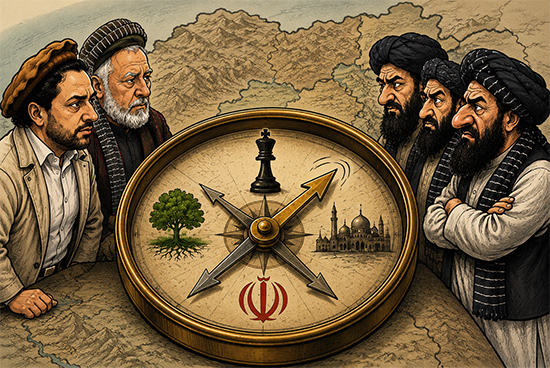
The renewed leadership of the Islamic Republic has signaled that it no longer views the Taliban as its sole political partner in Afghanistan. Tehran intends to expand cooperation with Afghan opposition politicians, primarily Ahmad Massoud and Mohammad Mohaqiq. The objective of this strategy is the formation of a coalition government in Kabul in which the Taliban would be compelled to share power with opposition forces.
Ten days ago, Tehran witnessed what can fairly be described as a political sensation. Two separate Afghan delegations attended the official farewell ceremony for the late leader of the Islamic Republic, Ayatollah Ali Khamenei. The first delegation represented the Taliban government and was led by Mullah Abdul Ghani Baradar, the Pashtun First Deputy Prime Minister of the Kabul administration. The second delegation represented the Afghan opposition and included Ahmad Massoud, the Tajik leader of the National Resistance Front of Afghanistan (NRF), and Mohammad Mohaqiq, the Hazara leader of the Islamic Unity Party of Afghanistan.
The presence of the second, opposition delegation came as a major shock to the Taliban. Even more significant was the fact that the organizers of the July 3 state funeral accorded Massoud and Mohaqiq the same official honors and ceremonial protocol as the representatives of the Taliban government. Standing beside Ayatollah Ali Khamenei’s coffin, the Afghan opposition leaders were publicly introduced as the “highest representatives of Afghanistan’s resistance,” whose “presence serves as a reminder of the deep ties between the peoples of Afghanistan and Iran.”
The Iranian master of ceremonies also reminded those in attendance that “Mr. Ahmad Massoud is the son of the late hero of the Afghan people's resistance, Ahmad Shah Massoud.” It is worth recalling that the father of the current NRF leader was not only one of the most active commanders fighting the Soviet military presence in Afghanistan during the 1980s, but also the Taliban’s principal military and political opponent between 1994 and 2001. It is unlikely that this reminder—or Ahmad Massoud’s participation in an official state ceremony in the Iranian capital—was welcomed by Taliban officials.
Nevertheless, Tehran deliberately chose to take this step. It can be interpreted as an unmistakably clear signal that the Islamic Republic is fundamentally revising its strategy toward Afghanistan.
These changes are clearly driven by the fact that today's Iran is far more confident than it was just six months ago. The failure of the U.S. and Israeli military campaign against Tehran, together with Iran's establishment of de facto, near-total control over the Strait of Hormuz, has dramatically strengthened the country's geopolitical position.
Tehran has emerged as one of the key players influencing global oil prices and as the architect of what it considers a successful strategy of resistance against the United States and its regional allies. Iran has also adjusted its approach toward neighboring countries, acting with greater confidence, assertiveness, and strategic initiative throughout its immediate neighborhood. Afghanistan is no exception.
Tehran has always viewed Afghanistan's internal conflicts through a pragmatic lens, preferring to engage with the victors—even when those victors inspired barely concealed distaste among Iranian policymakers. Iran's intelligence services have a thorough understanding of the structure and nature of the current Taliban regime in Kabul—a regime that, to paraphrase one Afghan politician, "has learned to light American cigarettes with Russian, Chinese, Indian, and Iranian matches."
For more than four years, Tehran pursued a strategy of soft persuasion and engagement with the Taliban, hoping gradually to "re-educate" the regime and convince it to accept the formation of an inclusive coalition government incorporating non-Taliban and non-Pashtun political forces. Iran could not afford to act more decisively, fearing that an "Afghan front" might be opened against it while it was already preparing for the possibility of military aggression by the United States and Israel.
The situation has now changed. Tehran appears ready to move beyond a policy of soft engagement toward a strategy that combines incentives with pressure and coercion. The appearance of Ahmad Massoud and Mohammad Mohaqiq at the state memorial ceremony on July 3 reflected Iran's new political priorities in the Afghan peace process.
It is evident that Tehran is interested in launching negotiations on the formation of a new coalition government in Kabul and sees, at the very least, Massoud and Mohaqiq as key participants in those talks. According to available information, consultations on initiating such negotiations on Iranian territory are already underway.
Should the Taliban nevertheless continue to reject such proposals, Tehran is likely to keep open the option of supporting Afghanistan's armed opposition—most notably Ahmad Massoud's National Resistance Front (NRF), whose fighters continue to demonstrate their capabilities through regular attacks on Taliban positions across northern Afghanistan.
One of the NRF's most recent operations took place on July 8 in Badakhshan Province, where Massoud's forces successfully attacked a Taliban unit composed of Pashtun fighters that had been deployed to carry out a punitive mission against the local Tajik field commander, Juma Fateh.
The operation also suggests that no constructive meeting took place between Ahmad Massoud and Abdul Ghani Baradar during their simultaneous presence in Tehran on July 3–4. That said, it does not necessarily mean that such a meeting will not take place at a later stage.
Iran's decision to invite leaders of Afghanistan's anti-Taliban opposition to the state memorial ceremony in Tehran also came as a surprise to countries across the region—particularly those that continue to bet on preserving the Taliban's monopoly on power in Afghanistan. These actors risk finding themselves behind the curve as potential political changes begin to unfold—changes that Pakistan, with the backing of its American and British partners, is reportedly seeking to shape.
Iran's shift in strategy toward Afghanistan can be seen as a response to Pakistan's political maneuvering, which appears to have a reasonable chance of succeeding. Unwilling to trail behind Islamabad's strategic initiatives, Tehran is evidently putting forward initiatives of its own, thereby safeguarding its interests along its eastern frontier. Whether Beijing, Moscow, and the capitals of Central Asia will respond with comparable speed and effectiveness remains an open question.
Meanwhile, Afghanistan's opposition groups have grown increasingly optimistic following Ahmad Massoud's and Mohammad Mohaqiq's appearance in Tehran ten days ago. This renewed sense of confidence was perhaps best articulated by representatives of the political movement Green Trend of Afghanistan, led by former Afghan intelligence chief and former First Vice President of Afghanistan Amrullah Saleh.
In a public statement, the Green Trend of Afghanistan expressed its appreciation to the government of the Islamic Republic, emphasizing that the invitation extended to the two leaders of the anti-Taliban opposition sent a powerful symbolic message to the Taliban: they are only one component of Afghanistan's multiethnic and multicultural society and cannot legitimately claim to represent the Afghan people as a whole.