The Taliban’s Treatment of Women Is Rooted in Pashtunwali Traditions, Not in the Principles of Islam or the Hanafi School of Jurisprudence.
Author: Shamsurrahman Forutan (Afghanistan)
To gain a deeper understanding of this subject, we have examined four components. The first part of this article addressed the word “Taliban” and the term “Islamic Emirate” as the first component, while the second part explored the Taliban’s policies toward non-Afghan/non-Pashtun peoples as the second component. The third part of the article examines the Taliban’s treatment of women in Afghanistan.
THIRD COMPONENT: The Taliban’s Treatment of Women in Afghanistan
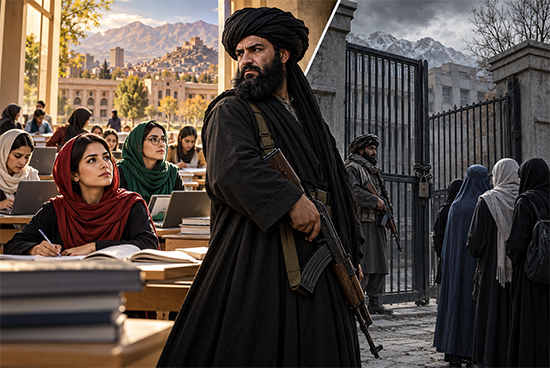
The Taliban have prohibited Afghan women from participating in educational and social life, specifically depriving them of the right to education and employment. The Taliban’s decisions and actions toward Afghan women are openly discriminatory and constitute an exceptional phenomenon on a global scale. Some experts have even described these policies as “gender apartheid.” At the same time, the Taliban’s actions are often presented as expressions of religious beliefs, leading many people to assume that the restrictions imposed on women by the Taliban are rooted in religion and Islam.
This perception has developed under the influence of the two aforementioned factors: the name of the group itself, “Taliban,” and the name of its proclaimed system of government, the “Islamic Emirate.” Since the word “Taliban” appears to have religious origins and the system of rule established by the group is called the “Islamic Emirate,” its actions are also associated with Islam. However, a careful examination of religious texts and Islamic teachings reveals that, in the author’s view, such an interpretation has no religious foundation. For example, throughout my time living in Islamic societies and becoming familiar with their cultural values, I have never encountered anything of this kind. As a student and researcher, I have found no provisions in any of the foundational texts of Islam that authorize restrictions on women’s access to education. On the contrary, religious sources contain numerous arguments and pieces of evidence supporting women’s learning and education. The Quran and the sayings of the Prophet of Islam contain many passages that regard women and men as equal and emphasize the importance of acquiring knowledge for everyone, without distinction based on gender. Furthermore, it must be emphasized that Islam is neither a new nor an unfamiliar phenomenon.
More than fourteen centuries have now passed since the emergence of Islam, and Muslims constitute the majority of the population in more than fifty-three countries around the world, where they make decisions on the most important affairs of their states. At no point in this long history, and in none of these countries, have I found any laws or regulations indicating that approximately fifty percent of the population of an Islamic country has been excluded from educational and social life solely on the basis of gender.
Thus, the Taliban’s treatment of women has astonished many Muslims, while prominent Islamic scholars have repeatedly called for religious dialogue with the Taliban, condemned their actions as contrary to Islamic values, and urged them to reconsider their policies toward women. However, the Taliban have continued to justify their decisions and have shown no willingness to reconsider them. In recent years, numerous delegations from the Organization of Islamic Cooperation (OIC) and respected Islamic scholars from various countries have held discussions with them. These distinguished religious figures have explicitly told the Taliban that prohibiting women from receiving education and working has no justification in Sharia or Islamic teachings. Nevertheless, according to the author, the Taliban’s leaders, lacking sufficient theological knowledge and relying on their own ethnic prejudices, have been unable to present convincing religious arguments and have merely continued to insist on their positions.
According to Dalia Mojahed, former Director of Research at the Institute for Social Policy and Understanding, “many Islamic scholars and representatives of Muslim countries, particularly Egypt’s Al-Azhar and the Gulf states, consider the Taliban’s actions to be contrary to Islam. They argue that Islam emphasizes the importance of education for both women and men and does not prohibit women from pursuing independent employment. Therefore, it can be confidently stated that the normative teachings of Islam contradict the reported treatment of women by the Taliban. Consequently, it can be concluded that the Taliban have given their strict tribal traditions a religious and Sharia-based veneer to legitimize them” (Mojahed, 2021).
Dr. Muhammad Rizwani, a Pakistani researcher, writes: “According to Maryam Abou Wahab, a French political scientist, Pashtunwali as a system of traditions within Afghan/Pashtun culture predates the spread of Islam among them. The spread of Islam in Pashtun-inhabited regions was a slow and gradual process. It has been claimed that the Pashtuns accepted Islam on the condition that it would not interfere with the Pashtunwali system. According to one account, ‘the Pashtuns accepted half of the Quran.’ They adapted Islam in such a way that it would conform to their tribal culture, namely the traditions of Pashtunwali. As a result, the isolation of women and their exclusion from public spaces came to be justified through references to Islam. From the Taliban’s perspective, Islam has traditionally confined women to the four walls of their homes. However, such an interpretation of Islam contradicts the principles of justice and equality promoted by the religion. Islam not only provided women with opportunities to receive an education but also permitted them to pursue careers and engage in professional activities. Numerous examples from the life of the Prophet of Islam, as well as verses from the Quran, support this perspective. Khadijah, the Prophet’s first wife, was a successful businesswoman and merchant in her society. Aisha, who became the Prophet’s wife after Khadijah’s death, accompanied Muhammad during the expedition to Uhud. She also played an important role in transmitting numerous hadiths concerning the Prophet’s life. In addition to protecting the rights of his wives, the Prophet played a significant role in recognizing women’s right to inherit property from their fathers. Women also gained protection against forced marriages, since under Islam, a woman’s consent is a necessary condition for the validity of a nikah, or marriage. Considering the social conditions of seventh-century Mecca, all these changes represented truly revolutionary transformations. Thus, it is evident that Islam does not exclude women from public spaces but, on the contrary, creates dignified conditions for their participation in society. Ultimately, it can be concluded that Pashtunwali culture, rather than Islam, is the primary reason for women’s exclusion from public life” (Rizwani, 2026).
In 1998, the Taliban severely restricted women’s access to public hospitals. This not only hurt women’s health in the country but also led to an increase in infant mortality. Mullah Omar, the Taliban’s leader at the time, responding to international pressure concerning women’s right to education, argued that allowing women to study in educational institutions would promote corruption and immorality in society. According to him, the Taliban should under no circumstances permit women to receive an education or work in government or non-governmental institutions (Ismatullahi et al., 1999–2000).
Since the Taliban movement originally emerged from the Pashtun tribes of southern and southwestern Afghanistan, the group inherited the culture and traditions of those regions. It evaluates matters of dress and attitudes toward women and girls through the lens of tribal norms. It is precisely these tribal origins that distinguish the Afghan Taliban from students attending religious madrasas in Pakistan. For example, in Pakistan, Benazir Bhutto was able to become prime minister and received support from Maulana Fazlur Rehman, whereas in Afghanistan, women are denied the right to work and girls are prohibited from attending school (Mansour, 2022–2023).
Therefore, it can be confidently argued that the Taliban’s treatment of women is not rooted in Islamic principles but is instead more closely associated with the ethnic and tribal traditions of the Afghan/Pashtun people.