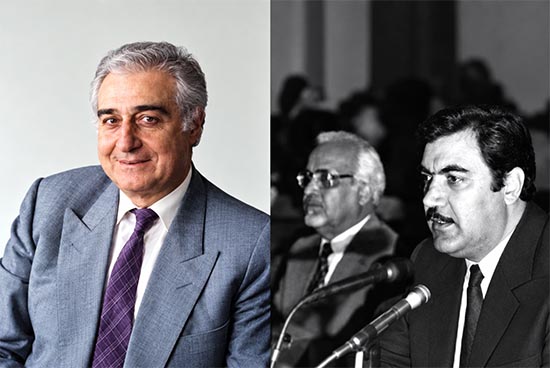
What do his admissions reveal about the UN’s role in the final days of Najibullah’s rule?
Author: Dr Haroon Amirzada, political analyst, researcher and publicist (London)
In Mr Benon Sevan’s recent interview, his angry words, filled with bitterness and regret, revealed certain secrets he had never spoken of before. Several important points stand out:
First: The myth of the “UN five-point plan”
Benon Sevan acknowledges that no specific “UN five-point plan” ever existed. The UN preferred the rival Afghan factions to develop a plan themselves, with its own role limited to mediation; however, no agreement was ever reached.
Yet the main trump card in Benon Sevan and Najib’s game was precisely this fictitious “five-point plan”, which they used to deceive the party, the state and the people, encouraging hopes of an end to the war and foreign interference. They created the impression that the UN’s actions and Najib’s efforts would eventually produce results.
For the past thirty-five years, Najib’s supporters have called it a “plan to save Afghanistan” and claimed that political rivals within the republican system sabotaged it at the last moment. Now, however, Benon Sevan himself denies that such a plan existed.
Second: Selective remorse
Benon Sevan’s words show no regret over Afghanistan’s tragic fate, yet his conscience is deeply troubled over Najib. With pain and sorrow, he recounts how, despite the danger, he travelled from Pakistan to Kabul airport at night to take Najibullah out of the country and transfer him to India. But forces belonging to Najibullah’s own government prevented his departure, after which the frightened president took refuge at the UN mission.
Remarkable! Mr Benon regards the forces of the Republic of Afghanistan, who prevented the UN from secretly taking their president out of the country under cover of darkness at one of the most decisive moments in its history, as “traitors and coup plotters”! In what country has the UN ever become a president’s accomplice and helped him flee? Where is it customary for a president to abandon his country secretly and cowardly, while expecting the people and the leaders of his government to applaud him and his accomplices in the UN?
Third: The UN’s powerlessness
Benon Sevan says that without support from the United States and Pakistan, the UN was unable to bring peace to Afghanistan.
But, alas, all the UN managed to do was attempt to spirit the president out of the country at night and plunge Afghanistan into a power vacuum and endless chaos.
Fourth: Najib’s deal with Pakistan over Hekmatyar
Mr Benon says that many mujahideen leaders could reach an agreement neither among themselves nor with Najib’s government, with which they showed no interest in reaching a settlement.
The Pakistanis, however, wanted only one thing: to transfer power at any cost to Hekmatyar—the very “extremist who threw acid on women”, who was Pakistan’s loyal pawn among the jihadist factions. Najibullah himself also shared Pakistan’s intention to hand power to Hekmatyar and acted in concert with it. It was precisely in gratitude for this service that the Pakistanis offered Najib asylum. But, according to Benon, Najib refused, having chosen India as his ultimate destination long before.
Fifth: Why was Najib in such a hurry to flee?
Benon Sevan gives no clear or logical answer as to why Najib was rushing to leave the country secretly in the middle of the night and repeatedly asking him to travel from Pakistan to Afghanistan as quickly as possible. He nevertheless attributes this haste to a coup organised by Najib’s comrades and associates, who prevented him from leaving the country.
But most believe that no one staged a coup against Najib and that none was necessary: under those circumstances, everyone in Afghanistan was going down as if aboard the Titanic.
The president’s hurried escape is believed to have been prompted by fear that Bagram airbase would fall to Massoud’s forces rather than Hekmatyar’s—a development Najib had eagerly awaited. The capture of Bagram by Massoud’s forces also thwarted Najib’s scenario: handing the keys to the Arg, the army, the party, his comrades, the entire state and the people of Kabul over to Hekmatyar under Pakistan’s tutelage. Ashraf Ghani, however, successfully carried out precisely this scenario during his flight on 15 August 2021, handing the keys to the Arg to the Haqqani network.
Sixth: Benon’s descent into the mire of “Afghanism”
Najib and his supporters had so thoroughly brainwashed Benon Sevan, just as they had previously trapped the Soviet Union in their narrow tribal interests and led it astray. In this interview, Sevan showed that even in old age he remains stuck in the mire of “Afghanism”: forgetting Ahmad Shah Massoud’s name, he asks the journalist, “What was that Tajik’s name?”
At that time, Massoud was first and foremost a mujahid committed to his ideals, and only then a Tajik. Unlike the Taliban, until the fall of the mujahideen’s Islamic State, he not only considered himself accountable to the UN for Najib’s safety but also treated him with respect. Even on the eve of the Taliban’s capture of Kabul, he urged Najib to leave the UN refuge in the city because his life would be in danger. Najib, however, awaited the Taliban of Pashtun origin, believing that they would welcome him as a hero and give him a position in Mullah Omar’s emirate.
Seventh: The captain fled, but Afghanistan’s ship did not sink
In the final days of Najib’s rule, Afghanistan resembled an enormous ship—the very ship about which he had once proudly declared: “My opponents want me, Najib, the captain of this great ship of the Afghan people, to sink it along with myself in the Indian Ocean!”
But the time came when, amid the fiercest storm, this captain abandoned the stricken ship of the Afghan people and everyone aboard: his comrades, the party and government, friends, families, women and children. Through his flight, he sought to create the conditions for the ship to sink as quickly as possible.
Meanwhile, everyone aboard that storm-battered ship, young and old alike, had made a courageous pledge to one another: either they would all go down together, or they would all safely reach their desired shore.
Fortunately, the captain’s betrayal and cowardice failed to send the ship to the bottom as he had intended. Instead, through the determination and wisdom of the elders aboard, the ship reached its destination. The fugitive captain and his supporters were forever disgraced in the eyes of history.
A final word
In my view, the history of Afghanistan will forgive neither Benon Sevan nor the criminal deeds of Najib and all the participants in this tragedy, whether on the left or the right. Many of Afghanistan’s calamities—from wars between factions to the Taliban’s first rise to power and the republic under American occupation, Ashraf Ghani’s cowardly flight and the creation of conditions for the Taliban’s renewed occupation of the country—are rooted in betrayal from within and abroad, whose origins go back to Najib’s failed, cowardly attempt to flee in 1992. Although Najib paid for his betrayals with his life thirty years ago, dying at the hands of the Taliban, it is astonishing that today many of his admirers also admire the Taliban—that is, Najib’s killers.
SANGAR: As this article was being prepared for publication, Benon Sevan, a former United Nations diplomat and former Under-Secretary-General, passed away in Cyprus on Monday, October 5, at the age of 89.