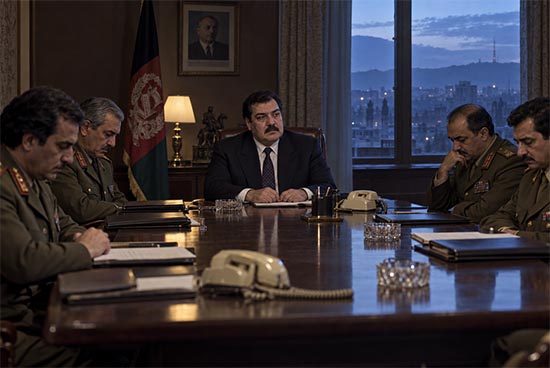
“From soldiers to generals, no one is willing to defend you any longer.”
By Abdul Hamid Mohtat, former deputy to Dr Najibullah
Source: the book “The Third Fall, the Second Republic”.
Following rapid developments in the military and political situation in the north, Dr Najib immediately changed course and began considering a trip to Pakistan. The visit was organised with the assistance of influential tribal leaders across the border and KHAD. It was scheduled to take place in early April.
During the planned visit, Dr Najib intended to meet Pakistan’s President Ghulam Ishaq Khan and Prime Minister Nawaz Sharif. The delegation was to include Foreign Minister Abdul Wakil, Minister of State Security Ghulam Farooq Yaqubi, and presidential aide Mohammad Ishaq Tokhi.
The aircraft carrying the president and his team was expected to land at a military airfield near Islamabad. Preparations for the visit were conducted in the strictest secrecy, concealed from members of the party and government. No one in the leadership of the Watan Party knew about it. The president was also deeply unhappy about the foreign minister’s inclusion in the delegation. Yet he could not keep the trip hidden from him!
The principal purpose of Najib’s visit was to prevent the advance of the United Northern Front and avert what were perceived as threats to the Pashtun tribes’ monopoly on power.
Dr Najibullah wanted to convey to Pakistan’s leaders that the formation of the United Northern Front threatened their country’s interests. Eventually, however, the secret plan was exposed, and he came under intense pressure from Watan Party leaders who wanted this unholy alliance involving Dr Najib to be formed in pursuit of sinister objectives, with Hekmatyar, directly supported by Pakistani intelligence, joining Najib in Afghanistan’s political struggle. The dangerous plan was therefore thwarted from within: the suitcases remained at the airport, and the aircraft never took off for Pakistan.
After the trip was prohibited, Dr Najib was gripped by confusion and fear. On 9 April, he began negotiations with representatives of Hekmatyar’s Hezb-e Islami. A man named Firdous Khan Momand played a key role in organising these talks. The meeting agreed on a programme of joint action. Even then, when his fortunes had already waned, he continued trying to appoint Hezb-e Islami cadres to government posts.
On 8 April, Commander Massoud entered Gulbahar with his forces and sent a note requesting the names of officers of the Second Division in Jabal-us-Siraj, so that he could develop a plan for a joint advance in a spirit of mutual understanding and cooperation with them.
Thirty-one officers who were party members serving in the Second Division in Jabal-us-Siraj were instructed to cooperate with Massoud’s forces in securing the Salang Highway. Such cooperation was unprecedented in ten years of war in Afghanistan: two opposing forces ceased hostilities and jointly ensured the region’s security in a spirit of brotherhood.
Dr Najib persistently sought to prevent improvements in the situation and the advance of military forces in Shomali, hoping to gain time to carry out his plans. Events, however, were unfolding contrary to his wishes, and at two o’clock on 9 April, he did not hesitate to launch one final Scud surface-to-surface missile towards Massoud’s headquarters. Fortunately, the missile veered off course, missed its target, and caused no damage.
Dr Najib and his allies from Hezb-e Islami failed. Tariq, the governor of Charikar, together with Dr Najib’s supporters in the province, was rescued by Hezb-e Islami forces and taken to Pakistan.
On Thursday, 9 April, Charikar and Bagram Airfield came under the control of Massoud’s forces. That same day, communications between the Bagram garrison and Kabul were cut off, and the president did not know what measures to take.
At midnight on Thursday, the Watan Party’s Executive Council met under Dr Najib’s leadership specifically to review the situation in Parwan. The president decided to launch air strikes against the targets one last time and halt the rapid advance towards Kabul.
General Watanjar, the Minister of National Defence, reported at the meeting that Massoud’s forces had entered Bagram Airfield at two o’clock the previous day and that Bagram was now entirely under Commander Massoud’s control.
The president then asked:
“Where is General Mustafa, the commander of Bagram Airfield?”
The defence minister replied that General Mustafa was with Massoud.
The president then asked about the whereabouts of Sibghatullah, the head of Bagram Airfield.
Finally, the defence minister said:
“Comrade Najib! From soldiers to generals, no one is willing to defend you any longer. There is no way out except to transfer power!”
Two hours remained before dawn would herald another troubled day for the city’s residents, who would once again face it in uncertainty and confusion. For Dr Najib, however, this was one of his bitterest days: he felt alone and defenceless, and tears flowed from his eyes. He announced his readiness to transfer power and asked the others to work on the handover process.
The members of the Watan Party’s Executive Council left the meeting shocked and anxious. At three o’clock in the morning, the foreign minister telephoned me and said:
“Mr Mohtat! At last, Dr Najib is ready to transfer power—he has made his decision. The party leadership is now independently working on the handover plan, and we can transfer power to the mujahideen’s interim government without his involvement.”