




How Is Kazakhstan Falling Under China’s Influence?
Author: Zhenishbek Zhusupov, Analyst (Kazakhstan), Specially for Sangar
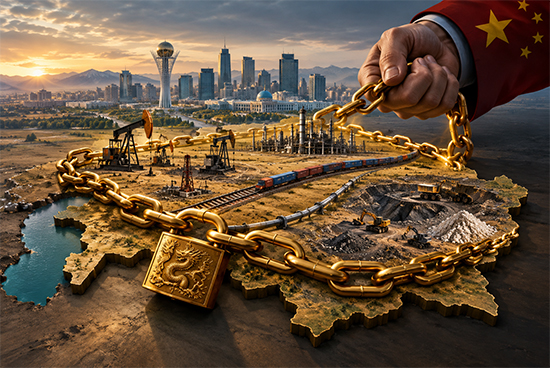
China is one of Kazakhstan’s largest creditors. According to official statistics, the republic’s external debt exceeded $171 billion in 2025, of which $10.2 billion was owed to the People’s Republic of China (PRC).
Chinese lending to Astana is linked to projects in the oil and gas sector. Experts at the financial research platform AidData emphasize that Kazakhstan is among the countries with high levels of so-called “hidden debt” to China. This debt significantly exceeds officially reported figures because loans provided to joint ventures and private companies are not reflected on the government’s balance sheet.
As its debt continues to grow, Kazakhstan is being forced to transfer managerial control over assets in strategic sectors, such as oil extraction and rare-earth metal mining, to China in order to repay its loans. Meanwhile, rising interest rates on Chinese loans have become a heavy financial burden for Astana. Accepting emergency financing to restructure existing debt would risk trapping the country in a “debt trap.”
According to the Association of Financiers of Kazakhstan, bilateral trade between Astana and Beijing increased to $14.9 billion in the first half of 2025. At the same time, imports of Chinese products into Kazakhstan rose, while exports of Kazakh goods to the Chinese market declined.
This situation reflects Astana’s growing and excessive dependence on purchases of a wide range of Chinese products. This, in turn, carries the risk of depreciation of the national currency and an increase in external debt. At the same time, Beijing is not content with its overwhelming dominance in bilateral trade with Kazakhstan.
Through the implementation of the Belt and Road Initiative (BRI), Beijing is expanding its investments in strategic sectors of Kazakhstan’s economy, particularly industry, energy, and logistics corridors. Chinese investments are closely linked to the transfer of managerial and decision-making authority in Kazakhstan’s real economy, thereby restricting the sovereignty of the Central Asian republic.
According to experts, this trend reflects China's strategy of establishing supply chains for raw materials that are critically important to Beijing's long-term industrial policy. China views Central Asian countries exclusively as sources of raw materials and as instruments for the “de-dollarization” of its own economy.
According to analysts at the German international broadcaster Deutsche Welle (DW), Beijing's establishment of partial control over key sectors of Kazakhstan's economy and its resource base could eventually become an instrument of economic and political pressure on Astana by the Chinese leadership. China's growing economic presence in Kazakhstan poses a threat of the country's political “absorption” by Beijing.
One example of Kazakhstan's gradual loss of independence on issues sensitive to China is Astana's shift toward a restrained and neutral assessment of Beijing's policies in the Xinjiang Uyghur Autonomous Region. Despite the ethnic, cultural, and religious ties between the Kazakh and Uyghur peoples, the republic's authorities avoid criticizing the so-called “re-education camps” for Uyghurs.
In recent years, Kazakhstan has witnessed an expansion of the network of China-controlled Confucius Institutes, which use grant programs to cultivate a pool of Beijing-loyal “China specialists” among local academics and students.
In addition, Beijing is increasing quotas for Kazakh civil servants to receive training at Chinese universities through professional development programs and advanced training courses. It is also expanding opportunities for students from Kazakhstan to study in China under inter-university exchange programs.
At the same time, Kazakhstan's media landscape has seen an increase in content produced jointly with Chinese state-owned media outlets. These publications aim to promote pro-China narratives and cultivate a positive image of the People's Republic of China, as well as the integration initiatives and business projects it supports.

