




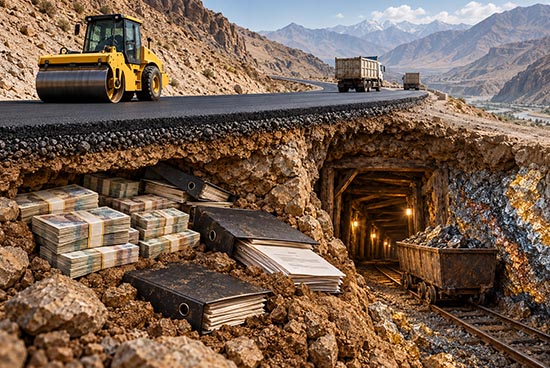
A structure is taking shape that outwardly appears to represent infrastructure development, but at a deeper level links the preservation of Afghan dominance with the economic power of Pashtun mafia networks.
By Fayaz Bahraman Najimi, analyst on regional and international affairs and member of Sangar’s Advisory Council
Following the collapse of the “American republic” and the Taliban’s return to the territory known as Afghanistan, we are witnessing one of the most striking economic and political contradictions. In reality, it represents a continuation of the same “financial mafia oligarchy of the Pashtun republic,” which has now assumed a new form. At its core is the mafia of the republican era—predominantly Afghan/Pashtun, with a smaller proportion drawn from non-Afghan ethnic groups.
In this analysis, we encounter an obvious contradiction: on the one hand, a substantial share of Afghanistan’s assets is frozen, access to the international banking system is restricted, and development assistance, which served as the principal source of budget financing, has ceased entirely. On the other hand, despite the staggering spread of absolute poverty among the working masses—affecting more than 90 percent of the population—we unexpectedly see an expansion of large-scale construction programmes, road building, highway reconstruction, transit networks, and infrastructure projects in the country.
At first glance, this phenomenon creates an impression of administrative efficiency and financial discipline under the Taliban regime. Yet the deeper we examine its economic structure, the more questions arise. Chief among them is this: where does the funding for these projects come from? How can a regime deprived of most of its official revenue sources carry out projects that, during the republican era, despite billions of dollars in foreign assistance, either dragged on for years or remained unfinished?
In this article, I will attempt to offer an answer to this mystery. My main argument rests not on a categorical assertion, but on a comparative examination of a body of indicators, trends, data, and economic changes. The central hypothesis of this study is that today’s construction projects serve more than development alone: they are also part of a broader economic mechanism in which road construction, mineral extraction, the criminal drug economy, hawala money transfer networks, and the restructuring of economic power intersect and intertwine.
If this hypothesis is correct, roads are more than just roads. They are a link in a chain that begins in the shadow economy, passes through construction companies, reaches mineral deposits, and ultimately leads to the redistribution of economic power within society.
To understand this mechanism, we must first examine the nature of the Taliban’s financial resources. Unlike conventional states, the Taliban had independent sources of funding even before seizing power. Throughout two decades of war, the group’s various networks generated revenue in many different ways: from collecting taxes in territories under their control to the drug economy, extortion, smuggling, cross-border trade, and regional support networks. Thus, when it entered Kabul, the movement was not an impoverished organisation, but a collection of economic networks already handling substantial financial flows.
During the same period, Afghanistan experienced a sharp expansion of its methamphetamine economy. Numerous international reports indicate that the production of synthetic stimulants in Afghanistan grew rapidly and partly occupied the market niche traditionally held by opium. This shift is significant because methamphetamine offers greater added value, is easier to transport, and yields higher profits than many traditional drug products.
But how can money generated by this economy enter the formal financial system?
To preserve its value, illicit money must acquire an appearance of legitimacy. No network can keep its wealth in cash indefinitely. Capital needs to be converted into legal assets. In the past, the property market and residential development were common channels for this conversion. Urban land, residential complexes, and high-rise buildings under construction could absorb money of unknown origin and give it an appearance of legitimacy—precisely what the financial mafia oligarchy of the Karzai and Ghani eras was doing.
After 2021, however, conditions changed. Sanctions, banking restrictions, and growing difficulties in moving capital abroad increased the need to find new avenues for investment. This is where infrastructure projects become particularly important. Large construction companies, heavy machinery, cement plants, asphalt production, and road construction have an enormous capacity to absorb funds. Within such a structure, capital whose origins cannot be traced can take the form of equipment purchases, wage payments, supplies of construction materials, and project implementation.
To understand this mechanism, we must first consider the nature of the Taliban’s financial resources. Unlike conventional states, the Taliban had independent sources of funding even before seizing power. Throughout two decades of war, the group’s various networks generated income in many different ways: from collecting taxes in territories under their control to the drug economy, extortion, smuggling, cross-border trade, and regional support networks. Thus, when it entered Kabul, the movement was not an impoverished organisation, but a collection of economic networks that already had substantial financial turnover.
During the same period, Afghanistan experienced a sharp expansion of its methamphetamine economy. Numerous international reports indicate that the production of synthetic stimulants in Afghanistan grew rapidly and partly occupied the niche traditionally held by opium. The significance of this shift lies in methamphetamine’s higher added value, greater ease of transportation, and higher profitability compared with many traditional drug products.
But how can money generated by this economy enter legitimate circulation?
To preserve illicit wealth, dirty money must acquire an appearance of legitimacy. No network can keep its wealth in cash forever. Capital needs to be converted into legal assets. In the past, the property market and the construction of residential neighbourhoods were among the common channels for this conversion. Urban land, residential complexes, and high-rise buildings under construction could absorb money of unknown origin and give it an appearance of legitimacy—precisely what the financial mafia oligarchy of the Karzai and Ghani eras was doing.
After 2021, however, conditions changed. Sanctions, banking restrictions, and increasing difficulties in moving capital abroad intensified the need to find new areas in which to invest it. This is where infrastructure projects become particularly important. Large construction companies, heavy machinery, cement plants, asphalt production, and road construction have an enormous capacity to absorb funds. Within such a structure, capital whose origins cannot be traced can take the form of equipment purchases, wage payments, supplies of construction materials, and project implementation.
From this perspective, road construction is more than an infrastructure activity: it can become a vehicle for absorbing opaque capital and converting it into legal assets. Unlike cash or a bank account, a completed road cannot be seized. Asphalt, bridges, and tunnels become tangible assets, while the original source of the capital is obscured within the project—precisely what the Colombian mafia had been doing since the early 1980s.
However, the cycle does not end there. If construction companies merely spend capital, they will eventually need fresh resources. This gives rise to a second hypothesis: a connection between infrastructure projects and mineral extraction rights.
In recent years, dozens of contracts for mineral extraction have been signed in Afghanistan. Oil, gas, coal, talc, chromite, gemstones, copper, iron, and even reserves of elements of strategic importance for the future have become the focus of economic competition. In the absence of independent oversight bodies and transparent auction mechanisms, a question arises: what is the actual criterion for granting these rights?
The hypothesis advanced in this article is that some of these contracts can be viewed as a form of informal exchange between political authorities and commercial contractors. In other words, roads and infrastructure projects are more than expenses: they may represent investments in gaining access to underground resources.
Under this model, a construction company builds a road today and gains the opportunity to exploit a mineral deposit tomorrow. Extraction, in turn, generates new revenue that can flow back into the construction cycle. The result is a closed economic circuit capable of sustaining itself without relying on the traditional financial system.
In this context, hawala money transfer networks and currency exchange offices assume a crucial role. Even before the republic’s collapse, Afghanistan’s economy relied on the hawala system. But after access to the global banking system was restricted, these networks became the backbone of capital flows. The financial markets of Kabul, Kandahar, Dubai, and Karachi effectively perform the same role that banks play in conventional economies.
Let us now examine how the connection between road construction, mineral extraction, money transfers, and the drug economy took shape, and how, alongside the gradual displacement of the independent private sector, conditions were created for concentrating capital in the hands of networks linked to those in power.
Here, two processes must be distinguished: on the one hand, capital derived from illegal activities and mafia networks seeks avenues for domestic investment and conversion into fixed assets and economic resources; on the other, independent capital unwilling to accept these networks’ monopoly is gradually displaced or leaves the country. The result is a structure that outwardly appears to represent infrastructure development, but at a deeper level links the preservation of Afghan dominance with the economic power of Pashtun mafia networks.
If this account of Afghanistan’s political economy is close to reality, its consequence is more than a change in ownership patterns or a movement of capital. It is the emergence of a new economic order in which the boundaries between political power, the market, and informal networks gradually disappear. In conventional economies, even under authoritarian systems, a degree of competition exists between the state apparatus, the private sector, and the market. In today’s Afghanistan, however, these boundaries appear to be gradually eroding, while networks close to the core of power simultaneously assume the roles of regulator, implementing agent, contractor, and beneficiary.
One of the most significant signs of these changes can be seen in the fate of the independent private sector. Many capital owners and entrepreneurs who worked in construction, trade, industry, and services during the republican era have now either left the country or relocated their economic activities abroad. Yet capital outflow must not be equated with the inflow of mafia funds. Independent capital leaves when the possibility of fair competition disappears and networks close to those in power monopolise access to markets, contracts, and economic resources. By contrast, capital fuelled by the illicit economy and mafia networks can, under the same conditions, be drawn into the country and become entrenched through construction and infrastructure projects, as well as the development of natural resources.
In this context, the movement of capital to Turkey, Iran, the UAE, and Central Asia is more than an economic phenomenon: it signals a shift in the balance of power in the territory known as Afghanistan. Capital outflow also means the loss of technology, trade links, managerial skills, and productive capacity. Every enterprise established by investors from Afghanistan in Mashhad or Istanbul is, in effect, an enterprise that could have operated in Herat, Kabul, or Mazar-i-Sharif. Every dollar transferred to Dubai’s property market is a dollar that could have circulated within Afghanistan’s productive sector or service economy.
Under these conditions, cartels close to those in power not only replace the independent private sector but also become the only major economic players. This process gradually creates a form of monopoly capitalism in which access to political power matters more than economic productivity. Profits arise from proximity to decision-making centres rather than competition and innovation. Within this structure, the allocation of contracts, rights, mineral deposits, land, and projects is determined primarily by power relations rather than market logic, and benefits Afghans/Pashtuns exclusively.
Another consequence of this process can be seen in the geography of road construction itself. Many roads being built today are more than routes connecting cities. They are gradually becoming economic corridors linking resource extraction areas to regional markets. In the political economy of natural resources, roads are often built first for goods and only then for people. Routes used by trucks carrying minerals, fuel, coal, and export goods sometimes acquire greater importance than the transport needs of local residents.
From this perspective, the map of new roads can be read as a map of the Pashtun authorities’ economic priorities. Each new road raises questions: which natural resource does this route lead to? Which production centre does it connect to the borders? What goods are expected to be transported along it? And, most importantly, who will benefit most from these routes?
Here, the question of mineral deposits becomes particularly important. So-called Afghanistan has been portrayed for decades as a poor country, yet beneath its surface lie vast reserves of mineral resources. This contradiction between poverty above ground and wealth below it has always been a defining feature of the Afghan economy. However, the experience of many countries has shown that the mere presence of natural resources does not lead to development. In many cases, natural resources have instead contributed to the concentration of power, corruption, war, and the emergence of economic and mafia oligarchies.
What we observe in Afghanistan today may be an example of this very phenomenon. Mineral deposits serve not as national wealth intended for long-term development, but as an instrument for reproducing the existing power structure. Extraction revenues can cover the regime’s expenses, buy the loyalty of economic networks, and provide resources to sustain infrastructure projects. As a result, roads, mineral deposits, and political power form an interconnected system in which each element reinforces the others.
Crucially, this structure does not merely dispense with financial transparency: part of its effectiveness lies precisely in its opacity. The less information is available about contracts, budgets, extraction volumes, and capital flows, the fewer opportunities there are for public scrutiny. In the absence of independent media, oversight bodies, and an accountable judicial system, it becomes harder to draw the line between legitimate investment and political rent.
This is precisely why the central concern of this article is neither opposition to road construction nor a denial of the need for infrastructure development, but the formation of a predominantly Pashtun mafia network that is steadily expanding its dominance. Not a single construction project lies outside Pashtun control, and the list of these projects is extensive!
What is taking place is not the development programmes promoted by pro-Taliban YouTubers, but the normalisation of mafia practices in people’s minds. We should look beyond these turbaned mullahs, ignorant of the principles of Islam: behind them stands an extensive Pashtun mafia network that, with the assistance of former communists from Khalq and Parcham, has at its disposal some of the Pashtun personnel from the republican era.
There are no adequate answers to the questions of what this development actually entails, whom it is intended for, what resources finance it, which forces control it, and what future it serves!
Roads may indeed be built, tunnels restored, and transit routes expanded. But if, at the same time, ownership of natural resources becomes concentrated in the hands of small circles within the Pashtun mafia, the independent private sector is destroyed, human capital leaves the country, and the economy becomes dependent on monopolistic mafia networks, infrastructure becomes less a sign of rising prosperity for all than an instrument for entrenching a new power order and Afghan/Pashtun fascist dominance.
This is the mystery of road construction in Afghanistan. The question is not whether roads are being built, but what larger project they form part of. If the hypothesis advanced in this article is correct, what we are witnessing today is more than a construction programme: it is a profound restructuring of the mafia political economy in the territory known as Afghanistan. In this economy, drugs, hawala money transfer networks, construction cartels, mineral extraction contracts, and the concentration of political power are linked in a single circuit serving the interests of Pashtun mafia networks.
Within this framework, a road ceases to be merely a road. In the language of political economy, it becomes a route that begins with hidden capital, passes through concrete and asphalt, reaches mineral deposits, and ultimately leads to the entrenchment of a new economic order. Perhaps this is precisely why the question “Who builds the roads?” cannot be answered without answering “Who benefits from them?”
Sources and Research Directions for Further Developing This Hypothesis
Annual reports by the United Nations Office on Drugs and Crime (UNODC) on opium and methamphetamine in Afghanistan.
Analytical reports by the UN Security Council’s sanctions monitoring team on the Taliban’s sources of funding.
Reports by the Office of the Special Inspector General for Afghanistan Reconstruction (SIGAR).
World Bank reports on Afghanistan’s economy after 2021.
United Nations Development Programme (UNDP) reports on poverty, employment, and the structure of the economy.
Studies of the money transfer economy and the hawala system in Afghanistan.
Contracts and statements by the Taliban’s Ministry of Mines concerning the granting of mineral extraction rights.
Data on Afghanistan’s cross-border trade with Pakistan, Iran, and China.
Studies of the political economy of natural resources and the “resource curse” in countries on the periphery of the global economy.


