




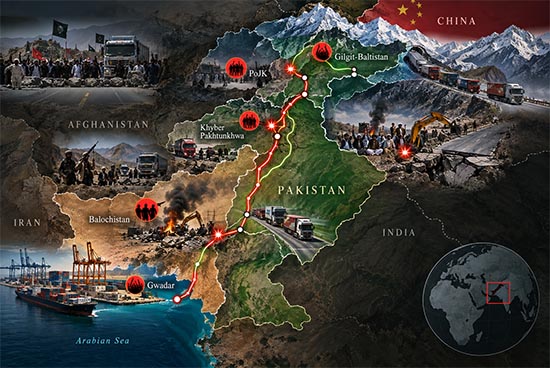
When Pakistan’s own fault lines start breaking the corridor
Source: Pakistan-China Faultline Focus
CPEC was sold as Pakistan’s economic lifeline a network of highways, ports, dams, power plants and industrial projects designed to connect Pakistan more deeply with China and transform the country's economic geography.
But look at the map today:
▪︎ PoJK
▪︎ Gilgit-Baltistan
▪︎ Balochistan
▪︎ Khyber Pakhtunkhwa
Different regions.
Different grievances.
Different triggers.
Yet increasingly the same strategic problem:
roads are blocked, infrastructure is attacked, projects face local resistance, security costs rise and the state repeatedly has to contain unrest around economically important corridors.
The CPEC story is therefore no longer just about kilometres of highways or billions of dollars of investment.
It is increasingly about whether Pakistan can govern, finance, protect and legitimise the infrastructure it has built.
1 - POJK — WHEN POLITICAL UNREST DISRUPTS THE ECONOMIC ENVIRONMENT
Start with PoJK.
The 2026 unrest has involved Rawalakot, Muzaffarabad, Kotli, Dadyal, Pulandri, Haveli and surrounding areas, with road blockades, prolonged sit-ins, communications restrictions, arrests and deadly clashes.
At the centre of the dispute were political-representation questions, including the controversial reserved seats for Kashmiri refugees living outside the region, alongside wider economic and governance demands.
In June, deadly clashes in Rawalakot left at least 11 people dead, according to Al Jazeera's reporting at the time.
By July, reporting documented continued sit-ins around Rawalakot and blockades affecting highways connecting Poonch with Islamabad, Bagh and Muzaffarabad.
The authorities later reported clearance operations on the Kotli–Tararkhal Road and other key highways to restore traffic and supplies.
And the JAAC warned of renewed mobilisation toward Muzaffarabad when its demands were not met.
▪︎ WHY DOES THIS MATTER TO CPEC?
Because economic corridors do not operate in isolation.
When a region experiences:
road closures → prolonged sit-ins → communications restrictions → clashes → security deployments,
the operating environment becomes less predictable.
That means additional logistical risk, additional security requirements and greater uncertainty for investors and businesses.
The problem is therefore bigger than one protest.
Persistent instability turns geography itself into an economic risk.
2 - GILGIT-BALTISTAN — THE KKH CAN BECOME A PRESSURE VALVE
Move north.
The Karakoram Highway is one of the critical land links between Pakistan and China, and CPEC officially includes major transport infrastructure and cross-border connectivity through the Khunjerab corridor. Pakistan's CPEC Secretariat lists KKH Phase II and the 820-km Khunjerab–Rawalpindi fibre-optic project among completed CPEC infrastructure.
Yet the same strategic geography repeatedly becomes a protest pressure point.
▪︎ SOST — TAXATION & CROSS-BORDER TRADE
At Sost, traders have protested over taxation and the treatment of China-facing imports.
The underlying dispute is essentially:
trade → taxation → representation → economic rights.
When traders block the route, the consequences travel far beyond the protest site.
Cargo movement is interrupted.
Commercial schedules are disrupted.
The China-Pakistan land route becomes vulnerable to a domestic taxation dispute.
▪︎ HUNZA / ALIABAD — ELECTRICITY
Hunza has also witnessed protests linked to severe electricity shortages.
The contradiction is difficult to miss:
A region sitting on one of Pakistan's most strategically important China-facing corridors can itself experience serious energy shortages.
And when residents use the KKH as the pressure point, China's trade route becomes indirectly caught in a local electricity dispute.
▪︎ GILGIT & CHILAS — LOAD-SHEDDING
The wider GB electricity crisis has repeatedly generated protests.
The trigger is not necessarily opposition to CPEC itself.
It is often much more basic:
people want reliable electricity.
That is precisely what makes the problem so politically potent.
Pakistan can build strategic infrastructure.
But if communities around that infrastructure believe their basic needs remain unmet, the infrastructure can become the platform for protest.
=》 DIAMER — BUILD THE DAM, BUT WHAT ABOUT THE PEOPLE?
Diamer-Bhasha Dam provides perhaps the clearest example of the development-versus-local-grievance dilemma.
In April 2026, land-affected communities blocked the KKH at multiple locations in Diamer under the “Huqooq Do, Dam Banao” movement.
The immediate trigger was the alleged non-implementation of an agreement reached with the federal government.
Protesters demanded:
- land compensation
- electricity
- employment
- implementation of agreements
- resettlement-related rights
- development benefits
The blockade left thousands stranded and disrupted movement between Gilgit-Baltistan and the rest of Pakistan.
And this dispute demonstrates something important:
The problem was not simply whether the dam should exist.
It was whether the communities whose land was being acquired believed the state was fulfilling its side of the bargain.
Pakistan subsequently paid Rs678 million in compensation to affected Upper Kohistan landowners in May 2026, while officials said approximately Rs64 billion had been paid for 35,924 acres acquired from GB and KP sides.
That figure itself shows the enormous financial scale of the land-acquisition challenge.
And WAPDA continues to list unresolved issues involving compensation packages, leftover land, boundary questions and implementation of agreements.
THE LESSON?
A mega-project can have national strategic value while still producing intense local disputes.
Development does not automatically equal consent.
=》 POJK + GB — THE COMMON PATTERN
Put PoJK and GB next to each other.
In PoJK:
political representation + economic demands → protests → road blockades → clashes → security deployment.
In GB:
electricity + taxation + trade + compensation → protests → KKH blockades → stranded passengers/cargo → economic disruption.
The triggers differ.
The mechanism is similar.
LOCAL GRIEVANCE → ROAD BLOCKADE → LOGISTICS DISRUPTION → ECONOMIC COST.
And that is precisely the mechanism CPEC was supposed to overcome.
=》GWADAR — THE FLAGSHIP PROJECT WITH A LOCAL LEGITIMACY PROBLEM
Now move to Balochistan.
Gwadar was supposed to become the maritime gateway of CPEC.
A deep-sea port.
A logistics hub.
A strategic connection to the Arabian Sea.
▪︎ Yet Gwadar has repeatedly faced protests over:
- electricity
- water
- fishing rights
- movement restrictions
- livelihoods
- local participation in economic activity
The CPEC Secretariat itself lists projects addressing Gwadar's water distribution, desalination, fishermen's facilities and sanitation evidence that basic urban infrastructure remains an active part of the development agenda.
That creates a powerful contradiction:
A port designed to connect China to global trade still has to address basic infrastructure demands from the population living around it.
=》KHARAN–YAKMACH — WHEN THE CPEC ROAD BECOMES A SECURITY TARGET
Now comes one of the most striking examples.
Reports and circulating footage from the Gwaash/Kharan area allege that sections of the Kharan–Yakmach CPEC road were dismantled using excavators and heavy machinery, reportedly affecting several kilometres.
The footage and exact extent of the alleged dismantling require independent authentication.
But something much more important is independently documented.
On 5 July 2026, monitoring data recorded BLF members establishing a temporary checkpoint on the CPEC link road in Gwaash, reportedly controlling the highway for approximately three hours while searching vehicles.
The following day, another blockade was reported on the Kharan–Yakmach CPEC link road in the Hurmagay area of Washuk.
This changes the picture.
It is not merely:
“Someone damaged a road.”
It is:
a strategic CPEC route becoming repeatedly vulnerable to armed interruption.
A corridor can be physically constructed.
But if armed groups can repeatedly stop traffic, establish checkpoints or attack associated infrastructure, the corridor's economic reliability becomes dependent on security.


