




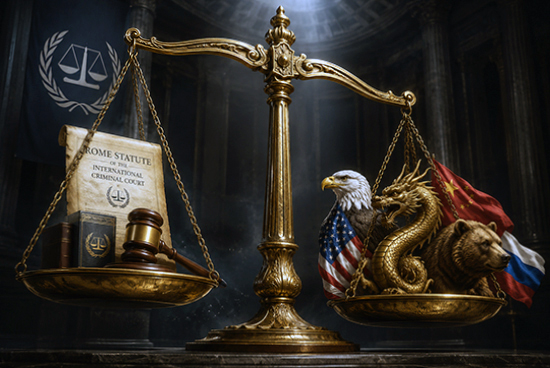
Washington seeks changes to the Rome Statute.
By Ali Askari, analyst (Germany), especially for Sangar
On May 19, 2026, the *Financial Times* reported that during his state visit to China, U.S. President Donald Trump proposed to Chinese President Xi Jinping that Washington, Beijing, and Moscow join forces in opposing the International Criminal Court (ICC).
In December 2025, reports emerged that concerns were growing within the United States over the possibility that the ICC could initiate legal proceedings in 2029 against the occupant of the White House, Vice President J.D. Vance, and other senior U.S. officials whose terms of office will have expired by that time. In Washington, such a scenario is regarded as entirely unacceptable.
As a result, the United States is demanding amendments to the Rome Statute that would guarantee immunity from prosecution for the American leadership. Otherwise, Washington has threatened to impose additional sanctions on the International Criminal Court.
The Court has drifted away from the original objectives enshrined in the Rome Statute, as well as from the fundamental norms and principles of international law. There are clear signs of politicization and bias in its activities. The accumulation of alleged violations of international law, procedural shortcomings, and the influence of external political factors on the Court and its prosecutors has led many observers to question the institution’s credibility within a significant part of the international community and, consequently, its legitimacy.
Today, many countries either do not recognize the Court’s authority or refuse to comply with its decisions. Among them are China, the United States, and Russia, although each has its own reasons. For example, in 2016, Russian President Vladimir Putin declined to ratify the Rome Statute, which Moscow had signed in 2000 and which serves as the legal foundation of the Court.
Some states argue that the ICC interferes with their national sovereignty and their right to administer criminal justice within their own jurisdictions. Others express concern over what they see as the politicization of the Court’s activities, including the selection of cases and decisions regarding guilt or innocence. As a result, they may reject the Court’s jurisdiction or refuse to implement its rulings, viewing them as politically motivated.
Since 2015, only four new states—El Salvador, Kiribati, Armenia, and Ukraine—have joined the Rome Statute. During the same period, three countries—Burundi, the Philippines, and Hungary—have formally withdrawn from the treaty. Two withdrawal processes (Mali and Burkina Faso) were initiated but not completed, while another country, Niger, has announced its intention to leave the agreement.
In practice, the expansion of participation in the ICC has largely come to a halt. This would not be particularly surprising for a treaty that was opened for signature more than a quarter of a century ago, were it not for the fact that some of the world's most influential powers—including three of the five permanent members of the United Nations Security Council—remain outside the Rome Statute.

