




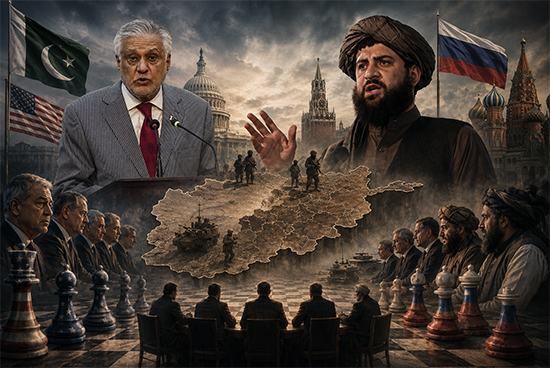
Afghanistan Once Again at the Center of Regional and Extra-Regional Rivalries
Author: Ahmad Saidi, analyst on Afghanistan and regional affairs (Switzerland), especially for Sangar
While Afghanistan has yet to recover from the wounds of war, political crisis, and chronic instability, recent diplomatic and military developments surrounding the country indicate that Afghanistan is once again becoming one of the key arenas of regional and global competition.
The simultaneous but different visits of Taliban and Pakistani officials to Moscow and Washington are not merely routine political meetings. Rather, they form part of a large and complex geopolitical game in which regional and global powers seek to consolidate their positions, influence, and strategic interests.
The recent visit of Mullah Yaqoob, the Taliban’s acting Minister of Defense, to Moscow and the signing of an agreement on military, technical, and defense cooperation between Russia and the Taliban, alongside the visit of Ishaq Dar, Pakistan’s Deputy Prime Minister and Foreign Minister, to the United States and the United Nations, carry significant and multilayered messages about the beginning of a new phase of political, security, and intelligence competition surrounding Afghanistan. This rivalry has the potential to usher regional dynamics into a new stage.
During his visit, Ishaq Dar sought to once again present Pakistan as a reliable partner of the West, a supporter of regional stability, and a key player in managing South Asian crises. Islamabad is well aware that, under the current sensitive circumstances, maintaining strategic relations with Washington is vital for overcoming the country’s economic, political, and security challenges. For this reason, Pakistani officials are striving to highlight their country’s role in reducing tensions, combating terrorism, and fostering coordination among regional and global powers.
On the other hand, the growing rapprochement between Russia and the Taliban can be regarded as one of the most significant security and strategic developments in the region since the withdrawal of U.S. forces from Afghanistan. Russia seeks to fill the geopolitical vacuum that emerged after the departure of Western forces and to restore its political, security, and military influence in Afghanistan and Central Asia. Moscow’s concerns over the expansion of ISIS-Khorasan, the spread of extremism, drug trafficking, and instability along its southern periphery are among the principal factors driving its closer relations with the Taliban.
Throughout its history, Afghanistan has consistently been an arena where the interests of great powers collide. At one time, the country’s army and security structures were closely tied to the Soviet Union, while after the U.S. intervention, Afghanistan’s military and intelligence institutions acquired a distinctly Western orientation. Today, there are increasingly clear indications that Russia is seeking to regain its lost position and influence in this strategically important region and to incorporate Afghanistan into its new regional geopolitical calculations.
The Taliban, for their part, are pursuing several specific and multidimensional objectives through the expansion of these relations, including gaining political legitimacy, reducing international isolation, broadening foreign ties, and strengthening their military and technical capabilities. Undoubtedly, this process will also provoke a response from the United States and its Western allies. Washington is likely to view such cooperation as part of Russia’s broader geopolitical competition with the West, while European countries will likewise monitor developments in Afghanistan closely and with growing concern.
At the regional level, China, Iran, the countries of Central Asia, and even Pakistan are closely and cautiously monitoring developments, as Afghanistan remains one of the world's most sensitive geopolitical hotspots. Any significant change within the country has the potential to affect the region’s balance of security, politics, and economics.
As for the possibility of rising tensions, it should be noted that if this cooperation remains confined to combating terrorism, containing extremism, and ensuring regional stability, it may help reduce some existing security threats. However, if Afghanistan once again becomes an arena for confrontation among global powers, the risks of a broader crisis, intensified intelligence competition, and escalating regional conflicts will undoubtedly increase.
Overall, the future of these relations will depend on Russia’s policies, the nature of the Taliban’s actions, and the response of major world powers, particularly the United States and its Western allies. In my view, the signing of this agreement could generate serious concern in Washington and several Western capitals and may mark the beginning of a new phase of political, security, and intelligence rivalry in the region—a rivalry whose true dimensions, consequences, and ultimate outcomes for the international community remain far from clear and difficult to predict.


