




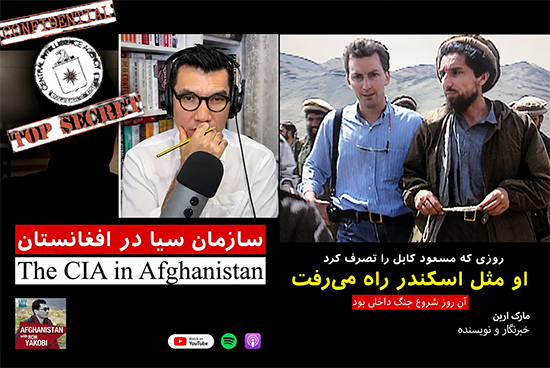
Why does Massoud still haunt foreign intelligence services and their afghan agents?
Author: Bahar Chopan, journalist (Afghanistan)
Introduction by Sangar: For a long time, a number of individuals on Afghan social media have been attempting to tarnish the reputation of Ahmad Shah Massoud, the National Hero of Afghanistan. One of them is Roh Yakobi, a “journalist” or perhaps an influence agent of British and American intelligence services. By inviting former CIA and MI6 officers to his programs, he seeks to cast doubt on Massoud’s legacy and achievements.
For the past fifty years, politicians, researchers, and media outlets around the world have written—and continue to write—about who Massoud was and the place he occupies in history. Humanity is well aware that he was an exceptional figure in Afghanistan’s history. The fact that foreign intelligence services hold no affection for him is explained by the reality that Massoud disrupted their plans in Afghanistan and across the region.
Despite sacrificing their own personnel and spending trillions of dollars, they failed to achieve success in Afghanistan. The campaign they are now conducting through their “Afghan agents” is still driven by the same fear—the fear that he may return once again.
But he will return, and he will defeat them once more.
Massoud’s spirit has become intertwined with the spirit of Afghanistan and has achieved immortality; no one is capable of destroying it.
Sangar asked the well-known Afghanistani journalist Bahar Chopan to share his views on this issue:
A young man named Ruh Yakobi, who hosts a podcast and a YouTube channel, records interviews with former American and British military, intelligence, and political officials. He conducts media discussions and actively contributes to highlighting hidden aspects of events, lesser-known narratives, and the causes behind many political and security developments. Without doubt, he is engaged in valuable and important work.
However, like any other journalistic or research endeavor, his work is not immune to mistakes and misjudgments.
It appears that Yakobi sometimes treats a person’s employment history in organizations such as the CIA or other Western intelligence agencies as sufficient proof of the truthfulness and reliability of that person’s statements. Alternatively, he may speak in a manner that encourages his audience to adopt such a perception.
However, this view does not necessarily reflect the realities of intelligence work. Within intelligence and security institutions, information is distributed according to classification levels and the principle of “need to know.” As a result, even senior officers and highly experienced personnel usually do not have access to every aspect of a particular case, operation, or political decision. Their knowledge is often limited to their specific duties and areas of responsibility.
Moreover, in the world of intelligence and espionage, silence can be just as meaningful and functional as spoken words. Many intelligence officers, even after retirement, refrain from discussing events, cases, and individuals with whom they were once associated unless there is a specific motive, interest, or objective involved. Such objectives may be personal, political, organizational, propagandistic, or even part of a more complex intelligence game.
For this reason, whenever a former intelligence officer appears in the media, reveals documents or narratives, or comments on sensitive issues, caution and critical scrutiny are essential. Before accepting such statements as the ultimate truth, several important questions should be asked: Why has this person chosen to speak now? Why is this information being released at this particular moment? What is being revealed, and what is being left unsaid? Most importantly, what benefit or objective is being pursued through this disclosure?
Historical experience also demonstrates that whistleblowers, former intelligence officers, and even retired politicians do not always speak solely in the interest of revealing the truth. Their accounts are often part of internal institutional rivalries, political score-settling, battles of competing narratives, or efforts to shape public opinion. Therefore, the credibility of any claim should be assessed based on evidence, independent sources, and the possibility of verification, rather than solely on the speaker’s position or professional background.
Nor should it be forgotten that an experienced intelligence officer usually knows better than anyone else how to manage an audience and influence an interlocutor. One cannot rule out the possibility that the interviewee had long ago decided what he would say, what he would conceal, and which platform he would use to convey his message.
In such a situation, a program or media outlet that believes it holds the initiative may, in reality, become merely a vehicle for transmitting a message that was carefully designed and targeted in advance. In other words, Yakobi may believe he has “captured” yet another former spy and placed him in front of a microphone and camera, while in fact he himself has become the subject of a carefully orchestrated game.
Roh Yakobi, who speaks about former American and British intelligence, military, and political officials as though he enjoys close and trusting relationships with them, is undoubtedly familiar with the history of interaction between intelligence agencies and the media. He likely understands that the use of journalists, media platforms, and respected public figures to advance political, propaganda, and even intelligence objectives is neither a new nor an exceptional phenomenon.
Today, historical documents and scholarly research have demonstrated that during the Cold War, the CIA, like many other intelligence services, at times made use of media organizations and journalists to influence public opinion and advance its political objectives.
On the other hand, the Soviet KGB, as well as the intelligence service of East Germany (the Stasi), also had a long history of infiltrating media organizations, directing their activities, and influencing the journalistic community for political, intelligence, and even military purposes.
Therefore, anyone who conducts interviews with former intelligence officers and employees of such institutions should understand better than most that, in the world of intelligence, trust can never replace fact-checking and verification. A career in the intelligence services may lend weight to a person's words, but it is not, in itself, a guarantee of their accuracy, objectivity, or completeness. For this reason, any intelligence-related account or claim should be evaluated not based on the speaker’s authority, but on evidence, independent documentation, and the possibility of verification.
Accordingly, methodical skepticism and critical inquiry are not signs of prejudice or cynicism; rather, they are essential elements of a rational approach to intelligence and security-related narratives. This is especially true when such accounts come from individuals who have spent years working in a profession fundamentally built upon managing information, shaping perceptions, and advancing specific objectives.


