




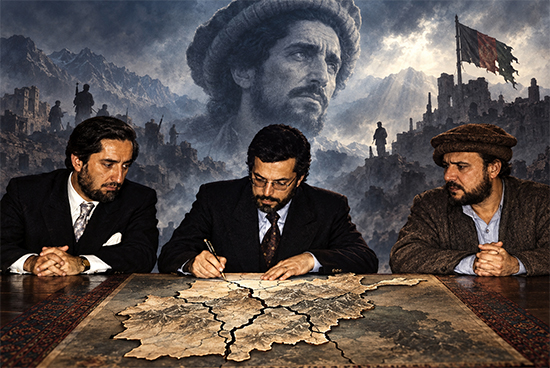
The most terrifying dagger is wielded by the one standing behind you in the front row of prayer!
Author: Fazlur Rahman Bebak (Afghanistan)
INTRODUCTION: The Surgical Dissection of Historical Memory and Breaking Free from the Great Deception of the People
Wake up! Zero hour is approaching. If you still believe that Ahmad Shah Massoud was killed merely by two hired Al-Qaeda terrorists in an isolated incident, you are still struggling within the layers of “strategic deception” and the thick fog of history.
Massoud’s assassination was not simply the physical elimination of a commander; rather, it marked the beginning of a “soft, creeping, and entirely systematic coup,” engineered by the “enemy within” under the guidance of external think tanks. The purpose of this operation was not merely to eliminate Massoud but to pave the way for the shameful collapse of August 2021 — a collapse whose seeds had been planted 20 years earlier in Khwaja Bahauddin. In this ruthless dissection, we are not seeking to compose elegies. We are pursuing “Mulhiqiyat” (the search for surgically concealed truth) to understand why those who called themselves his closest companions and most loyal followers entered into negotiations over the still-warm corpse of his ideals in the luxurious halls of “Bonn” immediately after the explosion. This article lifts the curtain on a chessboard where the white pieces committed the darkest betrayal of the century, turning the legacy of resistance into their personal credit card.
1 - THE MYSTERY OF SEPTEMBER 9: Physical Assassination or Systemic Suicide?
The “Commander’s System” was not merely a military structure; it was a strong and steel-like fortress, forged through two decades of relentless guerrilla warfare and bloody trials and errors against the most sophisticated intelligence operations in the region (the KGB and ISI). This system had repeatedly identified highly trained infiltrators and neutralized them before they could act. How, then, could two suspicious strangers carrying forged passports and a bomb-rigged camera remain for weeks within the most secure layers of protection, under the direct observation of the closest members of the security team?
The reality is that on September 9, the system did not collapse from external pressure; it was “hacked” from within. The incident at Khwaja Bahauddin was not merely an external terrorist attack but an act of “systemic suicide,” in which security protocols were knowingly and deliberately “suspended.” In intelligence doctrine, we encounter the phenomenon of “white infiltration”: individuals who possess the credentials of insiders, stand in the front row during prayers, and chant slogans of resistance, yet carry out the mission of eliminating the movement’s mastermind. Al-Qaeda carried the bomb, but the “access code” and the “authorization to pass through the seven layers of security” were provided by those who knew that, with Massoud and his doctrine of justice still present, there would be no place for them in the emerging technocratic order or the global financial markets.
The ultimate question that the younger generation must courageously ask is this: If the system had been hacked, who sold the “security password” to Massoud’s meeting room to the assassins in exchange for political guarantees?
2 - ENGINEERING THE VACUUM IN BONN: The Surgical Removal of Comrades to Establish Technocracy
The Bonn Conference was a marketplace where Massoud’s sacred blood was converted into international currencies and seats of power. While the rank-and-file mujahideen were mourning their leader in the trenches and valleys of Panjshir and Takhar, the “triangle of power” (Fahim, Qanuni, and Abdullah) was drawing up plans behind closed doors to divide the spoils. Before even the fortieth-day mourning ceremony for Massoud could take place, these three men replaced the doctrine of “independent and dignified resistance” with one of “absolute and humiliating dependence.” They were not faithful heirs but greedy “legacy profiteers,” who regarded Massoud’s ideals not as a historical responsibility but as a “credit card” and a bargaining instrument for entering the world of Western diplomacy and securing the support of colonial powers. At the negotiating table in Bonn, through strategic naivety (or deliberate betrayal), they surrendered all the instruments of hard power that had been won through the blood of thousands of martyrs to exiled technocrats who were afraid even of the air in Kabul, in exchange for a few symbolic positions and grandiose titles.
The title of “Marshal” was a heavy price paid at the nation's expense for the dissolution of the resistance's identity. This was a massive psychological operation: transforming a warrior of the Hindu Kush, who had fought for freedom, into a submissive, suit-wearing bureaucrat waiting in the corridors of a ministry for the signature of a foreign official.
3 - PURGING THE LOYALISTS: Why Were Arif Sarwari and Daoud Daoud Pushed Aside?
Following the establishment of technocracy in Kabul, the second project began: eliminating those who held the “treasure chest of secrets” concerning white infiltration. Every commander or official who remained loyal to Massoud's original doctrine had to be marginalized so that the path toward the final bargaining away of Afghanistan would remain unobstructed.
Dr. Arif Sarwari, Massoud's intelligence chief, possessed more than anyone else the codes of the September 9 betrayal. His removal from the leadership of the National Directorate of Security was the infiltrators' first major victory, ensuring that the investigation into Massoud's assassination would remain permanently buried. General Daoud Daoud, who symbolized military strength and served as the offensive arm of the resistance, was likewise reduced to a local figure and removed from the center of decision-making through the engineering of the triangle of power, leaving the resistance front “toothless.”
They sought to transform the resistance from a deeply rooted national movement into a “family-run political corporation” whose sole function was to extract privileges from the Presidential Palace and remain silent in the face of systematic crimes. The elimination of Panah Khan and the isolation of field commanders were part of the same project of surgically removing loyalists, ensuring that no one would dare question the truth about September 9.
4 - THE WEAPON OF “CUTTING OFF THE BREAD”: Controlling Commanders with Digital Tanks (AFMIS)
The real battle to eliminate Massoud's doctrine began in Kabul after the Bonn Conference, where rifles were defeated by bureaucracy and complex financial systems. In the new era, Kabul's Presidential Palace did not use tanks or artillery to subdue powerful commanders. Instead, it employed sophisticated financial systems such as AFMIS and ASYCUDA as “digital tanks.” The AFMIS financial system was designed specifically to control the logistical and supply lifelines of forces loyal to the doctrine of resistance. A commander whose slightest gesture once made the mountains tremble now had to wait for months outside the office of a biased, third-rate technocrat at the Ministry of Finance or the Presidential Palace, enduring humiliation merely to receive his soldiers' salaries or the money needed to fuel his tanks. This was precisely the policy of strategically “cutting off the bread.” The triangle of power not only failed to prevent the introduction of these restrictive systems but actively paved the way for the project. They had traded their silence and cooperation for “palaces in Dubai” and hidden investments in Turkey and Europe. By controlling procurement contracts, the Presidential Palace hollowed out loyal army corps from within, turning them into ceremonial institutions that, at the moment of crisis in August 2021, could not even provide their soldiers with dry bread.
5 - TWENTY YEARS OF SILENCE: Why Was the Investigation into Massoud’s Assassination an “Intelligence Taboo”?
The greatest and most disturbing question for today’s awakened generation is this: Why, throughout 20 years of republican rule and professed democracy, was not a single transparent national investigation launched into the assassination of Amir Sahib?
The answer to this mystery lies in the bank accounts and fabulous fortunes of the triangle of power and the network of “white infiltration.” Reopening the investigation into Massoud’s assassination would mean reopening the wound of their own betrayal in Khwaja Bahauddin and Bonn. They traded 20 years of silence for ill-gotten wealth. Their luxurious palaces in Sherpur and abroad were, in effect, built upon concrete beneath which Amir Sahib’s blood lay buried. To conceal this betrayal, they launched a project of “decorative hero-making”: they imprisoned Massoud within golden picture frames and enormous banners across the cities so that his true doctrine would never be implemented on the battlefield or in policymaking. Alongside these ceremonial commemorations, the republican era witnessed the physical elimination and a series of assassinations of loyal commanders, including General Daoud Daoud, Sayed Kheili, and Khan Mohammad Khan.
These assassinations, the author argues, were a logical continuation of the same September 9 project, intended to silence every voice that embodied Massoud’s spirit of resistance and dignity. The enemy within and the agents of “white infiltration” rendered the Resistance Front toothless from within, allowing the project of the “systematic surrender of 2021” to be carried out without serious obstruction and in complete tranquility.
6 - THE DOCTRINE OF THE GHOST OF THE HINDU KUSH: A Path Out of Strategic Blindness and Back to Power
The disgraceful collapse of August 2021 was neither sudden nor accidental. That collapse began at the very moment when the triangle of power in Bonn traded Massoud’s immense legacy for dollars and government positions. Massoud’s assassination was an unfinished project that was ultimately completed through “white infiltration” and the “enemy within.” Now it is the turn of the younger generation and enlightened intellectuals to apply the logic of “Mulhiqiyat” and the surgical dissection of history to expose this bloody and filthy chess game. To save what remains of the country and restore its trampled dignity, it is necessary to move beyond the fabricated narratives and false elegies of the triangle of power.
September 9 (18 Sunbula) must not remain merely a day of mourning and commemorative photographs. It must become a day of accountability and intellectual reckoning for those who turned his blood into capital. Identifying the “enemy within” is a prerequisite for any genuine resistance: the same enemy who approaches with a smile and Massoud’s name on his lips while concealing a dagger in his pocket for the next bargain. The only path to liberation is a return to the authentic foundations of Massoud’s doctrine: indigenous power, reliance on the strength of the people, and the decisive removal of opportunistic elites from decision-making structures.
Wake up before the profiteers of his legacy auction off what remains of your identity in the new intelligence marketplaces. The surgical dissection of history has begun, and no secret will remain buried forever.
FINAL CONCLUSION: The end of the performance and the beginning of truth
The disgraceful collapse of August 2021 was no accident; it was a planned downfall whose wheels were set in motion the moment the triangle of power signed the Bonn Agreement. When Massoud’s blood-soaked legacy was traded for project dollars and the shaky seats of power in Kabul, the “political corpse of the resistance” was effectively buried.
The September 9 assassination was an unfinished intelligence operation whose physical phase was carried out by Al-Qaeda and whose systemic phase was completed through “white infiltration” and the “enemy within.” Now it is the turn of the awakened younger generation to break free from the confines of ceremonial portraits and fraudulent marshal titles and, guided by the logic of “Mulhiqiyat,” lift the veil from this bloody chess game. Wake up! Before the same profiteers of his legacy bargain away what remains of your spiritual and physical homeland in the new marketplaces of intelligence operations.
The 20-year performance of the republic has ended, leaving behind the naked truth of betrayal.
1 - Was the triangle of power directly involved in massoud’s assassination?
The answer to this question lies in the realm of “strategic facilitation.” In the world of intelligence, eliminating a major target does not necessarily require pulling the trigger. It is enough to “suspend the protective shield” at the critical moment. Undeniable evidence demonstrates how the triangle of power, through “self-serving silence” and by facilitating the unrestricted presence of terrorists within the most secure perimeter of Khwaja Bahauddin, paved the way for the assassination. Their enormous political and financial gains immediately following Amir Sahib’s death, together with their emergence as uncontested power brokers in Bonn, elevate them from the status of suspects to that of “accomplices in a historic crime.”
They buried the assassination case because reopening it would have meant opening the doors of their own prison cells.
2 - Why were commanders like Daoud Daoud unable to prevent this betrayal?
The project of psychologically and physically disarming loyal commanders was launched immediately after 2001. Through deceptive Western-funded programs under the labels DDR (Disarmament, Demobilization and Reintegration) and DIAG (Disbandment of Illegal Armed Groups), they first stripped commanders of their military firepower and then isolated them within Kabul’s complex bureaucratic web. By transforming battlefield commanders into local and administrative figures, the triangle of power deprived them of their offensive capabilities and strategic influence. General Daoud Daoud and others like him became trapped in a structure where “a technocrat’s signature” carried greater authority than “a general’s command.”
This was a carefully engineered operation designed to hollow out the Resistance Front from within and render it ineffective.
3 - How did “white infiltration” operate within the resistance?
White infiltration is the most dangerous form of infiltration because it relies on respectable, educated, suit-wearing individuals who enter institutions equipped with modern language and administrative expertise. These individuals were effectively “systemic malware,” tasked with dismantling the resistance’s jihadist identity and commitment to independence. By making the forces’ financial lifelines dependent on the Presidential Palace and foreign resources, they deprived commanders of the ability to say no. White infiltration paved the way while repeatedly invoking Massoud’s name. In practice, however, it systematically dismantled the foundations of his power, connecting them one by one to foreign intelligence structures so that, at the zero hour of 2021, no organized resistance could emerge.
SOURCES AND REFERENCES
- A) Domestic Sources (Dari and Pashto)
- Saleh, Amrullah. (1398). An Intelligence Anatomy of White Infiltration within the Ranks of the Resistance. Kabul: National Security Publications.
- Panjshiri, Shahab. (1396). From the Rocks of the Hindu Kush to the Corridors of the Arg: An Examination of a Collapse. Kabul: Balkh Publishing.
- Qazi, Mohiuddin. (1401). Hidden Codes: Revisiting the Untold Stories of the Bonn Conference. Mazar-i-Sharif: Umm al-Banad Publications.
- Sajjadi, Abdul Qayum. (1400). Massoud's Political Doctrine: Deviations and Post-2001 Challenges. Kabul: Azim Publications.
- Mashahid, Mohammad Nader. (1399). White Infiltration: How Was the System Hacked from Within? Herat: Ansari Publishing.
- Haqgo, Basir. (1400). Panjshir after Amir Sahib: Heirs or Exploiters of the Legacy? Kabul: Center for Strategic Studies.
- Nasri, Parviz. (1401). Hacking Power: The Paradox of Technocracy and the Mujahideen. Herat: Ariana Publishing.
- Bayat, Qasim. (1401). The Chain of Betrayal: From Khwaja Bahauddin to the Fall of Kabul. Mashhad: Hejrat Publishing.
- Barizi, Gul Khan. (2021). The Bonn Agreement and the Distribution of Power: The White Blueprint of Infiltration. Kandahar: Afghan Publishing Society.
- Salim, Mohammad. (1402). The Assassination of Massoud and the Role of Regional Intelligence Networks. Jalalabad: Nangarhar University.
- Archive of Directorate 5 of the National Directorate of Security. (1380). Classified Reports on Security Purges in Takhar Province. (Archival documents).
- Minutes of the Supreme Command Council of the United Front. (1380). An Examination of Security Breaches in the Northern Region.
- Pamir Scientific and Analytical Journal. (1400). Special Issue: Dissecting History — The Realities of September 9. Kabul.
- Special Report of the Ministry of Interior Affairs. (1390). Analysis of Infiltration into Supply and Logistics Structures. Kabul.
B) English-Language Sources and References
- Coll, Steve. Ghost Wars (2004): The Secret History of the CIA, Afghanistan, and Bin Laden. Penguin Press.
- Gutman, Roy. (2008). How We Missed the Story: Osama bin Laden, the Taliban, and the Hijacking of Afghanistan. USIP Press.
- Rashid, Ahmed. (2001). Taliban: Militant Islam, Oil and Fundamentalism in Central Asia. Yale University Press.
- Gall, Sandy. (2021). Afghan Napoleon: The Life of Ahmad Shah Massoud. Haus Publishing.
- SIGAR Special Report. (2021). What We Need to Learn: Lessons from Twenty Years of Afghanistan Reconstruction.
- Human Rights Watch. (2001). The Assassination of Ahmad Shah Massoud: A Systemic Failure.
- World Bank Strategic Review. (2010). Public Financial Management Reforms in Afghanistan (The AFMIS Impact).
- Massoud, Ahmad Wali. (2022). The Unfinished Journey: Massoud’s Legacy and the Betrayal of a Nation.
C) Russian-Language and Other International Sources and References - Moscow Institute of Strategic Studies (MGIMO). (2021). The Fall of Kabul: An Analysis of Malware Infiltration into the Structures of Power.
- Simonov, Vladimir. (2005). Afghanistan after Massoud: The New Great Game and White Infiltration. Moscow: Vostok Publishing.
- GRU Intelligence Report. (2002). Analysis of the September 9 Operation: Suspension of Internal Security Protocols. (Translation).
- Christophe de Ponfilly. (2002). Massoud: The Noble Afghan — Anatomy of a Planned Assassination. Paris: Gallimard.
- French Journal of Geopolitical Studies (IFG). (2022). Bonn and the Appropriation of the Legacy: The Absorption of the Resistance Front.
- Bernard-Henri Lévy. (2021). The Fall of the Hindu Kush: Betrayal by Allies and Infiltration into Hidden Layers. Paris: Éditions Grasset.
- Arte Television Network Investigative Dossier. (2021). Who Sold the Security Codes of Khwaja Bahauddin? (Documentary report).


