




The war is ethnic, the state is ethnic, and the solution is ethnic.
Author: Nabi Saqi, historical researcher (Afghanistan)
1 — As long as the country is called Afghanistan, everything in it has an ethnic character. The name of the state—Afghanistan—the name of the currency, the national anthem, supposedly nationwide terminology, the language of the army, university titles: everything is Afghan. The principal function of the state that existed for a hundred years under the name Afghanistan was to undermine the Persian language and seize the lands of other peoples. An entirely ethnic project.
2 — Almost all wars in the country called Afghanistan had ethnic and linguistic roots. Nadir Khan’s war against Habibullah Kalakani, Nadir Khan’s assassination, the projects of Hashim Khan, Shah Mahmud Khan, and Mohammad Gul Khan Momand, infighting among the mujahideen during the jihad, internal disputes within the Khalq party and its conflicts with SOZA and others, the collapse of Dr. Najibullah’s government, the mujahideen wars in Kabul, the first Taliban uprising, the first resistance, the confrontations during the republic, the fall of the republic, and the current cabinet—all were clear manifestations of ethnonationalism and the ethnic problem in Afghanistan.
All the thoughts and concerns of Mohib, Fazli, Ghani, and others revolved around ensuring that the negotiations in Qatar failed, lest other peoples gain a share of power. Ghani’s flight itself was motivated exclusively by ethnic considerations.
3 — The mistake of Ustad Rabbani and Commander Massoud during their time in power was that they saw themselves as national leaders and pursued Afghan and Islamic identities. During the jihad, the mujahideen killed Setamists precisely because they regarded them as ethnonationalists. However, during the first resistance, Massoud gradually came to understand that “military operations are conducted for the sake of literature.”
4 — During the republic, our shared mistake was failing to recognize the dangers posed by the ethnic factor and ethnic politics. It was the collapse of the republic that revealed the underlying problem to us. Had we recognized that danger during the republic, we would not be in our present situation. If only Dr. Abdullah had refused to make concessions after winning elections, and each people had gone its own way. Dr. Abdullah’s commitment to national unity ended up harming us. I personally supported his decision to make concessions and believed it was in the country’s best interests, but now I realize that I was completely wrong.
5 — The sooner and more fully people recognize the ethnic nature of the conflict, the better it will be for them. Had the Tajik mujahideen understood Tahir Badakhshi’s words, and had we understood Pedram’s words, we would not be in our present situation. The more we deny the ethnic dimension of the problem, the longer the crisis will last.
6 — The current resistance initially made every effort to bring Qari Isa, Shukria Barakzai, and others like them to the forefront at its meetings and gatherings. But what was the outcome? Eventually, Qari Isa joined the camp of his own ethnic group and now does nothing but hurl insults at the resistance for ethnic reasons.
7 — Some secular politicians and members of the Pashtun academic elite may oppose the Taliban, yet even they are under no circumstances willing to work under the leadership of a Tajik, an Uzbek, or a Hazara. What harm, for example, did Ustad Mazari ever do to the Pashtuns throughout his life that makes them hate him so much, alongside Dostum and Massoud? Mazari’s fault was that he was a Hazara and claimed the right to lead and make decisions. Anyone who claims leadership and does not belong to their own ethnic group is a traitor, a thief, and a warlord. Whether it is Habibullah Kalakani, Marshal Dostum, Ustad Mazari, Ustad Rabbani, Mustafa Kazimi, or even Juma Fateh. Only Ramazan Bashardost and Latif Nazari are considered “good people.”
8 — No country will achieve success through ethnonationalism. If that were possible, Afghanistan would already have succeeded. But what should we do now that ethnonationalism is widespread and commonplace?
The first step is to demonstrate that ethnonationalism exists and that it is wrong. Ethnonationalists still regard it as the solution to the problem. They believe: either you accept our superiority, or we will sweep you away, all the way to Kulob. Faced with such reasoning, pleas, entreaties, and talk of “national unity” will achieve nothing. Other peoples must make it clear by force that ethnonationalism is untenable and wrong. No one understands any other language.
9 — Does discussing the ethnic problem benefit the Taliban and help perpetuate their rule? No. It does not.
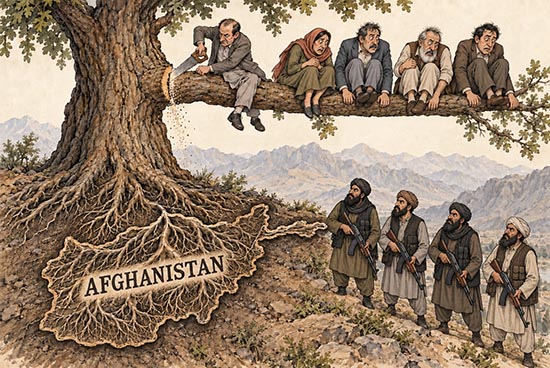
In fact, prevailing ethnonationalism stems from people’s lack of awareness. If Fasihuddin, Salahuddin Fateh, and others in the north and west recognize the nature of ethnonationalism, the north will be liberated the very next day. Denying ethnonationalism means keeping people in ignorance while they unwittingly saw off the branch they are sitting on.
Therefore, public awareness and understanding are the first prerequisites for changing the situation. Perhaps those who benefit from not understanding will continue not to understand, but gradually the truth will become clear to everyone. Silence in the face of ethnonationalism therefore benefits the current rulers: it simply erases the very question at issue.
10 — Those who entertain the illusion that Pashtuns will come and fight the Taliban for the sake of Tajiks and Hazaras so that Ahmad Massoud, Mohammad Mohaqiq, and General Dostum can come to power are living in a fantasy. No one will stand beside you for the purpose of bringing you to power. Even Mullah Nadeem and Mullah Muttaqi do not hate you as much as Khushal Saadat and Dewa Patang do.
If you come to power through your own efforts, flatterers and office-seekers from every ethnic group will gather around you. If you amount to nothing yourselves, no one else will ever help you.
11 — Ordinary Pashtuns deserve respect, and hatred and hostility toward the Pashtun people or any other people are neither reasonable nor ethical. To me, there is no difference between a Pashtun, a Hazara, a Tajik, a Jew, an Arab, and a Pakistani. Every human being deserves respect. If someone oppresses Pashtuns, I oppose them—whether it is my father, my own people, or my friend.
However, discussing misguided policies is a separate matter from respecting people. If misguided, mistaken policies prevail among Pashtuns, those policies must be criticized and changed.
Pashtun ethnonationalism should be opposed because it harms everyone, as well as this land as a unified country.
If Tajiks also come to power and pursue such policies, we will oppose them.
We oppose wrongful actions, not any particular people. Any group, individual, or people pursuing misguided policies must be opposed, whoever they may be.


