




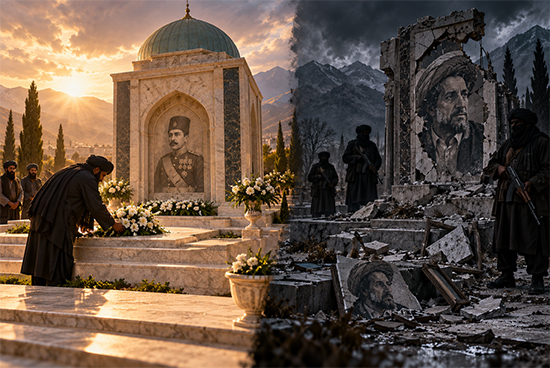
The Taliban not only revere the “apostate” Amanullah Khan as the principal symbol of Afghan nationalism but also continue to pursue his policy of “Afghanization.”
Author: Shamsurrahman Forutan (Afghanistan)
To gain a deeper understanding of the subject, we have examined four components. The first part of this article addressed the word “Taliban” and the term “Islamic Emirate” as the first component, while the second part explored the Taliban’s policies toward non-Afghan/non-Pashtun peoples as the second component. In the third part, we discussed the Taliban’s treatment of women in Afghanistan as the third component. The fourth part examines the alignment of interests and mutual support between Afghan/Pashtun nationalists and the Taliban.
FOURTH COMPONENT: Alignment of Interests and Mutual Support Between Afghan/Pashtun Nationalists and the Taliban
Afghan/Pashtun leaders who adhere to ethnonationalist views, such as former Afghan presidents Hamid Karzai and Ashraf Ghani Ahmadzai, as well as other Afghan/Pashtun nationalists, including Zalmay Khalilzad, and a significant portion of the Afghan/Pashtun political elite, have on numerous occasions directly or indirectly supported the Taliban. Not only did they refer to the Taliban as their “brothers” and express solidarity with them during their years in power, but they also remain silent today in the face of the Taliban’s unacceptable actions and, in many cases, even lobby on behalf of the group.
“The solidarity of Hamid Karzai and Ashraf Ghani with the Taliban, along with the support they provided to the group during their respective terms in office, constitutes, in the author’s view, the most compelling evidence that all politicians of Pashtun origin seek to monopolize political power. The silence of prominent figures of Pashtun descent in the face of the Taliban’s inhumane policies and horrific crimes only exacerbates the situation and, in some cases, is regarded as evidence of unity and coordination among the entire Pashtun elite” (Mansour, 2022–2023).
Karzai has repeatedly expressed support for the Taliban, describing them as “our own forces” and “disaffected brothers.” He has never referred to the Taliban as enemies.
“Hamid Karzai, the former president of Afghanistan, says that the Taliban are our own forces. In an exclusive interview with the BBC, he stated that the Taliban are Afghans and our brothers. We are Afghans too. They came as an Afghan force and took control of a certain area. There is nothing wrong with that” (Etilaat Roz, 2016–2017).
Hamid Karzai and Mohammad Ashraf Ghani, two former presidents of Afghanistan, face serious allegations of facilitating the Taliban’s return to power or supporting the group during the collapse of the republican system, although their respective approaches and roles differed (Roozbeh, 2026–2027).
Many experts believe that Karzai not only defended the Taliban throughout his presidency but also increased his support for the group and showed considerable leniency toward it in the period following the Doha Agreement, during the final years of the republican government, hoping to secure a position in an interim or coalition government. Moreover, he even invited the Taliban to enter Kabul, contrary to the provisions of the Doha Agreement.
“Former Afghan President Hamid Karzai stated in an interview with the Associated Press that the Taliban did not seize Kabul but were instead invited by him to enter the city after Ashraf Ghani had left Afghanistan” (Deutsche Welle, 2021–2022).
However, repeated expressions of solidarity and ideological alignment between the Taliban and Afghan/Pashtun nationalists are not limited to these instances and are also clearly evident in other areas. The Taliban are deeply committed to the values of Afghan/Pashtun nationalism and follow them in practice. They attach great importance to the symbols of Afghan/Pashtun nationalism, treat them with respect, and remain committed to the traditions associated with them. For example, the Taliban revere Amanullah Khan, the former king of Afghanistan, who is regarded as the principal symbol of Afghan nationalism.
Every year, they lay flowers at his grave and commemorate historical occasions associated with his reign, including Afghanistan’s Independence Day, despite the religious differences between the Taliban and Amanullah Khan. In contrast, the Taliban insult and destroy the symbols of other ethnic groups. For example, they have repeatedly visited the mausoleum of Ahmad Shah Massoud and published videos showing the desecration and destruction of his tomb.
“A video showing the destruction of Ahmad Shah Massoud’s gravestone circulated on social media, provoking widespread outrage among the people of Afghanistan. Ahmad Shah Massoud, Afghanistan’s national hero, is one of the prominent figures of twentieth-century anti-colonial resistance. Massoud was an ethnic Tajik from Panjshir, but his role in resisting the Soviet invasion of Afghanistan earned him popularity among other ethnic groups as well, including Uzbeks, Hazaras, Turkmens, and Pashtuns. When the Taliban first arrived at Ahmad Shah Massoud’s mausoleum, located in central Panjshir, they destroyed photographs and memorial symbols erected in his honor. Photographs and videos have repeatedly emerged showing Taliban members dancing and singing at Massoud’s grave, desecrating his mausoleum, and tearing up his portraits” (Independent Persian, 2022–2023).
Such behavior, in the author's view, is rooted in ethnonationalist attitudes and can be explained solely on ethnic grounds. Moreover, the Taliban continue to kill prisoners belonging to other ethnic groups, driven by ethnic hatred. In many cases, they even brutally desecrate the bodies of the dead by dismembering them. Sometimes they sever certain body parts of slain members of other ethnic communities and display them publicly. They kick the heads and faces of the dead or deliberately film the desecration of their bodies and subsequently circulate the footage in public.
All these actions are entirely contrary to Islamic teachings and are explicitly prohibited by the foundational texts of Islam. According to the author, such acts have no precedent among true Muslims. However, such practices have occurred in tribal societies and, as the author argues, can be explained within the framework of the ethnic and tribal values of Afghans/Pashtuns. During intertribal conflicts, such acts are committed when the interests of one community are threatened by a rival tribe or when its members are motivated by hatred and a desire for revenge. In other words, when there is a perceived need to intimidate a rival tribe or take revenge against its members, such acts may be carried out without any restraint.
Under such circumstances, religious values are pushed entirely into the background and cease to exert any influence. The Taliban, in essence, are portrayed by the author as an extension of what he describes as primitive tribal communities that entered Kabul with their traditional tribal worldview and value system and seized power. They remain committed to their own ethnic and tribal principles and seek to impose these values on the entire population of Afghanistan, particularly non-Pashtun/non-Afghan peoples.
In fact, with the emergence of Afghan nationalism and under the Taliban's current rule, the cultural and tribal structure of Afghans/Pashtuns has, in the author's assessment, undergone no substantial transformation. Instead, the tribe has merely expanded, consolidated its power, and come to be identified as an ethnic group. Afghan nationalists brought several tribes together to form the Afghan ethnic community. These tribes continue to retain their individual names today, but collectively they are referred to as “Afghans.” According to the author, it was this ethnic community, composed of several tribes, that shaped Afghan nationalism by adopting the ideological mantle of Nazism and nationalism. In this way, tribal values became more cohesive, while members of the individual tribes grew more united.
Today, these same tribes have established their rule over Afghanistan, while their actions and behavior remain tribal in nature. However, there is a serious misunderstanding of the situation. It lies in the fact that the international community lacks an accurate understanding of the Taliban's nature and therefore expects them to behave according to the standards of a civilized sociopolitical organization. According to the author, the principal reason for this misconception is that Afghan nationalists, sharing a common ethnic background with the Taliban, lobby on their behalf and mislead the international community by spreading inaccurate information.
Furthermore, according to the author, the Taliban are continuing the policies of Amanullah Khan and Mahmud Tarzi, whom he identifies as two of the principal founders of Afghan nationalism, by seizing lands belonging to non-Afghan/non-Pashtun peoples and transferring them to Pashtuns. This policy was implemented during the reign of Amanullah Khan. He introduced a regulatory document known as the Nizamnama-e Naqileen (“Regulations on Settlers”), under which he relocated large numbers of Pashtuns from the south to the north of the country. Amanullah Khan confiscated lands belonging to non-Afghan/non-Pashtun peoples and allocated them to Afghans/Pashtuns. At present, the author asserts, the Taliban are pursuing the same policy with even greater determination, using various methods to forcibly seize lands from non-Afghan/non-Pashtun communities and transfer them to Afghans/Pashtuns.
Another important point is that the Taliban, following the policies of Afghan nationalists, are seeking to eliminate the Persian language and replace it with Pashto. Persian serves as a language of culture and interethnic communication across Afghanistan, and about 77% of the country's population, including some Afghans/Pashtuns, speak it. More specifically, around 67% of Afghanistan's population belongs to non-Afghan/non-Pashtun ethnic communities and does not speak Pashto. The author characterizes Pashto as a primitive language incapable of meeting the needs of Afghanistan's population.
“During the Taliban's rule over Afghanistan, the group's actions against the languages, cultures, and histories of non-Pashtun peoples gradually exposed the ethnic nature of its policies, which had previously been concealed behind slogans and attempts by Western diplomats and the Taliban's own media outlets to whitewash the group. The Taliban removed Persian words from all signs at government institutions, including university signs and the titles of academic courses in Afghanistan. The number of Persian speakers in Afghanistan far exceeds that of speakers of any other language. The Taliban's leaders, most of whom are Pashtuns, have provoked outrage among a substantial portion of Afghanistan's population through their discriminatory measures against the Persian language and its speakers. Images of prominent figures associated with Persian, Uzbek, and Turkmen linguistic and cultural traditions are no longer visible in Afghanistan's cities, streets, universities, and schools. The Taliban removed all these images. The destruction of portraits of prominent Persian cultural figures from the Wall of Notables in Mazar-i-Sharif, as well as from the walls of the Persian Language and Literature faculties at Kabul and Balkh universities and numerous other locations, exemplifies the Taliban's treatment of symbols of the Persian language in Afghanistan. In addition, the Taliban removed images, names, and symbols of political leaders from the Tajik, Hazara, Uzbek, and Turkmen communities from Afghanistan's cities and streets” (Independent Persian, 2022–2023).
The Persian language is an official and widely spoken language in Afghanistan. It has deep roots in the country's history and culture. However, disregarding these realities, the Taliban have eliminated Persian script from most official administrative correspondence, replacing it with Pashto. They have abolished the calendar used by the Persian-speaking population — the Solar Hijri calendar. Most Persian-speaking employees have been dismissed from government administrative institutions. Citizens who address government offices in Persian are subjected to extremely discriminatory treatment.
All these actions not only fundamentally contradict Islamic values but are also incompatible with international law and human rights. Nevertheless, the Taliban justify them on ethnic and nationalist grounds, regarding such measures as a form of service to Afghan nationalism or the Afghan/Pashtun ethnic community. The cases presented here are merely a small selection of examples discussed to illustrate the nature of the problem. In reality, the author argues, there are hundreds of other examples of Taliban practices that directly contradict Islamic values and can be explained only through what he describes as the ethnic and nationalist logic of Afghans/Pashtuns.


