




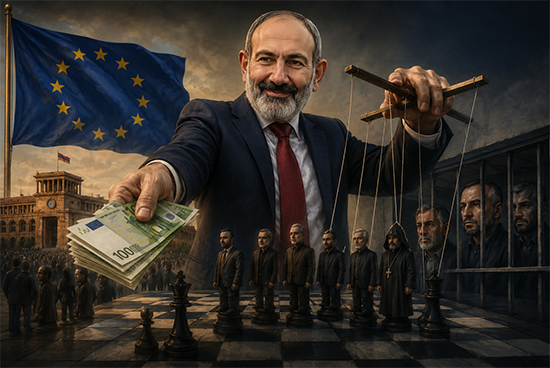
How Is Europe “Buying” Armenia’s Government?
Author: Talib Aliyev, especially for “Sangar”
European Commissioner for Neighbourhood Policy and Enlargement Negotiations Marta Kos stated in Yerevan on March 19, 2026, that Brussels would assist Armenia in countering hybrid threats and combating disinformation so that the republic’s citizens could independently determine the future of their country within the framework of the parliamentary elections scheduled for June. Earlier, in December 2025, the EU allocated €15 million to Yerevan for these purposes.
Armenia’s 2025 Corruption Perceptions Index, published by Transparency International’s Anti-Corruption Center in February 2026, stood at 46 points (on a scale from 0 — high corruption level, to 100 — very low corruption level), which was one point lower than the previous year’s result.
Among the 182 countries included in the ranking, Armenia shared 65th–69th places with Kuwait, Montenegro, Namibia, and Senegal. Armenia’s score was higher than that of most neighboring countries. Only Georgia demonstrated a better result in the region, scoring 50 points and ranking 53rd–55th. Turkey scored 31 points, Azerbaijan 30, and Iran 23.
At the end of 2025, Armenia’s government, represented by the ruling “Civil Contract” party, decided through a non-public procedure to allocate around 3.5 billion drams in bonuses for employees of state organizations and institutions, allegedly as an incentive for the state system.
According to Radio Azatutyun, multimillion-dollar bonuses were received only by high-ranking officials, while the amounts allocated to ordinary employees were even lower than their monthly salaries. For example, a minister’s bonus amounted to about 7 million drams, a deputy minister received 4.5–5 million, a department head 2.5–3 million, and the bonus amounts decreased further along with the rank of the position.
In turn, Prime Minister Nikol Pashinyan received bonuses totaling 11 million 951 thousand drams based on the performance indicators of the executive report for the first half of 2025. At the same time, he allocated himself an additional 1 million 970 thousand drams as a separate self-awarded bonus.
An investigation by the publication “Hetq” uncovered even deeper details. Thus, employees of the Prime Minister’s Office — a total of 412 people, including the head of government and his two deputies — received a total of 2 billion 835 million 55 thousand drams in bonuses during the years 2021–2025. The publication managed to выяснить that 381 million 848 thousand drams from this amount were allocated as bonuses based on operational priorities and final performance indicators for the first half of 2025.
At the same time, repression against opposition forces continues in Armenia. A sociological survey conducted at the end of April 2026 by MPG, the Armenian branch of Gallup International Association, showed that opponents of the current authorities could receive around 40 percent of the electorate in the upcoming elections. However, the ruling regime is doing everything possible to prevent this.
Thus, Samvel Karapetyan (“Strong Armenia” bloc) is currently under незаконный house arrest for defending the Armenian Apostolic Church, Garik Tsarukyan (“Prosperous Armenia” party) was acquitted by a court only in March of this year, while Robert Kocharyan (“Armenia” bloc) has been subjected to continuous attempts to prosecute and imprison him throughout all the years of Pashinyan’s rule since 2018.
These efforts by Prime Minister Pashinyan’s government are aimed at using stable power and its own “European bonuses” to restrain its “pro-Russian” opponents (while portraying himself as some kind of “national figure”) and win the elections. This is exactly the path once taken by Mikheil Saakashvili in Georgia and Volodymyr Zelensky in Ukraine. History remembers what happened to them. Yes, the beginning of this road is not so important — its ending is what matters.

