




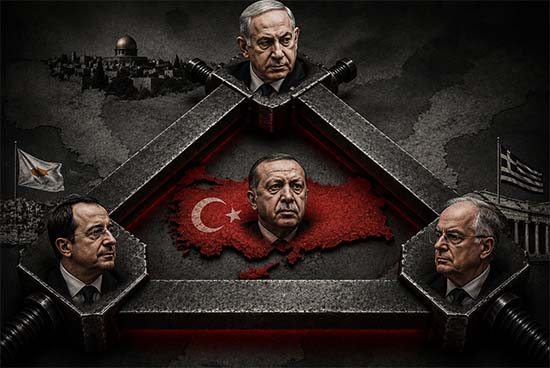
How Israel is encircling Turkey
By Ali Askari, analyst (Germany), especially for Sangar
The consequences of the Middle Eastern war that unfolded around Iran and its nuclear program are already being felt across the globe and will continue to affect the world for years to come. Yet, in the near future, the region may be drawn into an even more devastating conflict. Israel's military machine is preparing for a new confrontation—one that could reshape the entire geopolitical landscape of Western Asia and Southern Europe. Tel Aviv is strengthening its military capabilities for a potential showdown with Turkey. The consequences of such a conflict would inevitably affect the economy and security of the entire Northern Hemisphere.
Iran neither faltered nor, as political analysts often put it, "bent under pressure" in the face of American and Israeli missile strikes. Nevertheless, Tehran no longer represents a major concern for either Washington or Tel Aviv. Both understand that Iran is ultimately a secondary regional power operating under the heavy burden of international sanctions. At most, it is capable of waging a prolonged war through its network of proxy allies, without the ability to conduct large-scale offensive operations or seize foreign territory.
For Israel, however, Turkey represents a far more serious and dangerous opponent. Ankara is one of NATO's most influential members and possesses the Alliance's second-largest military after the United States. Turkey's defense industry ranks among the global leaders in the application of advanced military technologies, while the country's political influence is reinforced by its considerable regional standing.
Israel's concerns are further heightened by the blunt rhetoric of President Recep Tayyip Erdoğan, who has repeatedly declared Turkey's readiness to intervene in the Iran-Israel conflict, stating: "Just as we acted in Karabakh and Libya." Added to this is Turkey's "Blue Homeland" (Mavi Vatan) maritime doctrine, which envisions asserting control over vast maritime areas in the Eastern Mediterranean.
A potential confrontation with Turkey would not be limited to an exchange of strikes. It would quickly escalate into a large-scale conflict with a technologically advanced adversary. To avoid such a scenario, Israel would, at the very least, need to bring its war with Iran to an end. However, Tel Aviv is unwilling to "lose face" and is therefore likely to seek opportunities to take preventive measures against Ankara.
Some of these measures are already being implemented. Israeli envoys are actively engaging with Kurdish armed groups in northeastern Syria. There has never been, nor is there now, nor is there likely ever to be any genuine friendship between the Kurds and the Israelis. Nevertheless, Israel operates according to the principle that "the enemy of my enemy is my friend." Its objective is to support the Kurdish forces and use them to establish a buffer zone along Turkey's southern frontier.
Officially, the Kurdish authorities deny any cooperation with Tel Aviv. However, available information suggests that Druze armed groups in southern Syria are receiving Israeli financial and military support. For Turkey, this is a deeply troubling warning sign, as it points to the possibility of increased pressure on its borders and the destabilization of NATO's southern flank.
Another anti-Turkish front is emerging through the axis of Greece and Cyprus, with whom Israel has signed a military cooperation program for 2026. The agreement includes joint military exercises, intelligence sharing, and the coordination of defense initiatives. Given the territorial disputes that both Greece and Cyprus have with Turkey, the strategic implications—and the potential threat—of this emerging alliance are more than evident.
In essence, what is taking shape is an anti-Turkish coalition in the region led by Israel. Ultimately, the so-called "Iron Triangle" is emerging—a strategic alignment that could result in Turkey's geopolitical encirclement.
Israel has already begun supplying Greece with air defense systems and PULS rocket systems. At the same time, rapid reaction forces are being reinforced and prepared to support Israel in the event of a military confrontation.
Tel Aviv is skillfully exploiting Turkey's disputes with Greece, Cyprus, and the Kurds. Equally significant is Turkey's ambiguous and often contentious position within NATO itself. Israel is unlikely to overlook this vulnerability and will seek to turn it to its own strategic advantage.
It is evident that, in the event of a direct military confrontation, Israel does not intend to face Turkey alone. The broader strategy appears to be the gradual strategic encirclement of Turkey through a network of regional allies, placing sustained military and political pressure on Ankara.


