




The Mecca Pact and the New Struggle Over the Security Architecture of the Middle East and South Asia
By Abdul Naser Noorzad Tajik, researcher in politics and geopolitics, especially for “Sangar”
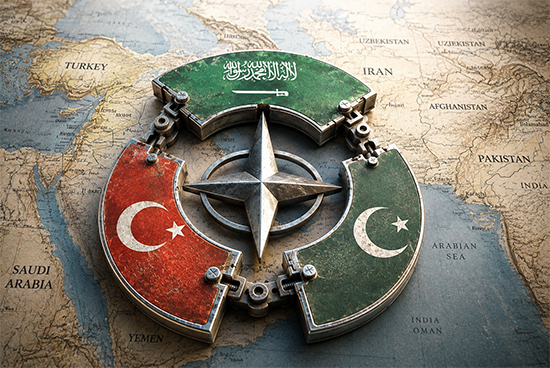
The security agreement between Saudi Arabia, Turkey and Pakistan cannot be viewed merely as an ordinary defense pact. It emerged at a time when the security architecture of the Middle East and its surrounding region is undergoing a process of redefinition, while regional actors are seeking to consolidate their positions within the emerging security order.
From this perspective, the Mecca Pact can be seen as an indication of an effort to create a new layer of security in the region — a layer that, although it outwardly seeks to distance itself from direct dependence on U.S. security mechanisms, nevertheless makes it impossible to ignore the role and influence of Washington and its Western allies in shaping such arrangements.
The significance of this agreement becomes even clearer when the political and security histories of the three countries are taken into account. Over the past several decades, Saudi Arabia, Turkey and Pakistan have, in various forms, played roles in regional security developments, supported armed groups, provided refuge or assistance to Islamist movements, and interacted with non-state actors. Therefore, the formation of a joint defense framework among them may carry a much broader geopolitical significance, extending beyond conventional military cooperation.
Some may view this agreement as a sign of the region’s transition from complete dependence on the United States toward more independent security arrangements. However, security autonomy does not necessarily mean a departure from the Western security architecture. Over the decades, the defense, military-industrial, intelligence, and political structures of these three countries have developed in such a way that their ties with the West, particularly with the United States and the United Kingdom, remain deep. Therefore, what may be changing is not the role of the United States itself, but rather the way that role is exercised — shifting from a more direct presence toward a network of regional partners that assume part of the responsibility for maintaining security.
From this perspective, the expression “Islamic NATO,” although attractive from a media standpoint, requires caution from an analytical perspective. Saudi Arabia, Turkey, and Pakistan are not fully aligned allies, do not have identical security interests, and do not share a common perception of threats across all regional issues. They compete for influence in the Islamic world, have disagreements over their approaches to Iran, differ in their regional policies, and even have divergent understandings of the very concept of security.
Therefore, directly comparing this agreement with NATO without taking into account the structural and historical differences may be more of a political formulation than a reflection of actual institutional reality.
However, these differences do not necessarily mean that the agreement is insignificant. Saudi Arabia possesses substantial financial and energy resources; Turkey has significant military, industrial and defense-technological capabilities, while Pakistan has nuclear capabilities and extensive experience in regional security policy.
The combination of these three capabilities can create different advantages for each of the parties. Saudi Arabia seeks to strengthen its own security and contain threats emanating from the surrounding region, particularly from Iran and forces aligned with it. Turkey is seeking to strengthen its position as an independent and influential power in the Islamic world and Central Asia. Pakistan, meanwhile, facing a wide range of economic, political and military challenges, seeks to preserve and strengthen its position within the new regional security system.
From this perspective, the Mecca Pact may be less the result of complete strategic convergence than the outcome of a temporary overlap of interests among several regional powers. Such alliances remain sustainable as long as a common threat or shared interests outweigh the internal differences among their participants. The fundamental question is therefore: do these three countries actually share a common perception of threats?
One of the key uncertainties surrounding the agreement is the issue of the “enemy” and the definition of the threat. Within any sustainable security arrangement, a threat must be sufficiently specific and clearly definable, because defense alliances are formed not merely on the basis of diplomatic relations, but primarily on the basis of a shared perception of the threat and agreement on its source. If an agreement refers to an enemy or a threat without clearly specifying what exactly is meant, the scope for interpretation becomes extremely broad. Under such circumstances, the agreement may be viewed less as a specific military alliance and more as a kind of “security insurance” for a period of geopolitical uncertainty.
At the same time, there is a possibility that the gradual reduction of direct U.S. involvement in certain areas of regional security has prompted Washington to build a network of regional partners — a network that would allow the United States to shift part of the burden of maintaining regional security onto its allies and partners without requiring a direct and costly American presence. Under such a model, Turkey, Saudi Arabia and Pakistan could become part of a broader security architecture in which the United States continues to play a decisive role, but is not necessarily on the front line.
Another important aspect of this process is the competition among different centers of power in Asia and the Middle East. China and Russia are expanding their influence in the economic, security and geopolitical spheres, while Iran, as one of the region’s key players, is directly involved in the Middle East’s security dynamics. Therefore, any new security arrangements in the region should be analyzed within the context of broader competition among regional and extra-regional powers.
In this context, the issue of Israel also deserves attention. One possible objective of such arrangements may be to maintain a certain level of control over the situation and manage tensions in the region in such a way that existing crises do not develop into a broader and more sustained anti-Israel polarization. Of course, additional evidence is needed to support such a conclusion, and this objective cannot be regarded as established solely based on the formation of a pact among the three countries.
Afghanistan: A Sensitive Link in This Architecture
However, the fundamental question for Afghanistan is the following: what position will this country occupy in the new security architecture if such arrangements expand?
Afghanistan lies at the intersection of several security spaces: Pakistan to the south, Iran and the Gulf states to the west and southwest, Central Asia to the north, and China to the east. This geographical position simultaneously makes Afghanistan a connecting bridge and a potential arena for competition among the powers.
For Pakistan, Afghanistan is part of the security equation in its confrontation with India and an element of its strategic depth. For Turkey, Afghanistan could become a link connecting Central Asia with South Asia. For Saudi Arabia, in the event of intensified rivalry with Iran, Afghanistan could be viewed as part of a broader sphere for containing Tehran’s influence. For China and Russia, Afghanistan can likewise be both a source of threat and an important point for managing the security of Central Asia and countering extremist movements.
Thus, the main danger for Afghanistan increases when the country once again becomes a space for security competition among regional powers — a space in which some actors begin to define their own security through instability in Afghanistan. The experience of the past four decades shows that whenever Afghanistan has become an arena for rivalry among external powers, it has been Afghan society that has paid the highest price.
Under such circumstances, Afghanistan’s current political situation further complicates this web of relationships. The Taliban government faces a crisis of domestic and international legitimacy, serious political and economic constraints, as well as a range of security challenges. This situation limits Kabul’s ability to pursue a balanced and independent foreign policy. A state that lacks broad domestic and international legitimacy will be more vulnerable to multilateral regional pressure.
In such an environment, Afghanistan needs a foreign policy based on balance — neither a complete alliance with one power nor complete confrontation with another. A rational strategy for a state situated between competing powers is to maintain balanced relations with rival actors, define vital national interests, and prevent the country from becoming an instrument of another state’s security policy. However, implementing such a strategy requires a state that possesses political legitimacy, institutional capacity, and a realistic understanding of the international environment.
The main problem is that the Taliban themselves are part of this security system. A group that was previously defined by the logic of war and armed networks must now make decisions in an environment that requires diplomacy, balancing, careful calculation of interests, and management of competition among powers. These two logics are not necessarily compatible with each other. For this reason, in the face of new developments, Afghanistan may emerge not as an active player but as an arena for competition among other states.
If such a situation develops, its consequences will not be limited to Afghanistan alone. The spread of instability from Afghanistan could affect Central Asia, China, Pakistan, Iran, and even the Persian Gulf region. In such a scenario, Afghanistan would once again become a point where regional crises intersect — a point that every power would seek to use to advance its own interests.
A New Order or a Redistribution of Instability?
It is still too early to call the Mecca Pact the birth of a new regional security order. However, there is no doubt that the agreement can be viewed as part of the process of reshaping the regional security system — a process in which the United States will probably remain present, but will no longer be the sole architect of regional security.
Turkey, Saudi Arabia, Pakistan, Iran, Russia and China will each seek to help shape part of this new architecture. Competition among them will probably not take the form of a direct and simple confrontation, but will instead be pursued through a network of alliances, security arrangements, economic partnerships and political influence.
In such an order, weaker states are more vulnerable to becoming arenas of rivalry. Afghanistan is one of the clearest examples. If the country fails to move from being an arena of security competition to becoming a balanced and independent actor, any new security arrangements around it could create a new threat instead of an opportunity.
Therefore, the main question concerning the Mecca Pact is not whether this agreement is an “Islamic NATO” or not. The more important question is what kind of security architecture this pact is creating in the region and what role Afghanistan will play within that architecture.
If this architecture is based on cooperation, stability, and the management of rivalry, it could contribute to reducing instability. However, if it becomes an instrument for reproducing geopolitical competition, transferring crises, and using regional countries as platforms for proxy confrontation, Afghanistan and other weaker states will be its first victims.
Ultimately, the future of this agreement will be determined not by the label “Islamic NATO,” but by the ability of its participants to define a common threat, manage their disagreements, identify their genuine interests, and resist turning the agreement into an instrument of competition among great powers.
For Afghanistan, the central question is equally clear: within the emerging regional security order, it must either become a balanced actor with clearly defined interests, or once again become a territory where others seek to ensure their own security at the expense of instability in Afghanistan.


