




Which Historical Work Is a Forgery?
Author: Dr. Farid Younes, Professor Emeritus of Middle Eastern Anthropology and Islamic and Philosophical Studies, Chairman of the Afghanistan Center for Thought, and Member of the Advisory Council of "Sangar".
While pursuing my Master's degree in History at Radford University in the United States, I learned a number of important lessons that I believe are worth sharing. Perhaps they can help reduce, at least to some extent, the tensions and disagreements that exist among our people regarding certain aspects of Afghanistan's history.
During my studies, we were assigned to read and review a book entitled: The American Revolution: How Revolutionary Was It? Edited by George Athan Billias (1980).
The book is a collection of essays by American scholars. Some argue that the American Revolution against Great Britain was indeed a genuine revolution, while others contend that it was not truly revolutionary because the United States failed to transform many of the political and institutional structures inherited from Britain.
Historically, humanity first learned about the past through religion, since sacred scriptures contain the stories of the prophets. In Islamic scholarship, these narratives are known as Qisas al-Qur'an ("The Stories of the Qur'an"). However, Qur'anic narratives differ fundamentally from human history. For believers, the stories of the Qur'an represent absolute truth, and their historian in the Torah, the Gospel, and the Holy Qur'an is God Himself.
Historical events recorded by human beings, whether by contemporary writers or historians of the past, inevitably reflect the author's own perspective, worldview, and interpretation. Every individual has the right to his or her own understanding of history, and different historical interpretations deserve mutual respect.
This is precisely why I referred to the book on the American Revolution. It demonstrates that people throughout the world often interpret the same historical events differently.
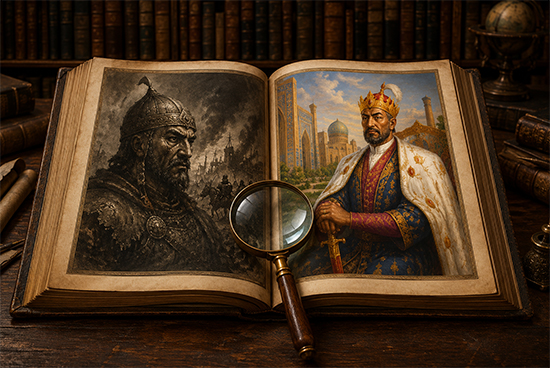
For example, we commonly refer to Shuja al-Din Timur, better known as Amir Timur Gurkani, as Tamerlane ("Timur the Lame"), a name carrying a derogatory connotation. Yet during my visits to Uzbekistan, Samarkand, and Bukhara, I discovered that the people of those lands regard him as a national hero and universally refer to him as Timur the Great.
This teaches us an important lesson: history belongs to the liberal arts and humanities, and every person has the right to hold his or her own perspective. Historical disagreements should never become a reason for hatred or enmity between people.
Secondly, anyone who is well-read and committed to serious study can write history. One does not necessarily need a Ph.D., a Master's degree, or formal academic training in history to become a historian.
Among our people, Dr. Abdulrahman Zamani, who is a physician by profession and one of Afghanistan's distinguished Pashtun scholars, wrote what is arguably the finest work on the reign of His Majesty Amanullah Khan, entitled "A Reassessment of the Amani Era and the British Conspiracies" (2013). The book was so impressive that it astonished even historians such as Dr. Kakar, himself a Pashtun with a doctoral degree in history. Moreover, in one of his later publications, Dr. Zamani openly criticized Dr. Kakar's interpretations. Anyone who has carefully studied the history of Afghanistan knows the remarkable skill with which Dr. Zamani wrote his work, despite having no formal academic education in history.
When writing history, an author must set aside ethnic, religious, political, gender, and family biases. Otherwise, objective historical analysis becomes impossible.
In our country, if a supporter of Gulbuddin Hekmatyar's Islamic Party writes history, the result often becomes little more than praise of Hekmatyar. Likewise, if a member of Jamiat-e Islami writes history, the narrative frequently turns into admiration for the late Burhanuddin Rabbani, rather than an impartial presentation of historical facts. Similarly, I have never seen members of the Mojaddedi family critically assess the actions of their own ancestors, despite the fact that they, too, made mistakes.
One of my acquaintances once wrote on Facebook that the late Sardar Mohammad Daoud Khan was an outstanding national leader and asked why so many people were hostile toward him. Yet many others believe that Afghanistan's misfortunes began precisely during Daoud Khan's rule.
Such is the nature of history. There is no reason for people to become enemies simply because they interpret the past differently. We should recognize that life in exile often reshapes people's perspectives and worldviews.
A committed supporter will not change his opinion even if you write a hundred books or articles. Nor will a determined opponent. Therefore, it is important to understand that history is not mathematics, where 2 + 2 always equals 4.
History should be taught by presenting students with multiple perspectives. That was precisely the approach taken during my own studies. We were assigned to read "The American Revolution: How Revolutionary Was It?", after which our professor simply told us: "Now write what you think."
However, we too often approach such questions through the prism of ethnicity and immediately declare, "No, that person is right." Yet, if we examine that individual's background more carefully, we often discover that he belonged to the leader's political party, held an important position under that leader, or was a supporter of that leader's policies. This is precisely why his views are so easily dismissed by those who hold opposing opinions.
As I have written before, religion, history, journalism, political science, poetry, literature, music, and the fine arts all belong to the liberal arts and humanities. Anyone—even without formal higher education in a particular field—can achieve success through dedication, hard work, and serious study.
I have neither formal religious education nor professional training in journalism. Nevertheless, in 2008 I received an award for producing the best religious program, an experience I later described in my memoirs.
Winston Churchill, Prime Minister of the United Kingdom, never completed secondary school, yet he is remembered as one of Britain's greatest statesmen. Likewise, Sufi Ashqari had little formal education, yet he became one of Afghanistan's most distinguished poets of the twentieth century.
Even in matters of religion, legitimate differences of opinion exist. Some scholars maintain that the Isha prayer becomes invalid after midnight, while others hold that it may be performed until dawn. Some consider temporary marriage (sigheh) lawful, while others regard it as prohibited.
All of these viewpoints deserve respect because religion, like history, belongs to the liberal arts and humanities, where thoughtful interpretation and diverse perspectives naturally exist.
What we need to cultivate is mutual acceptance. Slander, false accusations, and contempt for others are not the work of a historian. Neither are insults and abusive language.
For example, I have written about the so-called Pashtunistan issue, arguing that it no longer serves Afghanistan's national interests and should be regarded as a closed chapter. Pakistan is not going to commit political suicide, and the Pashtun territories across the border will not return to Afghanistan.
Many Pashtuns reacted with great anger to my views and even called me a traitor. What they fail to understand is that today we view history through the eyes of a new generation, approach religion from a different perspective, and regard public speaking as something natural, relaxed, and conversational rather than a rigid performance in which a speaker merely reads from prepared notes.
Life in exile has been an invaluable education for all of us. We should make the best use of the scientific and intellectual achievements of the countries in which we live and continue moving toward a more civilized and enlightened society.


