




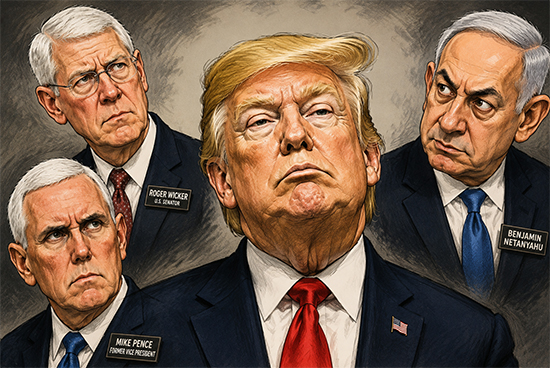
How Republicans and Israel Are Challenging Trump
By Ali Askari, political analyst (Germany), especially for Sangar
On the eve of the congressional elections, the United States has found itself on the brink of a major political divide. The deepest rifts have emerged within Donald Trump’s own camp of supporters. The Republican Party is experiencing its most severe internal turmoil in decades.
At the center of the controversy is the recently signed and highly contentious Memorandum of Understanding between the United States and Iran. A significant portion of the Republican establishment views the agreement as nothing less than a capitulation. Rather than weakening Tehran, the U.S.-Israeli strikes have only strengthened the position of Washington’s principal regional adversary.
The White House has effectively undermined the efforts of generations of American policymakers who sought to isolate Iran internationally and cripple its economy through sanctions. Under the terms of the memorandum, Washington is prepared to lift its principal sanctions against Tehran. Among the measures to be removed are the embargo on Iranian oil exports and the freezing of Iranian state assets.
Another controversial provision calls for the establishment of a $300 billion fund dedicated to Iran’s economic reconstruction.
In return, Iran is required only to reaffirm that it will not pursue nuclear weapons and to dilute its stockpile of enriched uranium. Oversight will be entrusted to the International Atomic Energy Agency (IAEA). However, the memorandum contains no specific commitments regarding the dismantlement of Iran’s nuclear program.
Although the armed conflict inflicted considerable losses on both sides, it has, in practice, worked to Iran’s advantage. The war launched by the United States has delivered to Iran what decades of peaceful development failed to achieve.
Against this backdrop, an increasing number of questions are being raised about Donald Trump. Some American politicians ask a simple question: What was the point of launching a military conflict in the first place? Others regard the memorandum as a strategic defeat for the United States.
The chairman of the Senate Armed Services Committee, Republican Senator Roger Wicker, has described Trump's decision as a "reward" for a hostile regime. Former Vice President Mike Pence has likewise criticized what he calls the "appeasement" of America's long-standing adversary. Both statements reflect an extraordinary level of distrust toward the current U.S. president.
Within the Republican Party itself, discontent over the sweeping concessions granted to Tehran is becoming increasingly evident. Many party members recognize the risk of alienating the conservative electorate.
Trump's own response amounted to little more than dismissing his critics as "fools." Yet such rhetoric is unlikely to strengthen the Republicans' already weakened position on the eve of the congressional elections.
Another major center of opposition to Trump's policy has emerged in Tel Aviv. The U.S.-Iran agreement was concluded without Israel's involvement, dealing yet another blow to Benjamin Netanyahu's political standing. His inability to prevent the signing of the memorandum is widely viewed as a sign of weakness—one that could have serious, even catastrophic, consequences. Israeli opposition leader Yair Golan has accused Netanyahu of deceiving the public and promoting "a false image of himself as the guarantor of Israel's security."
In response to Washington's actions, Israel has further escalated the crisis in Lebanon—a country whose territorial integrity Trump had previously pledged to guarantee. Tel Aviv has refused to withdraw its troops from southern Lebanon and continues its military operations against Beirut. More importantly, however, the trust that once bound the two allies has suffered far more serious damage.


