




A Fraternal Appeal to the Esteemed Mojaddedi Family in Contemporary Afghan Politics
By Dr. Farid Yunus, Professor Emeritus of Middle Eastern Anthropology and Islamic and Philosophical Studies, Chairman of the Afghan Center for Thought, and Member of the Advisory Council of Sangar.
From the history of Afghanistan, as well as from the accounts passed down by our fathers and elders, we know that during the reign of His Majesty Amanullah Khan, British intrigues—both from within the country and from abroad—led several prominent members of the Mojaddedi family, in alliance with the Jaji and Mangal tribes, to overthrow Amanullah Khan and bring Nadir Khan to power.
The alliance between the Mojaddedi family and the Jaji and Mangal tribes was the result of "an illegitimate marriage between Pashtun ethnicity and the Sunni madhhab." This alliance has remained a source of Afghanistan's misfortunes to this day. As a result, Afghanistan never truly became a unified nation.
During that period, the Mojaddedi family remained silent while Mohammad Gul Momand pursued his policy of Pashtunization throughout Afghanistan. They also remained silent when Nadir Khan persecuted many of the country's prominent families and when the notion was promoted that only one ethnic group should enjoy political prominence while all others remained marginalized. Such silence was unexpected from a religious family that regarded itself as a standard-bearer of Islam.
While living in exile, we learned that anyone who rises in the name of religion must first strive to establish justice among all people, regardless of their ethnicity, religion, or school of thought. As the Qur'an states:
"When you judge between people, judge with justice."
Regrettably, this Qur'anic ideal was never realized. The oppression committed under Nadir Khan remains astonishing for a Muslim country, particularly the discrimination and persecution directed against the Hazara community and the country's Shi'a population.
Today, through YouTube, people have unprecedented access to knowledge about history, science, religion, and many other subjects. One need only compare the justice of Sultan Mehmed II, the Conqueror of Constantinople, with Afghanistan's historical reality.
The celebrated Ottoman judge Khidr Beg, renowned for his impartiality, even summoned the Sultan himself before the court after the ruler, in a fit of anger, ordered the hand of the distinguished architect Atik Sinan to be cut off. The judge ruled that the Sultan should receive the same punishment, but the architect ultimately chose to forgive his ruler.
In Afghanistan, by contrast, even young children were imprisoned together with their mothers, even though Nadir Khan's Minister of Justice was himself a member of the Mojaddedi family.
In Afghanistan, however, even young children were imprisoned alongside their mothers, although Nadir Khan's Minister of Justice was himself a member of the Mojaddedi family.
This article is not directed against any particular individual. Today, the Mojaddedi family includes many honorable young people and respected figures of whom our society can rightly be proud. Nevertheless, the political reality of contemporary Afghanistan is such that some members of this family seek to restore the same political order that existed a century ago.
Every individual has the right to hold their own political views. Every citizen has the right to participate in the political affairs of the country. These are no longer the days of Nadir Khan, or later Daoud Khan, when political discourse belonged exclusively to state officials and religious matters were reserved solely for the clergy, while everyone else was denied the right to express an opinion.
From an Islamic perspective, however, expressing a political position must be guided by two fundamental principles: justice and moral integrity.
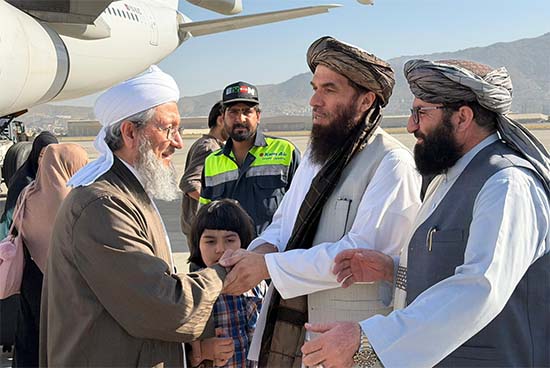
Over the past several months, we have seen Abubakr Mojaddedi—a young man widely regarded as honorable and respectable—wear the white turban of his ancestors, travel to Kabul, pose for photographs alongside the Taliban, adopt the title "Hazrat Sahib," and openly support the Taliban's repressive regime.
More recently, the media showed Ismatullah Mojaddedi, the son of the late Sibghatullah Mojaddedi, sitting alongside Taliban representatives, speaking about security in Afghanistan, and effectively lending political legitimacy to the movement.
Yet Afghanistan today lacks even the most basic standards of justice. For five years, women and girls have been denied the right to work and receive an education. Freedom of speech and freedom of the press have been eliminated. Journalists and reporters have been forced into exile. Artists and musicians have likewise fled the country. Pashto has effectively been imposed as the state's official language, even though the overwhelming majority of Afghanistan's population is Persian-speaking.
The fundamental problem of Afghanistan lies in "the illegitimate alliance between Pashtun ethnicity and the Sunni madhhab." These two forces have never embraced individual liberty, freedom of expression, freedom of the press, the arts, music, or the principle of civil equality between women and men.
At the same time, the Mojaddedi family also includes distinguished individuals who have made valuable intellectual contributions. Among them are the late Hashim Mojaddedi, as well as representatives of the younger generation, including Ghani Mojaddedi and other enlightened members of the family.
Today, anyone attending their family gatherings can observe that many women do not wear the hijab and that many young men do not grow beards. Nevertheless, this segment of the family remains a minority.
A video featuring Ismatullah Mojaddedi was sent to me by Fazl Ghani Mojaddedi. I replied that I was not surprised, because what I call "the illegitimate alliance between Pashtun ethnicity and the Sunni madhhab" continues to exist today.
Ghani kindly responded that an entire family should not be judged because of the actions of only a few individuals.
That is a fair point. However, regrettably, public opinion is often shaped precisely by the actions of those few individuals. The same was true during the reign of Nadir Khan: not every member of the Mojaddedi family was involved in what took place; only a limited number of its representatives played an active role.
When I was young, religious circles in Kabul enjoyed little respect among the educated segments of society. There were two principal reasons for this. First, memories of the Amanullah era were still vivid. Second, the religious establishment proved unable to introduce reforms that corresponded to the demands of a changing age.
It was within the framework of this alliance between ethnicity and the Sunni madhhab that the late Sibghatullah Mojaddedi performed istikharah concerning Ashraf Ghani, predicting that he would become president. Yet it is well understood that istikharah is a prayer that a person performs only for his or her own guidance. Otherwise, it becomes a form of fortune-telling, which is not permissible in Islam.
This family includes many sincere believers and people of high moral character. Nevertheless, its members—whether they are Mojaddedis from Herat, Kabul, or Kandahar—have yet to acknowledge collectively that the era of the alliance between ethnic nationalism and religion has come to an end, and that this alliance must be dissolved if Afghanistan is to become a truly united nation.
When Ismatullah sits alongside Taliban representatives, the author believes it conveys several messages.
First, it revives the memory of the Nadir Khan era in the public consciousness.
Second, it creates the impression that these individuals do not believe in women's rights, freedom of expression, freedom of the press, individual liberty, or fundamental human rights.
Third, it demonstrates a failure to recognize that we live in the twenty-first century and that today's realities differ fundamentally from those of the past.
From the younger generation of the Mojaddedi family, even if such actions are limited to only two or three individuals, one would not expect silent acceptance of injustice. Such conduct cannot be justified.
The Qur'an regards oppression as among the gravest of sins. Therefore, aligning oneself with oppressors—that is, the Taliban—and remaining silent during the sacred month of Muharram, when Muslims are called upon to stand against injustice, raises serious moral and religious questions.
Indeed, one of the central lessons of Muharram for both Sunni and Shi'a Muslims is that they should neither pledge allegiance to an unjust ruler nor become partners in his oppression.
For this reason, the actions of Abubakr and Ismatullah do not strengthen the reputation of the Mojaddedi family; on the contrary, they damage it—especially considering that neither of them is recognized as a distinguished Islamic scholar or possesses an established academic authority in the field of religious studies.


