




How is the Taliban undergoing a cautious “internal surgery”?
Author: Abdul Naser Noorzad, researcher in politics and geopolitics, especially for “Sangar”
Recent developments surrounding the Taliban following their return to power clearly indicate that Afghanistan remains at the center of a complex, multi-layered geopolitical game. In this context, concepts such as destabilization, remote control, rebalancing, and chaos management should not be viewed as components of a rigid, pre-engineered strategy, but rather as flexible frameworks for understanding the behavior of major powers. Within this landscape, the Taliban’s gradual shift toward the eastern axis particularly in its engagement with China, Russia, and Iran has emerged as a critical variable prompting Western powers to reassess their approach and intensify intelligence monitoring.
In the aftermath of the Doha agreements, the prevailing assumption was that the Taliban would operate within a relatively predictable framework as part of a managed arrangement. However, realities on the ground especially in foreign and security policy have shown that the group has not fully aligned with Western expectations. In some cases, it has adopted positions that significantly diverge from initial calculations. This gap, particularly in its relations with eastern actors and its handling of prior commitments, has contributed to growing distrust and dissatisfaction in the West.
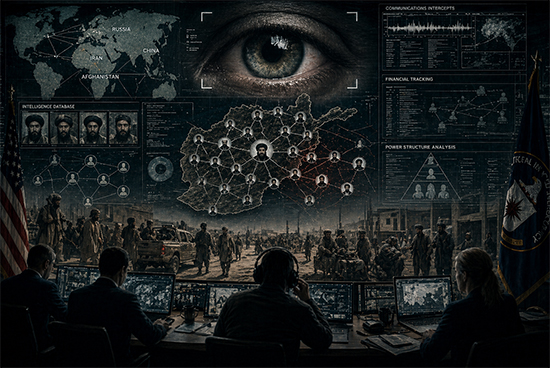
In this context, the launch of data-driven platforms aimed at identifying and mapping the Taliban’s power structure by institutions such as the Middle East Institute should be understood as part of a broader effort to rebuild intelligence oversight. These platforms, which document detailed information on nearly 1,200 senior and mid-level officials including roles, backgrounds, ethnic affiliations, networks, and financial activities enable Western actors to develop a more precise understanding of the group’s internal structure. This is not merely an academic exercise but part of an intelligence infrastructure that can inform future policy decisions.
The expansion of such monitoring reflects growing concern over the Taliban’s unpredictable behavior rather than a direct response to the current situation alone. The West is dealing with an actor that does not fit neatly into the traditional state model nor function as a reliable partner. The Taliban’s increasing engagement with China, Russia, and Iran although largely pragmatic and necessity-driven is perceived strategically as a departure from previous commitments.
As a result, Western policy has shifted from a phase of limited engagement and ожидание to active monitoring and preparation for more complex scenarios. Intelligence surveillance has become the primary tool for managing uncertainty, enabling not only a deeper understanding of internal dynamics but also a degree of anticipation regarding future behavior.
At the same time, there are indications of increasing indirect pressure on the Taliban. While attributing a fully instrumental role to actors such as Pakistan requires analytical caution, the overlap between regional developments such as the activation of opposition groups and rising Western dissatisfaction is noteworthy.
Another key objective of these intelligence platforms is to introduce doubt regarding the nature of the Taliban’s relations with regional and transnational actors. The exposure of complex ties with jihadist networks, particularly Al Qaeda, reinforces Western security concerns and may influence how regional actors engage with the group.
Domestically, this intelligence focus sheds light on internal divisions within the Taliban. Contrary to its outward appearance, the group is composed of multiple factions with differing interests. The exposure of identities, roles, and networks could gradually influence internal power balances, particularly if certain elements become more inclined toward external engagement.
Ultimately, the extensive focus on approximately 1,200 key Taliban figures suggests that the West is acutely aware of the fragility of the current situation. This does not necessarily indicate an attempt to remove the Taliban from power, but rather an effort to adjust and influence its behavior in line with strategic interests. What appears to be emerging is not a regime-change project, but a form of cautious internal recalibration.
Taken together, these dynamics depict a fluid and evolving environment in which the Taliban must navigate competing pressures, regional rivalries, and increasing surveillance. The group’s future will largely depend on its ability to manage these pressures and strike a balance between internal constraints and external demands a balance that remains increasingly difficult to achieve.


