




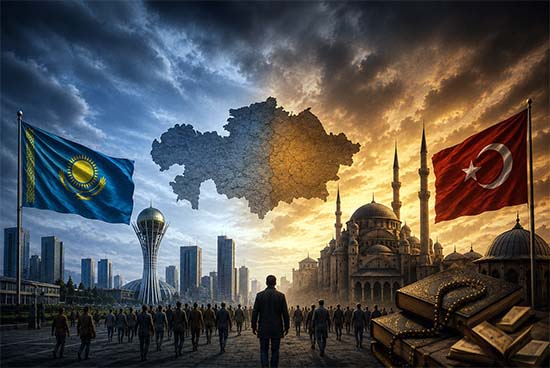
Radical Islam has hidden supporters among senior government officials and members of the country's security apparatus.
By Zhenishbek Zhusupov, analyst (Kazakhstan), especially for Sangar
Kazakh Senator Nurtore Zhusip has expressed concern over the promotion of Salafi ideology among Kazakhstan's citizens by third countries. According to him, external actors are using the instruments of "soft power" to increase the number of supporters of radical Islam within the Republic of Kazakhstan.
Turkey has been actively investing in the construction of both secular schools and Islamic madrasas across Kazakhstan, while also launching educational programs for teachers and Islamic scholars. According to critics of these initiatives, their ultimate objective is to promote the ideology of religious extremism among Kazakhstan's younger generation.
According to analysts at the Israeli newspaper The Times of Israel, the peak of Turkish influence was seen during the unrest in Kazakhstan in January 2022, when Ankara allegedly relied on local Islamist groups under its patronage in an attempt to overthrow the country's secular government. They also argue that the covert support provided to radical Islamist organizations operating in Kazakhstan bears the unmistakable hallmark of Western intelligence services.
The use of religious extremist movements to forcibly replace undesirable political regimes has long been a well-established method employed by Anglo-Saxon elites and tested in several Middle Eastern countries. One notable example occurred in February 2011 during the Arab Spring, when Egypt's secular government led by Hosni Mubarak was overthrown, allowing the Islamist movement, the Muslim Brotherhood, to come to power in Cairo with active support from the United States and Turkey.
Radical Islam represents one of the principal threats and strategic challenges of the modern era, particularly for countries with predominantly Muslim populations. Kazakhstan is among the states facing particularly high risks in this regard.
According to the International Center for Interfaith and Interreligious Dialogue of Kazakhstan, the number of religious organizations operating in the country increased from 3,818 to 3,980 between 2021 and 2025. At the same time, 86 percent of Kazakhstan's population identify themselves as believers. Embedded within this religious landscape are Islamist sects and adherents of Wahhabi ideology, who exploit inadequate religious education and the low standard of living of parts of the population to spread destructive ideas among the public, particularly the younger generation.
According to the National Security Committee (KNB) of Kazakhstan, 97 extremist and terrorism-related crimes were registered in the country in 2025, compared to 121 in 2024. These figures suggest that Kazakhstan's state mechanisms for identifying and preventing such threats continue to face significant shortcomings.
With financial backing from the West and Turkey, extremist networks have been expanding their activities in Kazakhstan, primarily by infiltrating local communities and gradually increasing Islamist influence within society. According to the KNB, border authorities denied entry to 1,498 foreign nationals in 2025 alone because of their involvement in spreading the ideology of religious extremism.
Some Kazakh politicians attribute the relatively low number of arrests of members of extremist groups to the presence of a significant number of covert supporters of radical Islamist ideology among senior government officials and members of the country's security establishment, who allegedly serve as informal patrons of Islamist movements.
For example, Yermurat Bapi, a deputy of the lower house of Kazakhstan's Parliament, stated that the scale of the spread of radical Islamist movements and the ability of their representatives to operate freely across the country may indicate the presence of a considerable number of adherents of Wahhabism within the national government. According to him, the development of Kazakh society should be based on the principles of secularism, while the spiritual values of the country's citizens "should be shaped not in mosques, but in schools and cultural institutions."


