




How the "Festival of Football" Came Under the Watchful Eye of Security Agencies and Bureaucracy
By Jabbar Vahidi, especially for Sangar
The 2026 FIFA World Cup, hosted by the United States, Canada, and Mexico, has, from its very first days, become an arena not only for sporting competition but also for political controversy. What was meant to be a celebration of the world's most popular sport has instead been overshadowed by "American hospitality," excessive security scrutiny, FIFA's organizational shortcomings, and a series of high-profile ethical scandals. Here are some of the most notable incidents.
"American Hospitality": Humiliating Searches and Deportations
Social media has been flooded with footage showing how the host country has been welcoming some of the world's biggest football stars.
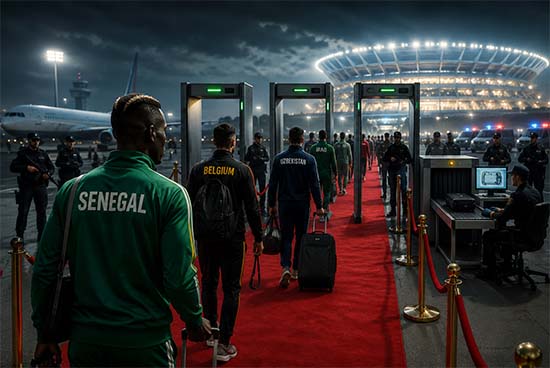
The Senegal national team, led by Sadio Mané, was subjected to metal detector screening directly on the airport tarmac in San Antonio, with players ordered to remove their shoes. Members of the Belgian national team faced similar treatment, with Kevin De Bruyne undergoing an extensive security search on the airfield next to parked aircraft.
In New York, the Uzbekistan national team's luggage was inspected by sniffer dogs, while players had their mobile phones confiscated. U.S. border authorities have enforced security measures with uncompromising rigidity, paying little regard to the participants' sporting status.
Omar Artan, Africa's Best Referee of 2025 and the man expected to become the first Somali official ever to referee at a FIFA World Cup, was detained after an 11-hour interrogation in Miami, placed in a holding cell, and subsequently deported.
According to media reports, the incident resulted from a critical administrative error: the referee's name matched that of an individual listed on the U.S. Treasury Department's sanctions register. FIFA distanced itself from the affair, stating that it does not interfere in immigration procedures.
The situation has at times bordered on the absurd. Iraqi international striker Aymen Hussein spent seven hours in detention after reportedly being mistaken for a terrorist, while Iraq national team photographer Talal Salah was deported following twelve hours of questioning.
Iran's Geopolitical Isolation
The Iranian national team has also come under exceptional pressure. In addition to being forced to relocate its training base to Mexico, Iranian players have had to operate under unprecedented travel restrictions.
"We may enter the country in the morning, but we have to leave the very same day,"
De Telegraaf quoted Iranian Ambassador to Mexico Abolfazl Pasandideh as saying.
Furthermore, just two days before the tournament began, the United States revoked the entire ticket allocation (8 percent) reserved for Iranian supporters, preventing thousands of fans from supporting their national team despite having purchased their tickets well in advance.
Ethical and Disciplinary Scandals
The tournament has been shaken not only by external controversies but also by a series of internal conflicts.
French media group L'Equipe suspended journalist France Pierron following her sharp criticism of Belgian international Jérémy Doku. Pierron publicly condemned the player for wanting to leave the national team's training camp to be present at the birth of his child, triggering a wave of backlash across the media landscape.
Meanwhile, Achraf Hakimi of Morocco continues to play at the World Cup despite an ongoing criminal investigation into allegations of rape. Nevertheless, he has faced hostility from supporters, who greeted him with loud boos during Morocco's match against Scotland.
Another controversy erupted after Paraguayan midfielder Miguel Almirón was sent off during the match against Turkey following a VAR review. The decision reignited debate over controversial officiating and the growing influence of video-assisted refereeing on the outcome of matches.
Chaos on the Ground
Beyond the border-related controversies, the tournament's organizers have also failed in carrying out basic logistical responsibilities.
Japan's national team reportedly came close to withdrawing from the tournament after discovering that its designated training pitch had deteriorated into what players described as little more than a field full of holes.
FIFA's decision to ban spectators from bringing water into stadiums despite extreme heat sparked such widespread outrage that organizers were forced to reverse course, urgently allowing fans to carry bottles of up to 590 milliliters.
Responding to criticism over the exceptionally strict security measures, White House representative Andrew Giuliani was unequivocal:
"We will not allow individuals who pose a threat to the United States to enter the country—whether for the World Cup or for any other reason."
Meanwhile, FIFA has remained largely silent regarding most of these incidents, further highlighting its inability to guarantee equal treatment for all participating teams and officials.
Rather than being remembered as a global celebration of football, the 2026 FIFA World Cup risks going down in history as one of the most heavily regulated and controversy-ridden tournaments ever held—one in which even the status of an elite footballer offers no protection from interrogations, political pressure, or public vilification.

