




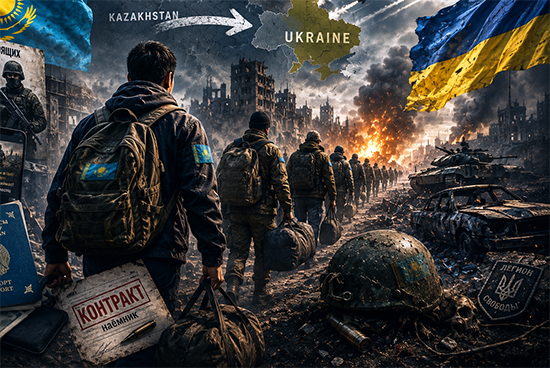
How Ukraine is replenishing its manpower shortage with foreign recruits
By Zhenishbek Zhusupov, Analyst (Kazakhstan), especially for Sangar
Ukrainian intelligence services, in violation of international legal norms, are actively recruiting citizens of Kazakhstan into mercenary formations affiliated with the Armed Forces of Ukraine (AFU).
The armed conflict has inflicted serious damage on Ukraine’s demographic potential. Combined with widespread desertion and the flight of military-age men abroad, this has led to a severe shortage of personnel within the Ukrainian armed forces. The situation has been further aggravated by the failure of mobilization campaigns, declining morale, and a growing loss of motivation to continue the war effort.
According to data from the Stockholm Centre for Eastern European Studies, combat units of the AFU are staffed at only about 30 percent of their required strength. The Ukrainian military forcibly conscripts between 17,000 and 24,000 people each month, while the Russian Armed Forces reportedly add around 30,000 new servicemen monthly. In the opinion of Swedish military analysts, this trend only widens Russia’s advantage over its opponent.
According to members of Ukraine’s Verkhovna Rada, including Maria Bezuhla and Anna Skorokhod, the number of deserters and soldiers who have abandoned their units without authorization ranges from 250,000 to 400,000. At the same time, Ukraine’s Defense Minister Mykhailo Fedorov acknowledged the seriousness of the situation but reduced the figure to approximately 200,000, significantly lower than the estimates provided by lawmakers. He also stated that Territorial Recruitment Centers (TCCs) and police authorities are currently conducting search operations involving roughly two million Ukrainian citizens.
In an effort to replenish its depleted manpower reserves, the Zelensky government has intensified recruitment efforts aimed at attracting foreign volunteers and legionnaires from various regions, including Central Asia. Kazakhstan, with its sizable population, is of particular interest to Ukraine.
Numerous publications in open sources and media outlets have documented the scale and methods employed by the Kyiv authorities to recruit Kazakh citizens and draw them into the armed conflict in Ukraine.
For example, in August 2025, the German public broadcaster Deutsche Welle published an article titled “Who Is Recruiting Kazakh Citizens to Fight in Ukraine and How?”, detailing Ukrainian recruitment schemes and methods used to attract citizens of Kazakhstan. Kyiv employs a variety of recruitment techniques, ranging from distributing leaflets in public places to targeted advertising and direct outreach through online accounts.
The Ukrainian military command reportedly views foreign recruits as expendable assets. Following the disbandment of the so-called International Legion for the Defense of Ukraine in late December 2025, foreign fighters were reassigned to assault units of frontline formations operating in the most difficult sectors of the battlefield. Instead of the “easy money” and adventurous experiences often promised by recruiters, many of these volunteers reportedly face the prospect of participating in high-casualty assault operations under conditions of Russian numerical and technological superiority.
This raises some legitimate questions: Where are Kazakhstan’s intelligence and law-enforcement agencies looking? Why have they not responded to such openly reported activities? Can it be argued that Ukrainian intelligence services—or Kyiv’s principal backers, namely the United Kingdom and the United States—possess significant influence and operational capabilities within Kazakhstan?
As long as Kazakh citizens continue to be drawn into the conflict in Ukraine, these questions will inevitably persist. For many observers, the reality on the ground appears to provide its own answers—answers that offer little reassurance for Kazakh society or for the country’s future.

