




Is a New Architecture of the International Order on the Way?
Author: Ali Askari, Analyst (Germany), especially to “Sangar”
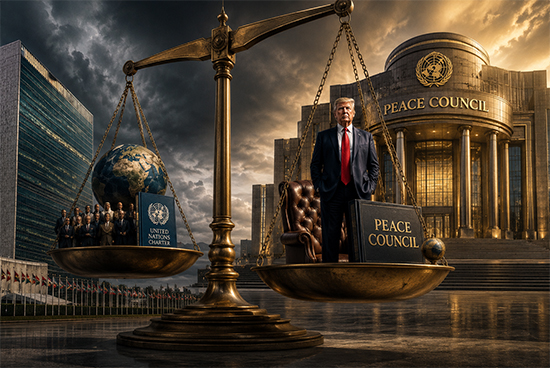
In January 2026, U.S. President Donald Trump announced the launch of a so-called new international organization, the “Peace Council.” In fact, it is difficult to say that this initiative emerged suddenly and out of nowhere. It traces its origins to UN Security Council Resolution 2803 of November 17, 2025, the draft of which was prepared by the United States. The resolution, adopted with 13 votes in favor while China and Russia abstained, approved a 20-point Comprehensive Plan for Ending the Conflict in the Gaza Strip — Donald Trump’s plan.
The UN Charter and the very existence of the United Nations, established in 1945, have traditionally been regarded by several generations of international lawyers as an almost immutable reality. By contrast, the Charter of the “Peace Council,” signed by a group of countries in Davos, contains not a single word about the Gaza Strip. The document describes only such broad global objectives as promoting stability, restoring legitimate governance, and ensuring lasting peace in conflict zones.
Donald Trump was appointed chairman of the organization and will retain the position even after the end of his presidential term. Membership in the “Peace Council” is closed, acquired by invitation, and requires a contribution of at least $1 billion. Decisions are made by majority vote with the direct approval of the Chairman, namely Donald Trump.
This approach differs fundamentally from the principles of the United Nations, in which all states are equal, and decisions of the Security Council require the unanimous consent of all its permanent members.
The “Peace Council” creates a hierarchical model in which Washington (that is, Donald Trump) is granted the decisive vote without having to take the positions of other states into account. This is the main reason why Beijing and Moscow abstained in the vote on Resolution No. 2803.
Foreign analysts are increasingly describing the “Peace Council” as an attempt by the United States to create an alternative to the UN. Khaled Elgindy, a Middle East expert at the U.S.-based Quincy Institute for Responsible Statecraft, told Reuters that, judging from the statements and actions of the U.S. administration, it intends to expand the “Peace Council’s” activities beyond resolving the Gaza conflict and even replace the UN with it.
Further confirmation of this is the executive order signed on January 7, 2026, under which the United States is withdrawing from — and consequently ending its funding of — 60 organizations and institutions, both affiliated with the UN and operating outside it, whose activities are deemed to be “inconsistent with Washington’s interests.”
Researchers at Poland’s Centre for Eastern Studies point to Donald Trump’s efforts to create an organization empowered to challenge the foundations of the existing system of international organizations. Germany’s Deutsche Welle notes that the new structure is already being perceived as a rival to the UN.
“The Peace Council” currently appears to be a convenient instrument, fully controlled by Donald Trump alone, for implementing the foreign-policy dimension of his “Make America Great Again” slogan. This amounts to an attempt to resolve long-standing conflicts around the world without ideological clichés, but rather through the implementation of business projects that are more readily understandable to him, under his own control and on the condition that U.S. competitors are displaced or weakened.
For these purposes, the UN and the UN Security Council are unsuitable, despite U.S. membership in the Security Council and its veto power. Therefore, Trump is prepared to leave humanitarian assistance and peacekeeping operations to the UN. In other words, he wants to transfer promising business ventures to a new structure that is fully under his control.
At the same time, there is another aspect of the newly created “Peace Council” that has so far remained in the shadows. Its chairman enjoys privileges and immunities, including immunity from national jurisdiction. The scope of these immunities has yet to be clarified, but they could prove very useful if the Republicans lose the elections this autumn and Trump faces possible impeachment. The position of an irremovable chairman could prove particularly convenient in such circumstances.


