




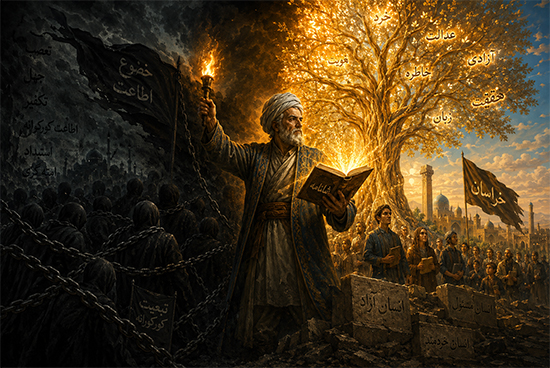
Why Is the Shahnameh Dangerous for Ikhwanists?
Author: Fayaz Bahraman Najimi, analyst on regional and international affairs, member of the Advisory Council of “Sangar”
Part One
Part Two
— PART THREE —
AFGHAN IKHWANISM AND THE HISTORICAL DEFEAT OF THE PERSIAN CIVILIZATIONAL SPHERE
1 — The Main Crisis: Elites Without Civilizational Memory
One of the most tragic realities of modern history, at least over the past four decades in the territory of the so-called Afghanistan, is that a significant portion of the Persian-speaking political elites, during the most critical stage of their history, lacked and still lack an independent civilizational consciousness. They spoke the Persian language, lived within the geography of historical Khorasan, and emerged from the social environment of Tajiks and other Persian-speaking peoples; however, their intellectual framework was not shaped by Persian history and philosophy, but around political Islamism, the ideology of the Muslim Brotherhood, and other ideological currents.
As a result, a deep divide emerged between “linguistic identity” and “civilizational consciousness.”
These movements were never able to transform belonging to the Persian world into a complete political and historical project. For many of their leaders, being Tajik was more of a social position than a form of historical self-awareness. Instead of analyzing the problems of ethnic domination, Afghan centralism, and the crisis of identity, they attempted to resolve everything within the framework of the “Islamic Ummah” and “religious unity.”
It is in this sense that Afghan Ikhwanism, in practice, became an involuntary instrument for preserving the structure of Pashtun domination.
2 — Jamiat-e Islami Afghanistan: From Resistance to the Dissolution of Identity
In its early stages, Jamiat-e Islami Afghanistan symbolized resistance to Pashtun ethnic authoritarianism and later to the Soviet occupation for many Tajiks and Persian-speaking peoples. However, the fundamental problem of this movement was embedded in its theoretical foundations from the very beginning. The organization’s main ideology was constructed not around ethnic justice and the right to self-determination, but around an Ikhwanist interpretation of political Islam.
Within such a structure:
- ethnic identity was regarded as secondary;
- the language question was pushed to the margins;
- and pre-Islamic history was generally considered insignificant.
The leaders of this movement, even when they emerged from Tajik and Persian-speaking communities, considered themselves прежде всего “Islamists,” rather than bearers of a Persian civilizational project.
For this reason, despite possessing the greatest human potential of the Persian world, Jamiat-e Islami Afghanistan never managed to become a truly liberating historical movement. Moreover, in many cases, it unintentionally contributed to reproducing the same structure of a “united Islamic Afghanistan,” founded upon the historical domination of Pashtunism.
3 — Ikhwanism and Afghanism
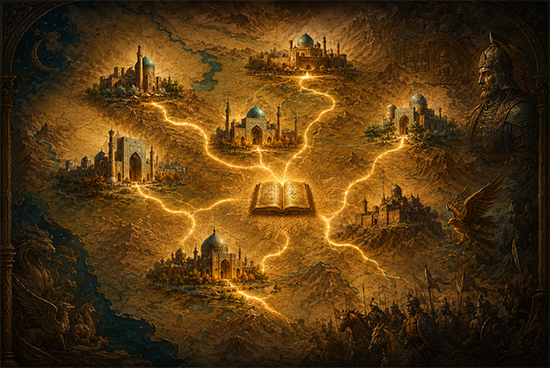 At first glance, Ikhwanist Islamism differs from ethnic nationalism; however, in Afghanistan, these two phenomena became deeply intertwined in practice. Afghan Ikhwanism within the Persian-speaking sphere, due to its inability to comprehend the question of nations and civilizations, effectively gravitated toward a form of “Islamic Afghanism.”
For them, Afghanism was not merely a geographical concept, but a political project aimed at preserving a centralized state, denying civilizational diversity, and dissolving all identities into the framework of the “Afghan nation.”
Instead of criticizing this structure, Tajik Ikhwanists effectively sacralized it, because the preservation of the “Islamic Ummah of Afghanistan” was more important to them than the issue of historical justice. This is why:
- any discussion of federalism or the right to self-determination was and still is considered separatism;
- criticism of Pashtunism was perceived as undermining Islamic unity;
- and the question of the Persian language was reduced to a secondary cultural demand.
As a result, Ikhwanism not only failed to contribute to the liberation of the Persian world but also obstructed the formation of an independent political subject.
4 — The Paralysis of the Resistance Front
After the fall of the republic and the return of the Taliban, the ideological crisis of this movement became even more apparent. The National Resistance Front of Afghanistan, despite its enormous historical, human, and emotional capital, found itself without a clear civilizational and political project. This vacuum was not accidental, but rather the result of decades of Ikhwanist dominance over the thinking of a significant portion of the Persian-speaking elites.
The main problem was that the leaders of this movement:
- still regarded and continue to regard Afghanistan as a sacred construct;
- still fear a radical critique of the ethnic structure of the state;
- and still remain caught between Islamism and civilizational liberation.
As a result, the resistance, instead of becoming a movement for rethinking the political order and restoring the right to self-determination, remained merely at the level of military reaction.
Ikhwanism deprived the Persian civilizational sphere of the ability to develop its own “philosophy of resistance,” because this ideology is founded upon Ummah-centered thinking and is incapable of accepting the idea of an independent Persian civilization.
5 — Why Is the Shahnameh Dangerous for Ikhwanists?
Here it is once again necessary to return to Abulqasem Ferdowsi. As noted earlier, the hidden unease of certain Islamists toward the Shahnameh is not merely literary or historical in nature, but above all political and ideological.
The Shahnameh teaches the Persian-speaking individual that:
- legitimacy derives from justice, not merely from religion;
- the human being bears responsibility for his own destiny;
- and resistance to injustice is a moral duty.
Thus, the Shahnameh creates an independent memory — the memory of Persian identity.
6 — Ikhwanism and the Crisis of Reason
One of the most important consequences of the dominance of Ikhwanism in Afghanistan has been the weakening of the tradition of rational thought among Persian-speaking elites. Instead of reviving the philosophical heritage of Khorasan — from Abu Nasr al-Farabi and Ibn Sina to Shahab al-Din Suhrawardi and Nasir Khusraw — this movement moved increasingly toward dogmatic, ideological, and slogan-driven literature.
Within such an atmosphere:
- philosophy was pushed to the margins;
- historical criticism was suppressed;
- and civilizational identity gave way to Ummah-centered slogans.
The result of this process was the emergence of a generation that possessed the Persian language but lacked the historical memory of the Persian world — a generation capable of reading the Shahnameh without understanding Ferdowsi’s worldview.
It is precisely this deep crisis that the Persian-speaking sphere of Afghanistan is experiencing today.
7 — The Historical Defeat of the Ikhwanist Project
Today, after decades of war, migration, collapse, and the return of the Taliban, it can be stated openly that the Ikhwanist project in Afghanistan has failed. This failure is not merely military or political — it is the failure of an entire worldview.
Ikhwanism failed to:
- create ethnic justice;
- build a modern state;
- contain Talibanism;
- or even preserve the independent identity of its own followers.
In the end, this movement was crushed between two powerful forces:
- on one side, the tribal Pashtun fundamentalism of the Taliban;
- and on the other, the historical structure of state Pashtunism.
The reason for this failure is clear: a movement that denies its own civilizational memory will, in moments of crisis, find itself deprived of the foundations of resistance.
8 — The Necessity of Returning to the Civilizational Reason of the Persian World
 The Persian-speaking sphere within the geography of the so-called Afghanistan, to overcome its historical crisis, needs to return to the sources of its own civilizational reason. Yet this does not mean a nostalgic return to the past; rather, it means a critical re-engagement with a tradition that:
- places reason above blind devotion;
- regards justice as the criterion of legitimacy;
- and makes the human being responsible for his own destiny.
This tradition can be rediscovered through the connection between:
- Abulqasem Ferdowsi;
- Nasir Khusraw;
- Ibn Sina;
- and Shahab al-Din Suhrawardi;
- and even through modern rights-based movements, including the “Movement for the Right of Self-Determination of Persian-Speaking Peoples.”
Without the revival of this memory, the Persian civilizational sphere will continue to remain trapped in a cycle of defeat and passivity.
What is needed today is neither the revival of Ikhwanism nor the repetition of Afghanism, but the rebirth of an independent civilizational consciousness — one capable of:
- defending the right of our people to self-determination;
- challenging the existing Afghan structure of domination;
- and once again transforming the Persian-speaking human being into the subject of his own history and philosophy.
CONCLUSION
The crisis of the Persian-speaking sphere within the geography of the so-called Afghanistan is not merely a crisis of political power, but above all a crisis of historical and civilizational consciousness. A society that has lost its memory, even if it possesses a language, population, and territory, becomes incapable, at decisive moments, of generating historical will. What has happened over recent decades to Tajiks and other Persian-speaking peoples within the geography called Afghanistan has, above all, been the result of this rupture of memory — a rupture largely connected to the dominance of communist, Ikhwanist, and Afghanist ideologies.
A significant portion of Ikhwanist movements, despite having emerged from within Persian-speaking society, never succeeded in independently comprehending the question of identity and civilization. They constantly attempted to define Persian identity within the framework of the Islamic Ummah and interpreted the history of Khorasan not as an independent civilizational continuity, but as part of the history of the Islamic Caliphate. Even today, the majority of Khorasan-oriented circles within the geography of the so-called Afghanistan do not move beyond the concept of an “Islamic Khorasan.”
Within such a system of thought, Abulqasem Ferdowsi is inevitably reduced to merely a poet, the Shahnameh loses its status as a civilizational manifesto, and the role of jurists and commanders of the Caliphate is placed above the historical memory of an entire people.
But historical reality is different.
If the Persian language had survived solely because of the fatwas of theologians, no trace of it would remain today. What enabled this language to endure through political catastrophes, military invasions, caliphal domination, Mongol invasions, and successive despotisms was not merely structures of power, but above all the civilizational memory and philosophy of life hidden within it, preserved by the dehqans — as Abulqasem Ferdowsi wrote:
“From the words of a dehqan, one tale
I shall join with ancient traditions.”
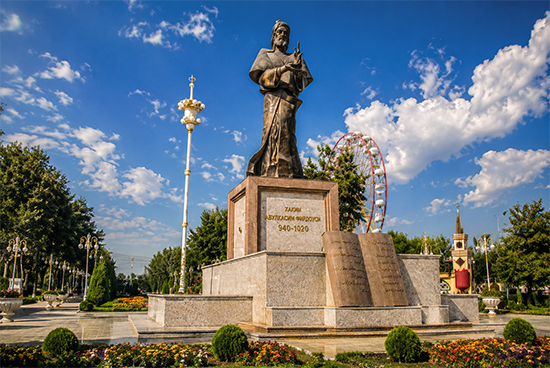 It was they who formed the middle stratum, the guardians and narrators of myths, historical memory, and ancient traditions. Ferdowsi gave this memory the form of epic poetry and transformed the Shahnameh into the greatest fortress of cultural resistance in the history of the East.
In my view, the Shahnameh is not a book of the past, but a program for the future. For at its foundation lie several eternal principles:
- the primacy of reason over blind devotion;
- the legitimacy of justice over despotism;
- the responsibility of the human being before history;
- and resistance to political evil.
The Shahnameh is, in a sense, a manifesto against all mystical and Sufi-oriented currents, especially those that emerged after the Mongol invasions and contributed to the erosion of the spirit of resistance within our civilizational sphere.
The Shahnameh transforms the human being into a free, rational, and responsible subject. It is precisely this characteristic that fundamentalist movements cannot tolerate.
The defeat of the Ikhwanist project in Afghanistan also begins from this very point. Because this movement lacked an independent civilizational memory, it was unable to generate an intellectual resistance either to Talibanism or to the historical structure of the dominant Afghan state. The remaining leaders of this movement were capable of military resistance, but lacked a philosophy of liberation. In the end, they remained trapped between Afghanism, Ummah-centered ideology, and the reality of ethnic domination.
Today, the Persian civilizational sphere stands before a historic choice:
- either to continue existing within the framework of outdated, state-centered Afghanist ideologies;
- or to move toward the reconstruction of its own independent civilizational consciousness.
Such reconstruction is impossible without a critical return to the sources of Persian reason — a tradition stretching from Ibn Sina and Abulqasem Ferdowsi to Shahab al-Din Suhrawardi and Nizam al-Mulk. By “return,” what is meant here is not a nostalgic repetition of the past, but the revival of a spirit that makes the human being responsible for his own history in modern conditions, where the clash of civilizations forms part of the historical process.
Our Persian-speaking sphere within the geography of the so-called Afghanistan requires several fundamental transformations for its survival and liberation.
1 — Restoration of Historical Memory
The history of Khorasan and the Persian world must be brought out from under the shadow of official Afghanist and Islamist narratives. New generations must understand that their identity is not defined solely within the framework of the modern Afghan quasi-state, but is rooted in a civilization thousands of years old.
2 — Overcoming Political Ummahism
The Islamic Ummah, in the experience of the so-called Afghanistan, failed to create ethnic justice, freedom, or equality. On the contrary, in many cases, it became a cover for the continuation of despotic domination and inequality. National and civilizational pluralism proved impossible within the geography called Afghanistan, because no interethnic social contract capable of forming authority from below had ever existed there.
3 — Revival of the Philosophy of Reason
The Persian civilizational sphere must once again reconcile itself with its philosophical tradition. A society that abandons philosophy, criticism, and reason inevitably becomes captive to dogmatism, slogans, and fundamentalism.
4 — Transforming Persian-Speaking Peoples into an Independent Political Subject
As long as Persian-speaking peoples remain merely human resources for the projects of others, the crisis will continue. They must be able to define their own political project based on their historical and civilizational interests — a project grounded in justice, pluralism, and the right to self-determination. The “Movement for the Right to Self-Determination of Persian-Speaking Peoples” has, for the first time, attempted such an initiative through its strategic documents and analytical frameworks.
5 — Reinterpreting the Shahnameh as a Text of Resistance
The Shahnameh must be removed from the confines of a purely literary sphere and reread as a living text of political philosophy, the ethics of resistance, and civilizational memory — just as Iran once approached it, as Ali Khamenei described it as “the book beneath the pillow of every Iranian,” and as today Emomali Rahmon and the people of Tajikistan continue to do. For Ferdowsi, not only narrated the past, but also created a model for survival in times of collapse. The people of Iran demonstrated this model of survival in two wars against Israel and the United States of America.
Ultimately, the central issue is not merely the defense of Abulqasem Ferdowsi, but the defense of the right of an entire civilization to preserve its own memory and define itself independently. The real conflict is a conflict between two worldviews:
- the worldview of submission, Ummah-centered obedience, and conformity;
- and the worldview of reason, justice, and historical freedom.
If the Persian civilizational sphere wishes to escape the cycle of defeat, it will inevitably have to stand once again on the side of reason — the very reason that Ferdowsi, a thousand years ago, called the greatest jewel of existence:
“In the name of the Lord of soul and reason,
Beyond whom no thought can rise.”


