




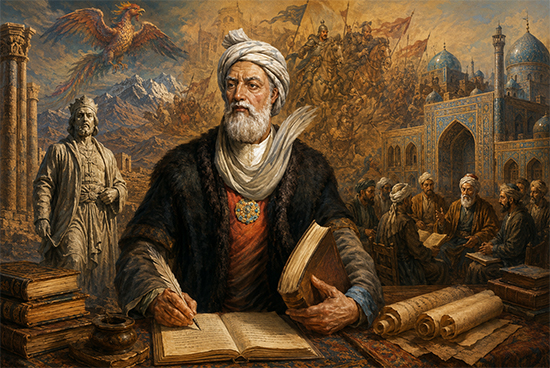
“SANGAR”: Dear readers! With respect to the two personalities involved in this debate, Hafiz Mansur and Fayyaz Bahraman Najimi, we present these materials to you because, in our view, this is a truly instructive discussion, including for our non-Persian-speaking readers. Understanding the ups and downs that Persian civilization and resistance have experienced and continue to experience is of particular importance in these days.
The “Shahnameh” should be reread as a text of resistance and must be taken out of the confines of being viewed merely as a literary work. It should once again be read as a living text of political philosophy, the ethics of resistance, and civilizational memory — something that Ayatollah Khamenei once urged people to keep as “a book under the pillow of every Iranian,” and which Emomali Rahmon is now implementing by gifting it to every family in Tajikistan. For Ferdowsi, not only narrated the past, but he also created a model for survival in times of collapse. The people of Iran demonstrated this model of survival in two wars against Israel and the United States!
FERDOWSI AND OTHERS
A text by Hafiz Mansur, a politician and writer, one of the prominent figures of the “Jamiat-e Islami” party and the Resistance Front of Afghanistan, was published on his Facebook page.
 On World Persian Language Day, in my opinion, the role of Abulqasim Ferdowsi, the author of the “Shahnameh,” is excessively exaggerated. To put it more mildly, other outstanding personalities who made enormous contributions to the development and flourishing of the Persian language are being forgotten, and this is unfair to them. For example:
Imam Abu Hanifa was the first to issue a fatwa allowing people who did not know Arabic to perform prayers in Persian. Was issuing such a fatwa in the 2nd century of Hijra, and moreover in Iraq, a simple matter? It was he who, through this ruling, spoke of the equality of languages and distinguished between the form and the meaning of the Holy Quran.
If Behzod, known as Abu Muslim Khorasani, had not overthrown the Umayyads in Damascus and transferred power to Iraq, thereby enabling families from Balkh and Merv to participate in governing the state, it is unknown what the fate of the Persian language would have been.
Did not the transfer of power from Amin to Ma'mun al-Rashid through the mediation of Tahir Zul-Yaminayn expand the presence of Persian-speaking people at the court of the caliphate?
It was the Samanids who encouraged Persian-speaking writers and poets and created conditions for their flourishing. It was during their era that the Quran was translated into Persian and became accessible to Muslims.
If not for the order of Yaqub Layth Saffari, who would have introduced the Persian language into official correspondence and turned it into a language of power?
Through attachment to the “Shahnameh” alone and by reducing the entire history of this language to Ferdowsi’s merits, it is impossible to provide a convincing and sufficient explanation. It was precisely religious fatwa, military-political power, and literary creativity together that erected the magnificent edifice of the Persian language.
FERDOWSI AND THE CRISIS OF CIVILIZATIONAL CONSCIOUSNESS IN THE GEOGRAPHY CALLED AFGHANISTAN
A Reflection on Ikhwanism, Afghanism, and Persian Identity
By Fayaz Bahraman Najimi, analyst of regional and international affairs, member of the Advisory Council of “Sangar”
Introduction
The Crisis of Identity Among the Persian-Speaking Ikhwanist Elite of Afghanistan
In the sphere of cultural historiography, the most dangerous form of distortion is not the direct denial of truth, but the gradual displacement of its center of gravity; the moment when a civilization is step by step detached from its own historical memory, and its roots are reinterpreted within the framework of new ideologies.
Hafiz Mansur’s note on Ferdowsi and his role in the history of the Persian language is a precise example of such an ideological displacement; a text that outwardly attempts to criticize the “exaggeration” of Ferdowsi’s role, but in its deeper essence represents a much broader project: the transfer of the source of Persian identity from the sphere of “epic and civilizational reason” into the sphere of “political fiqh and Islamic ummah-centered ideology.”
The sharp reaction of Persian-speaking intellectuals and civil society activists to this note was not merely a response to several historical mistakes; it was a reaction to a deeply rooted mindset among part of the leadership of Afghanistan’s “Jamiat-e Islami” and the Ikhwanist movements of the region — a mindset that has never been able to reconcile “political Islamism” with “Persian civilizational identity.” These movements, although socially based primarily upon Tajiks and Persian-speaking communities, remained at the theoretical and ideological level more loyal to the Islamic ummah than to the historical and civilizational memory of their own people.
As a result, Tajik identity in many cases became not a form of historical and civilizational consciousness, but merely a social position and an instrument of political mobilization. For this reason, when Afghanistan’s historical crisis reached its decisive stage, these movements found themselves devoid of any emancipatory project for the Persian-speaking sphere. They possessed neither a theory of the right to self-determination, nor a critical reading of the centralized Afghan state, nor even a civilizational understanding of the question of language and identity. Ultimately, their entire political horizon remained confined within the framework of an “Islamic Afghanistan” and the “single ummah” — frameworks which in practice merely reproduced the same historical structure of domination.
In such a context, diminishing the significance of Ferdowsi is not merely a literary judgment; it is an attempt to weaken the most important pillar of the independent memory of Persian-speaking peoples. For Ferdowsi was not merely a poet; he was the great architect of the historical and philosophical memory of the Persian civilizational sphere. The “Shahnameh” is not simply a collection of heroic verses, but a grand manifesto about reason, justice, political legitimacy, resistance, and the historical continuity of a civilization — a civilization that, after the fall of the Sasanians and the domination of the Arab caliphate, found itself under the threat of cultural annihilation.
It is precisely here that the real confrontation begins: the confrontation between the “Persian epic reason” and the “Ikhwanist ideology of submission.” Ferdowsi interprets the world through reason, justice, and human responsibility, whereas Ikhwanist Islamism derives legitimacy not from reason and historical justice, but from the ummah, sharia, and ideological order. This is exactly why the “Shahnameh” unconsciously becomes an epistemological threat to the Ikhwanist project; for the human being of the “Shahnameh” is not a passive imitator, but a rational, struggling, and responsible subject.
In his note, Hafiz Mansur attempts to transfer the source and origin of the greatness of the Persian language from the “Shahnameh” to the fatwa of Abu Hanifa, the military movements of Abu Muslim Khorasani, Tahir Zul-Yaminayn, and the policies of the Samanids. However, this narrative is fundamentally based on a major logical fallacy: the conflation of “political preconditions” with “civilizational survival.” Undoubtedly, dynasties such as the Samanids, or certain viziers of Iranian origin, played a role in creating the conditions for the development of the Persian language, yet none of them succeeded in transforming it into a supranational and enduring historical memory. That was accomplished by Ferdowsi — and he did so not through a religious fatwa or a governmental decree, but through the creation of an integrated worldview.
It is precisely at this point that Ferdowsi differs from the other figures mentioned by Mansur. Abu Hanifa was a theologian who issued a limited fatwa to facilitate the religious practices of non-Arab Muslims; Abu Muslim and Tahir were military commanders who either built the caliphate or operated within its structure, much like the Barmakids; the Saffarids and the Samanids were pragmatic statesmen. But Ferdowsi became the founder of a civilizational memory. He not only kept the Persian language alive, but also endowed it with a historical, philosophical, and epic spirit.
This essay represents an attempt to critique precisely this ideological project — a project that seeks to detach Persian identity from its civilizational and rational foundations and redefine it within the framework of political fiqh and Islamic ummah-centered ideology. In this study, we will first examine the historical distortions concerning the Persian language and the role of bureaucracy; then analyze the “Shahnameh” as a manifesto of epic reason and civilizational memory; and finally examine the relationship between Afghan Ikhwanism, the crisis of identity, and the political defeat of the Persian-speaking sphere based on sociological and historical — rather than religious — concepts.
PART ONE
DISTORTION OF THE HISTORY OF THE PERSIAN LANGUAGE
The Persian Language and Pan-Islamist Sophistry
 One of the most fundamental theoretical errors in Hafiz Mansur’s note is the conflation of the concepts of the “religious permissibility of a language” and the “civilizational endurance of a language.” By emphasizing the roles of Abu Hanifa, Abu Muslim Khorasani, Tahir Zul-Yaminayn, Yaqub Layth, and the Samanids, he attempts to create the impression that the preservation of the Persian language owed more to Islamic jurisprudence, the caliphate, and political power than to civilizational resistance and the independent historical memory of the Persian-speaking world. Such a reading outwardly appears historical, but in essence it is ideological, because its ultimate aim is to transfer the source of Persian identity from the sphere of “civilization” into the sphere of the “ummah.”
In this interpretation, the Persian language is no longer viewed as the bearer of an independent worldview, but merely as an instrument in the service of the Islamic order; as though Persian only gained legitimacy when theologians permitted its use or Muslim caliphs and emirs granted it space to exist. Such an approach effectively turns history upside down, because the Persian language, long before Islam, was the language of a great civilization, administration, philosophy, poetry, mythology, and statehood. This language was not created with the arrival of Islam; rather, after the political fall of Sasanian Iran, it entered a stage of survival and civilizational revival.
In reality, if the Persian language had merely been the product of a religious fatwa or the support of political authority, it should have dissolved within the Arab caliphate like hundreds of other languages. What preserved it was not the tolerance of the caliphate, but the resistance of the historical and cultural memory of peoples who refused to dissolve into the Arab-Umayyad order — much like the great Shu‘ubiyya movement!
2 — Abu Hanifa’s Fatwa: Facilitation of Religious Practice, Not the Engine of Civilizational Revival
Hafiz Mansur, like many Islamist Ikhwanists, attempts to emphasize the role of Abu Hanifa in preserving the Persian language and present it as equivalent to the role of Ferdowsi. He refers to Abu Hanifa’s well-known fatwa permitting non-Arab Muslims to perform prayers in Persian. Undoubtedly, for its time, this fatwa represented an act of theological flexibility, but turning it into the “root and source of the life of the Persian language” is a clear distortion of history.
Abu Hanifa was a theologian, not a theorist of cultural identity. His concern was preserving the unity of the Islamic ummah and facilitating religious practice for newly converted Muslims, not the revival of Iranian civilization or the defense of Persian identity. Even within the Hanafi school, this fatwa was later restricted, conditioned, or effectively set aside. Therefore, linking the survival of the Persian language to such a fatwa is less a historical argument than an attempt to Islamize the origins of Persian identity.
Such a view is an exact reflection of Ikhwanist thinking, which cannot accept the existence of a civilization outside the framework of the Islamic ummah possessing its own intellectual and philosophical independence. For such currents, the Persian language is valuable only when it serves fiqh, Quranic interpretation, and the Islamic order — not when it acts as the bearer of an independent historical memory and pre-Islamic wisdom.
3 — Abu Muslim and Tahir: Commanders of the Caliphate, Not Architects of Persian Identity
Mansur further mentions Abu Muslim Khorasani and Tahir Zul-Yaminayn, presenting them as figures who created the conditions for the development of the Persian language. However, this narrative too is based on exaggeration and conceptual substitution.
Abu Muslim Khorasani, although he originated from Khorasan and played a key role in the fall of the Umayyads, did not aim at reviving Iranian identity. Ultimately, he served the transfer of power from the Umayyads to the Abbasids. The Abbasids, contrary to the romanticized perceptions of some Islamists, continued the Arab-Islamic caliphate, whose cultural center was Baghdad, while Arabic remained the principal language of administration and scholarship.
Tahir Zul-Yaminayn, despite his Iranian origin, was likewise more a loyal military commander of the caliphate than a theorist of the cultural independence of Khorasan. Moreover, historical sources show that the Iranian nobility of that period often admired Arabic eloquence and the culture of Baghdad, since the language of power, science, and political legitimacy was exclusively Arabic.
Therefore, the attempt to portray these figures as heroes of the “salvation of the Persian language” is a manifestation of a particular form of ummah-centered nationalism, which seeks to reinterpret all the achievements of Persian civilization within the structure of the Islamic caliphate in order to erase the independent identity of this cultural space.
4 — The Samanids: Patrons of Persian Poetry, but Not Complete Persianizers of the State Apparatus
One of the most widespread myths in the modern historiography of Afghanistan and Iran is the claim that the Samanids fully Persianized the state administration and transformed the Persian language into a complete official language of power. Hafiz Mansur repeats this narrative precisely. However, a careful study of historical sources shows that such a picture is greatly exaggerated and, in many respects, inaccurate.
Undoubtedly, the Samanids played an enormous role in supporting Persian poetry and literature. Under their court, poets such as Rudaki, Daqiqi, and Bal‘ami were able to flourish, and translations of religious and historical works — for example, the “Tafsir al-Tabari” — were rendered into simple and literary Persian. However, there is a vast difference between “supporting Persian literature” and the “complete Persianization of the administrative system” and transforming Persian into the “language of power.”
A significant part of the Samanid administrative system continued to function in Arabic. Documents, official correspondence, and the religious-administrative structure of the caliphate-oriented era still remained under the dominance of the Arabic language. Moreover, many Samanid scholars and secretaries wrote their most important works in Arabic, since Arabic continued to be regarded as the language of scholarship and official legitimacy.
This point is of fundamental importance because it demonstrates that the survival of the Persian language was not merely the result of state support. If that had been the case, then after the fall of the Samanids, the Persian language would also have disappeared. However, what made Persian enduring was its transformation from the level of an “instrument of administration” to the level of “civilizational memory” through its principal guardians — the dehqans (landed gentry); and Ferdowsi became the most outstanding representative of this current, accomplishing a truly great task.
5 — Yaqub Layth: The Creation of a Myth from a Linguistic Reaction
Another well-known narrative repeated by Mansur concerns the role of Yaqub Layth Saffari in the official establishment of the Persian language. According to a popular legend, when a poet recited an Arabic qasida before Yaqub, he replied: “Why speak what I do not understand?” — and demanded that poetry be recited in Persian (literal translation):
“O Emir, to whom the emirs of the world — both noble and common —
Are servants, slaves, intimates, and subjects.
The eternal line was inscribed upon the tablet that kingship would be granted
To Abu Yusuf Yaqub ibn Layth Hammam.
Rutbil fell into confusion and was struck by defeat,
His army scattered, and his refuge turned to dust.
You, O Emir, confidently declared: ‘To whom belongs power?’
And with a small force achieved your aim amidst the army.
Umar Ammar marched against you but suffered defeat.
And your sword became the mediator between beast and trap.
His life fell into your hands, while you lived like Noah,
And his head became food for the body.”
According to the “History of Sistan,” Muhammad Wasif Saghzi composed this poem, half of which was written in Arabic, and some of its words are still used in Kabul today!
This narrative, although symbolically important, in no way signifies the Persianization of state administration. Yaqub Layth was neither a theorist of language nor an architect of a new administrative system. He was a military commander who emerged from the lower strata of society, far more concerned with consolidating power and spreading Islam than with the civilizational revival of Persian culture; even the fall of the Kabul-Shah state was part of the Arabization project he carried out!
Government chanceries and official correspondence during the Saffarid era still remained Arabic-speaking. The distinction between the “language of court poetry” and the “language of bureaucracy” is precisely the point that ideological narratives prefer to ignore.
5 — Isfaraini, Maymandi, and the Real Struggle for Language in the State Apparatus
The historical reality of the Persianization of administration emerged not during the Saffarid or Samanid periods, but in the complex confrontations of the Ghaznavid and later Seljuk eras. Here, particular importance belonged to viziers such as Abu al-Abbas Isfaraini.
Isfaraini, the vizier of Mahmud of Ghazni, attempted to transfer the state chancery and official correspondence from Arabic into Persian Dari. As a representative of the Iranian bureaucratic tradition, he sought to free the administrative system of Khorasan from absolute dependence on the Arabic language.
However, this process did not prove sustainable. After Isfaraini’s fall, Ahmad ibn Hasan Maymandi, who admired the culture of Baghdad and the Arabic language, abolished all of his reforms and once again subordinated state administration to Arabic.
This struggle demonstrates that the question of language was not merely a matter of “state support”; it was a battlefield between two worldviews:
the Iranian-Khorasanian worldview,
and the Arab-caliphal worldview.
Although another thinker — Bunasr Mushkan — attempted to restore the Persian language to state administration, the era of Masud of Ghazni was filled with turmoil, and his efforts did not receive proper continuation.
Ultimately, during the Seljuk era and through the work of such viziers as Amid al-Mulk Kunduri and Khwaja Nizam al-Mulk, the Persian language managed to secure a more stable place within administration and become a language of power. However, this victory was the result not of fiqh nor of the Islamic ummah, but of the continuation of the Iranian-Khorasanian civilizational tradition.
6 — Why Is Ferdowsi a Key Figure?
It is precisely here that the true significance of Ferdowsi becomes clear. All the figures mentioned by Mansur were, at best, merely creators of prerequisites or political actors; however, none of them succeeded in creating for the Persian language an “eternal historical memory.”
The “Shahnameh” carried the Persian language beyond the limits of an administrative instrument or court poetry and transformed it into the foundation of a civilizational identity. Ferdowsi revived not only words, but also myths, history, moral values, political philosophy, and the spirit of resistance. It was he who, for the first time after the fall of the Sasanians, reconnected Iranians and Khorasanians through a shared historical narrative.
It is precisely for this reason that Ikhwanist and ummah-centered projects inevitably seek to diminish the significance of Ferdowsi. A similar tendency existed in the early years of the Islamic Revolution in Iran, when there were even attempts to destroy Ferdowsi’s mausoleum, but Ayatollah Khamenei prevented this through his letter.
The “Shahnameh” serves as a reminder that the Persian-speaking world constitutes an “independent historical civilization.”


