




If in this performance they shoot from the stage at the audience, chaos will ensue, which could escalate into a civil war.
Author: Dzhambolat Sardalov, an expert on religion and terrorism (Chechnya), especially for "Sangar"
In the history of the once great country - the USSR - the August events of 1991 became a natural continuation of the socio-political flywheel that clearly determined such a phenomenon as centrifugal forces. That was indulged by the central leadership of the then country in the person of Mikhail Gorbachev. It is known that in the heat of confrontation with the no less ambitious Boris Yeltsin in the country after the 27th Congress of the CPSU, the internal struggle of the allied and newly-minted republican forces slowly began. Indulgence of small-town nationalist currents on the part of the allied authorities eventually reduced respect for Moscow to zero.
Boris Yeltsin had a great influence on the masses in those years: indeed, he was very popular among the common people of Russia, they believed him then. Another question is whether the hopes were justified - of course not, as the so-called reforms launched in 1992 were extremely negatively perceived by the people. It is clear that the former form of economic development and management was impossible. But the reforms undertaken were called shocking because they did not leave even the slightest ruble in the pocket of the population. And all under the slogan of democratization of the economy and society.
This legacy of the 90s has a bad influence even today, which has given rise to such a layer in Russian society as the oligarchy. A caste of untouchables, whose existence was blessed precisely by the West. The protection of their interests, in turn, was the sad result of the liberalization of the entire economy. And in this regard, it is surprising that there were those in the country who were ready to defend the interests of the country: terry liberalism almost completely destroyed such concepts as the need to protect the country, patriotism, and traditional values.
SMO (Special Military Operation) also showed how poorly our society was prepared for the perception of patriotism as such. An exception may be regional, and even at the personal level of manifestation. For example, in the Chechen Republic, work has been carried out for several years in the direction of spiritual and moral education and patriotic self-awareness. Therefore, the trouble in Ukraine in the Chechen Republic was perceived closely. The systematization of that work in the Chechen Republic was due to the adopted Concept of Spiritual and Moral Education of Youth. Unfortunately, this experience has not been updated across the country.
CMO showed the struggle of clans. This intra-species political struggle cannot in any way positively affect the situation in the country. Undermining the tree of power can lead to much more serious consequences. In such a situation in which the country finds itself, it is still extremely productive that forces are pulled to localize and even possibly eliminate the source of tension. We are talking about the very fact that requires the colossal attention of the authorities in the face of a tough confrontation in Ukraine. It would seem that all patriotic forces should have been directed toward solving a common military-political task.
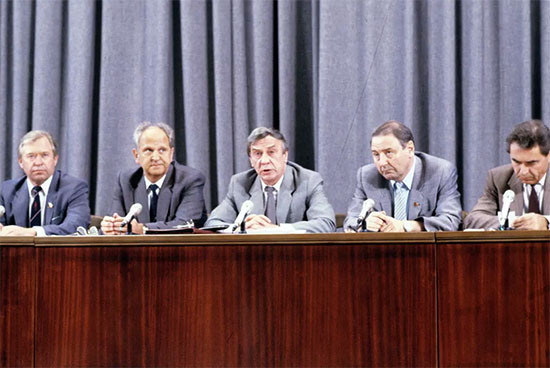
The GKChP in 1991 had its own foundation, there were certain aspirations in a society that was nostalgic for the previous strict rules. Gorbachev was not popular for a long time. That is, the GKChP reflected the opinion of a part of the population. Not for nothing that in the spring of that year, most of the population voted for preserving the USSR. The conspirators had a plan of action moreover. But the secret services and the army did not support them. In any country, this is a decisive moment.
The conspirators were punished, of course, taking into account liberal trends: under Stalin, of course, they would have been shot. And then the courts, everything is decorous and cultural. There is no basis for new (similar) radical outbursts, as well as, in fact, there is no popular support at all. Accordingly, roughly speaking, by who they hang on poles and who does it, we find out who is an enemy of the people.
Strength ennobles power, power in turn generates it. When there is no power, intrigues, and other political shows come to the fore. The only thing that must be avoided is that they do not shoot from the stage at the audience that has gathered to watch this show. Otherwise, this mess can turn into a civil war. There is a wealth of experience in this, and there is no need to "step on the same historical rake."
Russia does not need new Makhnos, but Kolchaks. It needs unity.


