




Who and why did send military forces to Afghanistan?
Author: Fayaz Bahraman Najimi
A quarter of a century later, the basic question of why the Red Army was sent to Afghanistan remains a mystery. Less accessible are documents and evidence explaining the main purpose of the Soviet leadership's decision to occupy Afghanistan. What has been published from the archives of the political party and the Central Committee of the CPSU does not answer the main question. Relying on several documents of the Communist Party of the Soviet Union leads us to speculation rather than access to facts. Our historians will have to wait decades to find a fundamental answer to the events that changed our history and the progressive evolution of our society until documents of strategic importance are released from the prison of Russian archives. One thing that exists as a historical fact is the Soviet invasion of Afghanistan with all its sad consequences.
This article attempts to present the reason for sending forces from different angles and dimensions without drawing definitive conclusions. This essay contains some surviving documents that are part of the archival documents of the Communist Party of the USSR on Afghanistan, which are important for our modern historiography. Their peculiarity is that many of them are absent from the book “Secret Documents of the Soviet Union on the War in Afghanistan 1991-1978” (1).
(*) We felt it necessary to shed light on the dark corners of the expansion of Soviet influence and interventions in Afghanistan, documents including the 1974 resolutions of the Communist Party of the Soviet Union on the visit of President Mohammed Daoud to the Soviet Union and the order to unite both factions of Khalq and Parcham, which was written to their leaders before the fall of President Najibullah - to be attached to this title, which ultimately shows the Russians' use of different tactics in Afghanistan. However, due to the limited pages of the magazine, their printing, in addition to the memoirs of Soviet political and military figures and Amin’s entourage, will be left for the following issues.
Regarding the Soviet attack on Afghanistan, what has been written so far and some of which has been translated into Dari Farsi, two types of trends can be seen in the question of the reason for the deployment of troops: one is the influence of the Cold War and the other comes from atmosphere free from ideological confrontation and according to research and expert criteria.
Works written before the collapse of the Soviet Union are largely based on assumptions stemming from the Cold War climate. In these works, more effort is put into giving an ideological coloring to the invasion - preventing the penetration of "imperialism" and the victory of the "counter-revolution" on the one hand, and the desire of the "Evil Empire" for dominance in "hot waters" on the other hand.
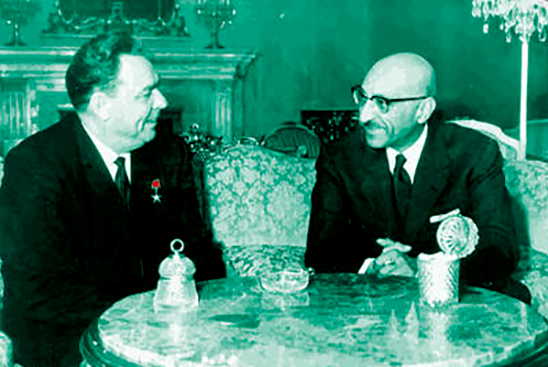 Expert discussions mainly after the collapse of the Soviet Union and at the beginning of the presidency of Boris Yeltsin, that is, when part of the archives of the CPSU Central Committee was open to experts, and, as a result, Alain Pierre, a book entitled “Secret Documents of the Soviet Union on the War in Afghanistan 1978-1991”, Vasily Mitrokhin's book "The KGB in Afghanistan" and other documents and interviews with former Soviet civilian and military leaders have opened new horizons about the war in Afghanistan. Along with increased access to documents, the nature of analysis has also changed. This approach is widely seen in many works of Western experts on Afghanistan. But they still present a confused view of the role of the West, and especially the United States, in Afghanistan. Attempts have also been made to evaluate the invasion problem in terms of political or economic factors, but they still lack basic foundations for their arguments. (1)
The approach of Russian experts to the issue of force deployment is still based on Soviet-era narratives. Lack of critical understanding prevented access to basic facts and ideas. Whatever revelations have been made about the war in Afghanistan largely go back to works published in the early 1990s. This situation changed with Russian generals writing books justifying the invasion, and even in January and February 2005, Russian Central Television in a series about Brezhnev tried to justify Brezhnev in the matter of sending forces.
Therefore, the basic question of why troops were sent to Afghanistan is still very relevant. This study attempts not only to summarize the various reasons that led to the deployment of troops but also, by presenting new documents, to identify the basis for considering the issue in new dimensions.
1 - INTERNAL FACTOR

IN THE PHOTO: Alexey Kosygin and Yuri Andropov were against the sending of troops into the Democratic Republic of Afghanistan
From an analytical point of view, looking at the internal situation in Afghanistan throughout 1979 takes us a little off topic, since the purpose is to show what the Russian perception of the internal situation in Afghanistan was. From the notes, writings, theories, and documents that are still available, it follows that the Soviet leadership monitored the development of the situation in Afghanistan during 1979 and hid its concern about the transformation of the “friendly” government of Afghanistan into a “hostile” one. The reports of Soviet advisers in Afghanistan at that time are full of contradictions. Some predicted the collapse of the Khalqi government at the height of the occupation and the rebel takeover, and some portrayed the situation as not so bad. What was interesting to the author in these reports was that the military and GRU agents, that is, State Intelligence Agency or Soviet military intelligence, reported better and more optimistically about the situation, while branches of the KGB and the First Agency (foreign intelligence) called the situation difficult and reported about the fall of the regime and the expansion of the influence of the United States and China. It should be noted that in our research work on Soviet agents of influence in Afghanistan, the role of the GRU was given almost the least attention - some explanations and interpretations were excluded from this** - especially since this apparatus is present and has enormous influence in the modern Afghan army, as well as small political groups whose offices were transferred to KHAD after the withdrawal of Soviet troops from Afghanistan
The April coup d'état and the subsequent military-ideological dictatorship suffered from a double crisis from the very beginning: one was a crisis of external legitimacy, and the other a crisis of internal divisions resulting from successive cracks within the regime. Soon, the collective and individual purges of the Khalki regime turned the “toiling masses” against the government of the “toilers.”
Along with increased violence and the weakening of the regime, popular uprisings also intensified. The peak of the popular uprising against the tyranny of the regime occurred in Herat in Khut 1358 or March 1979. This uprising posed a serious question to the Soviet leadership: is the Khalqi regime in Kabul capable of defending itself and surviving or not? The Soviets knew that without air support, the purpose of which was mainly to avenge the murder of their advisers, suppressing the uprising in Herat was simply impossible.
The leaders of the Khalqi regime, realizing the effectiveness of Soviet air assistance, persistently tried to convince the Soviet leadership to send troops to Afghanistan. The minutes of Taraki's negotiations and meetings with Soviet leaders are quite clear in this regard.
The Soviet leadership, despite sending advanced weapons, equipment, and military advisers to Kabul, considered the possibility of sending any forces to Afghanistan to the detriment of its interests and the deterioration of the international situation. Both Brezhnev and former Soviet Prime Minister Kasygin were categorically against sending any troops to Afghanistan. Andropov believed that, according to Lenin’s theory, “the revolution must be able to defend itself.” It is clear from the minutes of political discussions that they were aware of the negative consequences of military action in a backward Islamic country.
But despite this, a change occurred in Soviet policy, which led to the occupation of Afghanistan under the guise of international assistance. Undoubtedly, the reason for the deterioration of the situation in Afghanistan could not be a military invasion of a small country by a superpower.
2- EXTERNAL FACTOR
In 1979, as a result of the decision to deploy intermediate-range nuclear missiles and the deterioration of the "policy of détente," relations between the Soviet Union and the United States took a dramatic turn. Conflicts between East and West began to escalate. The SALT Treaty - (Strategic Arms Limitation) - 2 was not approved by the US Congress.
The Americans' intention to deploy medium-range nuclear missiles in Western Europe has become a reality. On December 12, 1979, NATO announced the Carter Administration's decision to install the missiles. This act of the United States angered the Soviet leadership, and in response, it adopted the famous decision No. 176 of December 12, at the end of the same night, in a narrow circle of representatives of the political elite (the text of the decision is attached).
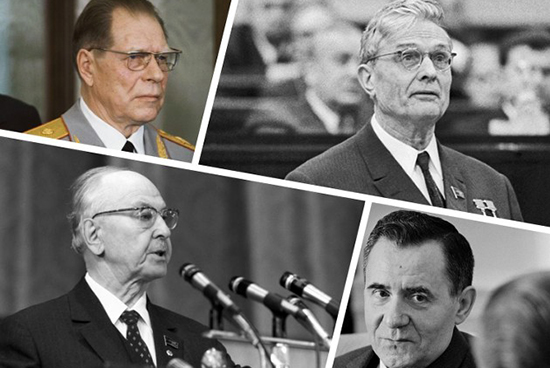 IN THE PHOTO: Gromyko, Suslov, Ustinov, and Ponomarev supported the sending of troops into the Democratic Republic of Afghanistan
It is noteworthy that to maintain the confidentiality of the decision, the text of the decision was written on one sheet of paper in Chernenko’s hand, so that no one, not even all representatives of the political elite, knew about its contents. Later included in the text, the confirmatory signatures of members of the Politburo and the Secretariat of the Central Committee were taken on December 25 and 26, that is, on the eve of the decisive attack. What was the reason for such an action is not yet clear, but the factor of distrust among the Soviet leadership cannot be denied. For example, the last to sign the text on December 25 and 26 were Kunaev, Romanov, and Sherbitsky, members of the Politburo and secretaries of the communist parties of Kazakhstan, Leningrad, and Ukraine.
As for the decision to install missiles, it is still unclear whether the Americans decided to provoke the Soviet leadership into an adventurous action or something more, i.e. the beginning of a new round of the arms race and, as a result, consolidation of military superiority.
Previously, the USSR Defense Minister was very concerned about the large US presence in the Persian Gulf and the possibility of an attack by this country on Iran. It is said that the Americans tried to seduce the Russians by spreading false information, that is, by spreading information about an attack on Iran.
(To be continued)
(*) The author accidentally found some documents, more than 30 in number, in the Internet Archive. One may have some doubt about their authenticity.
(**) The translator of the book “Davud Khan in the Hands of the KGB” - Mr. Seyyed Tab Javad mentioned this organization in some of his speeches, but until now we have not done any research on the role of the GRU.
Sources:
1 - Sonja Bartsch. Die Intervention der Sowjetunion in die Afghanistankrise 1979. Dipl. Pol.
APPLICATIONS
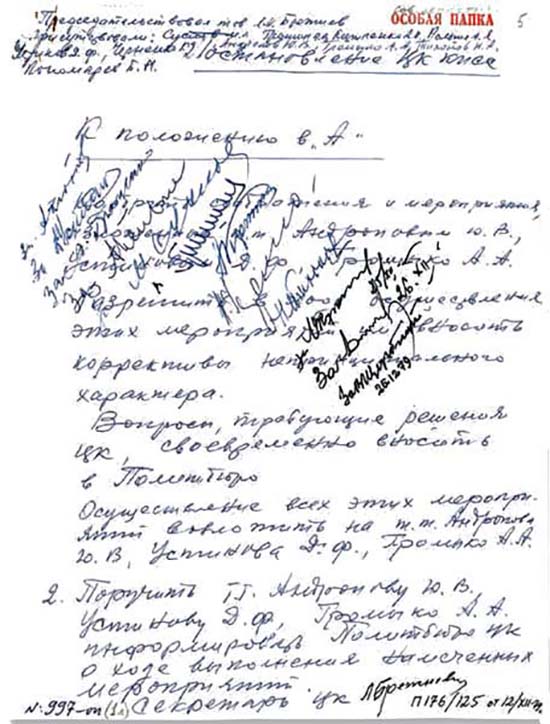 The written text of the famous Decision No. 176, which led to the Soviet invasion of Afghanistan.
SPECIAL FOLDER
Resolution of the CPSU Central Committee
Presided: Comrade L.I. Brezhnev.
Were present: Suslov M. A., Grishin V. V., Kirilenko A. P., Pelshe A. Ya., Ustinov D. F., Chernenko K. U., Andropov Yu. V., Gromyko A. A., Tikhonov N. A., Ponomarev B. N.
About the situation in "A"
1 - Approve the considerations and activities outlined by comrades Andropov Yu. V., Ustinov D. F., Gromyko A. A.
Allow them to make adjustments of a non-fundamental nature during the implementation of these activities.
Issues requiring a decision by the Central Committee should be submitted to the Politburo promptly.
The implementation of all these activities is entrusted to comrades Andropov Yu. V., Ustinova D. F., Gromyko A. A.
2 - Instruct comrades Andropov Yu.V., Ustinov D.F., and Gromyko A. A. to inform the Politburo of the Central Committee about the progress of the planned activities.
Secretary of the Central Committee Brezhnev L. I.
No. 997-op (1l)
P 176/125 from 12/XII
Secretary of the Central Committee L. Brezhnev
Supported by
Andropov
Ustinov
Gromyko
Pelshe
Suslov
Grishin
Kirilenko
Chernenko
Tikhonov
P 176/125 from 12/XII-79
RGANI, f. 89, per. 14, doc. 31, l. 2. Copy.
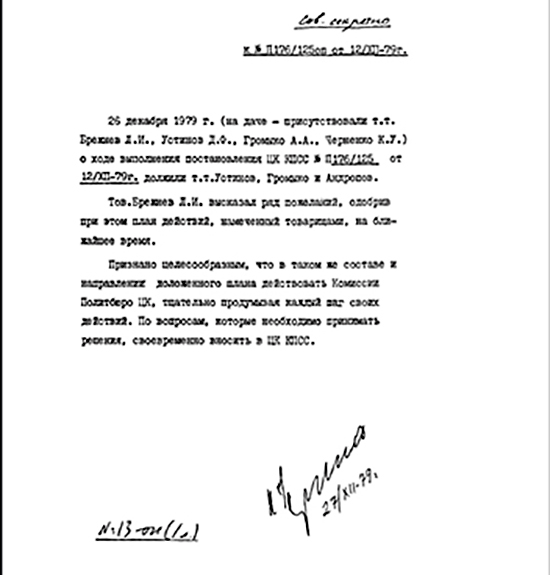 ATTACHED DOCUMENT
No. P176/125 from 12/XII-79.
December 26, 1979 (comrades Brezhnev L.I., Ustinov D.F., Gromyko A.A., and Chernenko K.U. were present at the dacha) on the progress of implementation of the resolution of the CPSU Central Committee No. P176/125 dated 12/XII-79 year, reported by comrades Ustinov, Gromyko, and Andropov.
Comrade L.I. Brezhnev expressed several wishes while approving the action plan outlined by his comrades for the near future.
It was considered advisable for the Commission and the Politburo of the Central Committee to act in the same composition and direction of the reported plan, carefully thinking through every step of their actions. On issues that need to be decided, promptly submit them to the CPSU Central Committee.


