




Where does Putin's grain go: to the poor, "jihadi madrasas" or terrorist organizations?
Author: Fakhriddin Kholbek, member of the Advisory Council of "Sangar"
Source: al-gebra.ru
Russian President Vladimir Putin agreed to the immediate shipment of grain to Afghanistan. His special envoy, Zamir Kabulov, who is considered by some to be the "Russian patron" of the Taliban, told the media that he had provided "a certain amount" of grain to Afghanistan "if needed."
We will not comment on this news, despite the fact that Vladimir Putin's decision was described by some on social networks as a "direct assistance to the Taliban", and this comes at a time when Russia has imposed a ban on the export of grain since March of this year.
Let's start the story from afar.
In 1992, after the mujahideen came to power in Afghanistan, a delegation of British and American intelligence (MI6 and the CIA) met with Ahmad Shah Massoud, the defense minister of Burhanuddin Rabbani's government, at the Intercontinental Hotel in Kabul. They asked Massoud for two things: first, to allow their military bases to be located on the territory of Afghanistan; 2) Foreign fighters or so-called "Afghan Arabs" who took part in jihad against the Soviets should be stationed in northern Afghanistan. Instead, they promised Massoud that they would support his government for at least the next 50 years. Massoud disagreed. After this meeting, Hekmatyar rebelled against the Rabbani government with the help of British, American, and Pakistani intelligence, and the Taliban appeared on the Afghan scene. Suffice it to recall the words of Benazir Bhutto, the Prime Minister of Pakistan, who said: "We, the US, Saudi Arabia, and the UK, formed the Taliban."
The Taliban is a product and project of the USA. This means that there is nothing in common between it and Russia, and to help this group means to help the United States in the implementation of this project. Those who think that Russia and the countries of the region ousted the US from Afghanistan with the help of the Taliban are deeply mistaken, and those hopes that the Islamic Emirate will bring "strategic stability" to the region are in vain.
The Taliban in Afghanistan gained power from the United States as a result of a pact like an iceberg, which is obvious, but it is not clear where its basis is. Their supporters are well aware that if the United States wanted and supplied the anti-Taliban forces, this proxy group, hated by the Afghan people, would never have come to power.
The US withdrawal was calculated according to the plan and was the beginning of the American presence in a different form. Over the 20 years of their presence, the Americans, in cooperation with the governments they established, have redeployed the Taliban and about 20 terrorist organizations, especially in the territory of the anti-Taliban resistance, eliminating dozens of anti-Taliban leaders, from Ahmad Shah Massoud to Burhanuddin Rabbani, as well as dozens of commanders and politicians. The result was so unexpected that, with the exception of Panjshir, 33 provinces were surrendered to the Taliban by the government of Ashraf Ghani without a fight. In addition, they provided the Taliban with all the equipment and infrastructure of the 350,000-strong Afghan army, which cost the US and NATO $85 billion. They turned this group, which is still listed as a terrorist organization, into the strongest fighting army in the region and threw it into the battlefield. Oddly enough, this whole plan could not have come true without the help of Russia, China, Iran, and the countries of Central Asia.
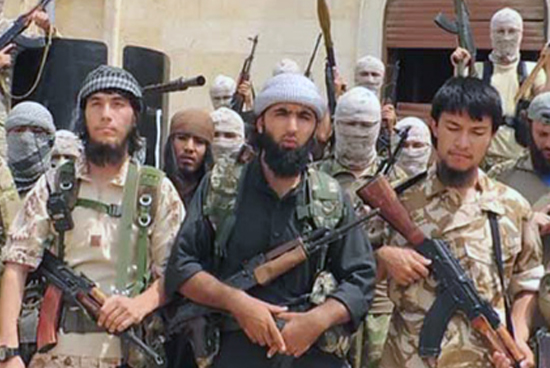 Today, in Afghanistan, more precisely, in its north - the borders of Central Asia, Iran, and China, terrorist groups are deployed, such as Al-Qaeda, the Islamic Movement of Uzbekistan, the Islamic Movement of East Turkestan, ISIS, Jamaat Ansarullah, Lashkari Tayiba, Katibat Imam Bukhari, Jundallah, and others. They have their bases and operate freely.
Specific examples: Al-Qaeda's large base or "mini-state" was established back in 2008 with the assistance of Hamid Karzai (who is a "great friend" of Russia) and the US in the area between Juzjan, Faryab, Ghor, and Saripul provinces of Afghanistan. In it, namely in the village of Khaval and the locality of Gujur, Kuhistanat district of Saripul province, there are enterprises for the manufacture of explosives, which make mines, rockets, and suicide belts from gas cylinders and iron pipes. All explosives used and still used in terrorist operations by the Taliban, ISIS, etc. are the products of these enterprises. The borders of Uzbekistan and Tajikistan were also fired upon by their rockets. Between 5,000 and 7,000 families of terrorists from Pakistan, Central Asia, Russia, China, Iran, etc. live in this region. Among them are Bibi Mukarrama and other offspring of Takhir Yuldashev, leaders of the Uzbek IMU militants, and Qari Subhanullah and Abdurauf Aka, Kazakh leaders of Al-Qaeda.
In short, the same terrorist organizations that were present in the Pakistani province of North Waziristan of the Khyber Pakhtunkhwa agency after the US and NATO came to the region were completely transferred to northern Afghanistan within 20 years. The program was carried out by Kabul proteges and under the leadership of the Americans.
For example, Qari Fasihuddin, the commander of the Tajik Taliban in Badakhshan, and Makhdum Alim, their Uzbek commander in Faryab, were funded by the border and tribal division of the 024th department of the former Afghan National Security Directorate, and the money was provided by the United States. Makhdoom Alim was arrested by the Taliban for collaborating with the United States but later released, according to some reports, with the intervention of the British and Pakistani secret services.
Both oversaw terrorist organizations. Qari Fasihaddin was in charge of the Taliban's ties to terrorist organizations in Badakhshan, and Makhdum Alim in Faryab and Jazjan was the link to that al-Qaeda "mini-state." Most of Qari Fasihuddin's bodyguards are currently Tajik citizens belonging to Jamaat Ansarullah.
Terrorist organizations in Afghanistan are controlled by the Haqqani Network, which is a partner and subordinate of al-Qaeda. The Haqqani family has blood ties to Al-Qaeda. One of the wives of its founder, Jalaluddin Haqqani, is the daughter of an al-Qaeda leader. At least 15 al-Qaeda members hold senior positions in Taliban government offices. Amin al-Haq, a former aide to Osama bin Laden, the founder of al-Qaeda, is a handler and adviser to the Taliban's security forces.
But what was missing from the “New Waziristan” plan in Afghanistan was the creation of hundreds of jihadist schools called “madrasat ul-jihad”, the process of organizing which is in full swing on the orders of the Taliban “Amir al-Mu'minin”, Mullah Haibatullah Akhunzadeh.
On March 17 of this year, he signed Decrees No. 235 "On the creation and use of schools of jihad." Accordingly, from 3 to 5 schools should be created in every 380 districts of Afghanistan. On average, schools will recruit between 500 and 1,000 students and 18 staff. In total, more than 1.1 million people will study in these schools. Two dollars a day are provided for each student, and their monthly expenditure throughout Afghanistan, a state that is on the needle of foreign aid, is about 65 million dollars.
 This plan has been intensively implemented over the past three months. For example, the Takhar Technical and Vocational Institute, the Mitra TV building in Mazar-i-Sharif, the Abdulkhai Habibi Higher Lyceum in Khost, the Kandahar Technical Lyceum, the Babrakhan Zadran Lyceum in Gardiz, Paktia province, etc. already turned into “jihad schools”.
In the city of Jalalabad, Nangarhar province, there is a place called Fomilii Kholis, which has 15 hectares of land and dozens of buildings and infrastructure. Now they have been turned into a "school of jihad". Or at the Takhar Technical and Vocational Institute, 236 male and female students studied electrical and computer engineering, construction, and car repair. It will "educate youth in the Islamic sciences through research and specialization" now.
Abdulhakim Haqqani, the Qaziyulquzzat or Chief Justice of the Taliban, published a book in Arabic called Al-Amarat al-Islamiya wa nizamha (The Islamic Emirate and Its System), which is practically the doctrine or constitution of the group. Everything that this group is doing in Afghanistan today, from the political to the social, is written in it. On the other hand, on page 243 of this book, Qaziyulquzzat calls on rulers and scholars to hinder the activities of modern schools, because they are the product of infidels and lead Muslims to perversion and deviation from religion. By all appearances, the writing of this book in Arabic is also a kind of message for the Gulf countries, which have an experience of funding "schools of jihad" in Pakistan, the product of which is the Taliban themselves.
This is the reality of Afghanistan today, but very bad news not only for the region but for the whole world. Who guarantees that in a year more than 1 million students of "schools of jihad", as in the notorious Pakistani schools, will not become suicide bombers? That's enough to blow up the whole world. The calculation of the world and regional intelligence agencies is accurate: the poor of Afghanistan will be forced to send their children to these schools so that their children at least do not die of starvation.
And this is all a continuation of the implementation of the same plan that was shared in 1992 by MI6 and the CIA with Ahmad Shah Massoud. What they wanted was the creation of bases for terrorist organizations in the north of Afghanistan, which was successfully done for them and to the misfortune of the countries of the region. The one million army of these organizations is also intensively trained in the “Madrasat ul-Jihad” of Mullah Haibatullah.
But these days, Russia and its allies - Central Asian countries, China and Iran, hang out with the Taliban day and night. They receive Taliban diplomatic representatives, they talk about “inclusive government”. Turkmenistan tells them stories about the gas pipeline, and Uzbekistan about the railway. The forces of the Taliban opposition are being pushed into the arms of the US and the UK in order to join them in the project. But at least once, at least for God's sake, no one asks the Taliban: what is happening, and what is all this for?
It is unlikely that when Russia delivers grain to the Taliban, it will be able to control its distribution so that it reaches the poor, who, according to Kabulov, are at risk of starvation from drought and crop failure in Afghanistan this year, and not terrorist organizations and “schools of jihad”. It seems that Moscow is giving bread to a dog that one day will bite not only his hand but also the hand of his allies.


