




The Taliban Intend to Penetrate the Virtual Life of the People.
By Abdul Naser Noorzad, researcher in politics and geopolitics, especially for “Sangar”
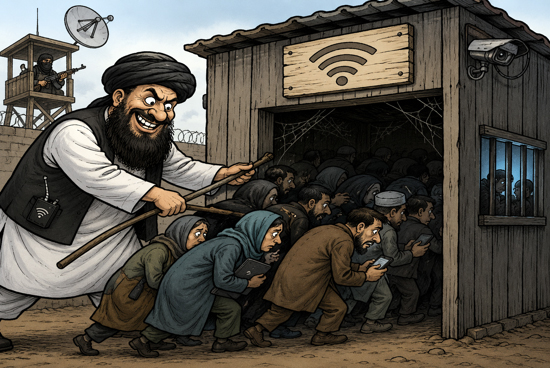
Digital blinding has now become part of the Taliban regime’s agenda. After ideological inspections, repression, and street intimidation — all considered hallmarks of a totalitarian system — the time has now come for restricting and shutting down fiber-optic internet. A regime that interferes in the most private spheres of people’s lives and imposes its preferred order upon society is now pursuing a nationwide blackout to tighten the ring of control and surveillance over citizens more than ever before.
By creating a massive digital wall, the Taliban are trying to restrict any manifestations of dissent, rebellion, informational penetration, and the dissemination of information about the nature and performance of their regime. This digital wall is, in reality, an attempt by the group to ensure a more secure continuation of its existence and to suppress any free flow of information.
Published reports indicate that the Taliban’s Minister of Communications ordered companies providing fiber-optic internet services to cut off Kabul residents’ access to the internet; a sudden and astonishing decision with deep security implications that will have broad economic and social consequences for ordinary people.
After holding an emergency meeting with executives of internet companies, the Taliban took another step toward closing the country’s digital space; a space whose restriction is aimed at establishing constant surveillance, increasing controllability, and consolidating Taliban domination over society.
Against this backdrop, Kabul has become the starting point of a digital blackout project designed to manage the situation based on intelligence consultations. By issuing an order for the digital blinding of the city, the Taliban seek to prevent and neutralize threats that could shake the fragile and illegitimate foundations of their rule. Disconnecting Kabul through a “quarantine” of fiber-optic internet is not only a preventive security measure, but also a further tightening of the siege and control over people’s daily lives.
In such conditions, more than thirty million people are facing not merely a technical restriction, but an imposed system born out of the fear and anxiety of the ruling regime, a system that with each passing day further constrains people’s living space. Moreover, what is emerging is the beginning of a large-scale project of security, intelligence, and control; a project that may outwardly begin with soft measures, but will ultimately lead to the formation of a modern digital prison.
What appears most alarming is that the Taliban’s program is not temporary in nature, but rather the beginning of a series of measures aimed at even further restricting the space for expressing people’s opinions and beliefs. Without a doubt, these policies are costly for the Taliban, yet apparently, the security requirements necessary for the survival of this group have compelled them to accept such costs. From controlling their own forces to police surveillance over people’s conversations, from depriving society of economic self-sufficiency to creating a cycle of dependency and need toward the regime, all of this forms part of the major objectives of this long-term security project.
This time, the Taliban have directly taken control of society’s most important instrument of communication and information. Restricting the internet system is the fastest, most stable, and harshest tool for controlling the flow of information; a step that simultaneously reveals both the weakness and the fear of this group.
This decision was made within the framework of a preventive calculation mixed with anxiety. The Taliban are attempting to reconstruct the digital space in such a way that the ring of surveillance and control over citizens becomes even tighter, restrictions expand further, and the channels through which information, images, and reports about their administrative failures leak out are blocked. This comes as the publication of photographs and reports concerning the violent and improper behavior of Taliban members toward ordinary people continues to increase pressure day by day on the circle of decision-makers within the group.
The Taliban’s attack on fiber-optic internet is not merely a move driven by ordinary censorship, but rather a sign of their deep fear and concern regarding the digital resistance of the people and society; a resistance that has pushed this group toward intensifying censorship and imposing even greater restrictions.
Existing analyses in the field of cybersecurity also indicate that the Taliban likely see themselves facing numerous threats: from the formation of protests and a digital revolution to the opposition’s use of virtual space and the creation of a cohesive front of Persian-speaking digital resistance against the group. These concerns are precisely what have driven the Taliban toward tighter control over public opinion.
In addition to political and security threats, the economic self-sufficiency of the population within the online sphere is also perceived by the Taliban as a source of danger. Therefore, it is highly likely that the creation of their own fully controlled internet will become one of this group’s priorities for preserving power, allowing them to exercise more complete surveillance and control over cyberspace.
Under such conditions, the Taliban narrative within an isolated and closed internet system may become the dominant version of events and serve as an attempt to gain legitimacy in the public consciousness. Alongside this, decisions by intelligence circles aimed at neutralizing threats inside Afghanistan before they spiral out of control are also considered among the primary reasons for shutting down the internet.
As noted earlier, this step is not merely a tactical security measure aimed at containing a crisis; rather, it is a political project for the gradual destruction of digital space within the framework of a large-scale psychological war. An action that could disrupt the transmission of the real image of Afghanistan under Taliban rule and drive society into informational isolation.
In such an atmosphere, censorship becomes an institutionalized and unquestionable phenomenon, the Taliban’s narrative gains even greater dominance, truths are concealed among manipulated versions of events, and society — trapped in a constant state of fear and anxiety caused by the absence of information — is inevitably steered along the path of Taliban policies.
On the other hand, restricting fiber-optic internet will create conditions for the expansion of the underground economy tied to the illegal sale of internet access; a market whose profits will once again flow into the pockets of mafias connected to the Taliban. VPN services and special internet access will likewise be monopolized and reserved for high-ranking Taliban officials.
Nevertheless, one thing remains clear: no government has ever succeeded in permanently stopping the free flow of information. Digital space may be restricted for a period of time, but the people’s desire for access to information and their determination to resist the Taliban’s imposed narrative will prove far stronger than any tactical measures, even if they are long-term and aimed at the digital blinding of society.


